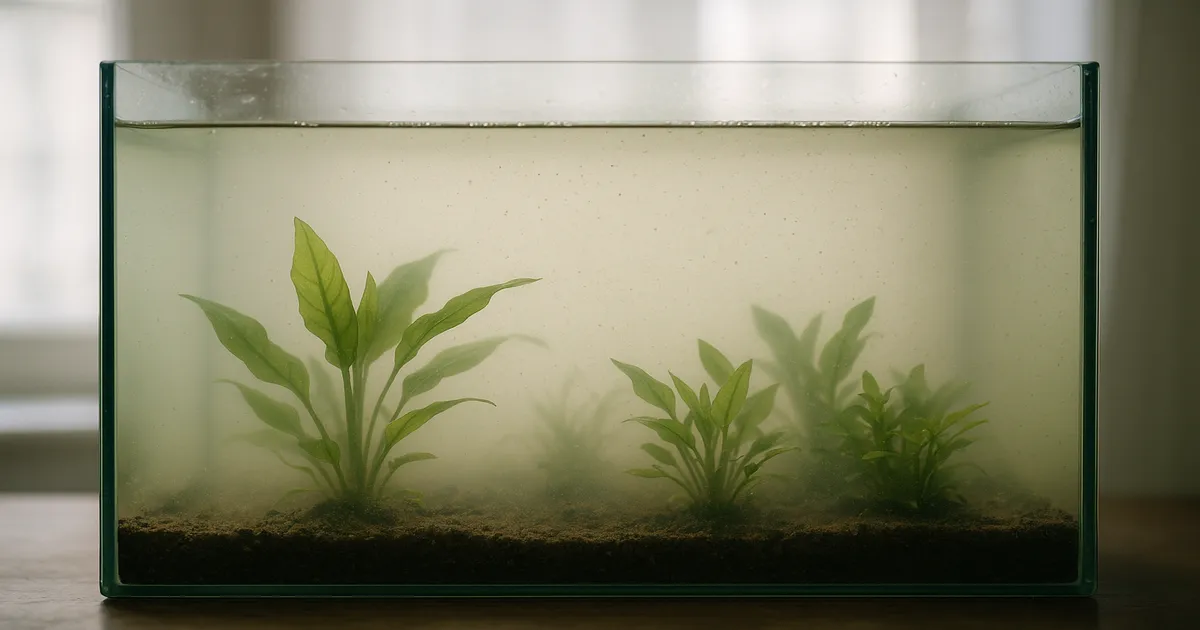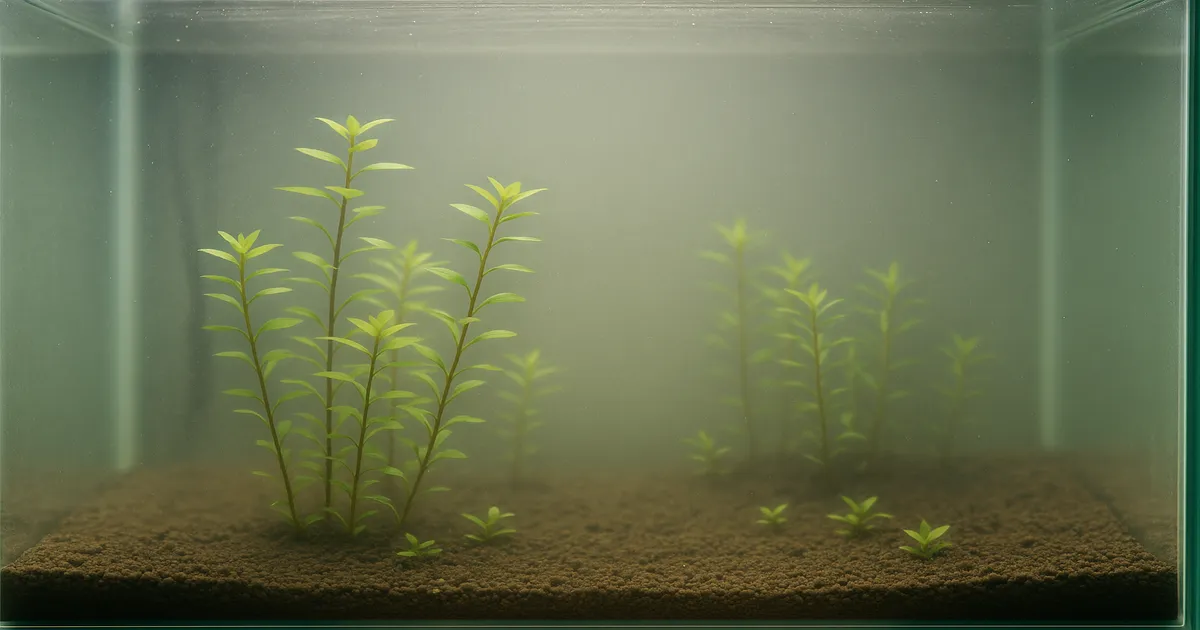
Quick Answer: Cloudy fish tank water is a symptom, not a single problem — the colour tells you the cause. White or grey cloudiness means a bacterial bloom, green means an algae bloom, and yellow or brown points to tannins or fine particles. Identify the colour first, then follow the targeted fix below.
How to Clear Fish Tank Cloudy Water: Diagnose by Colour First
Knowing how to clear fish tank cloudy water starts with one simple observation: what colour is it? Each type has a distinct cause and a different solution. Skipping straight to a product without diagnosing the colour first wastes time and money.
Hold a white piece of paper behind the tank and look at the water in good light. Milky or hazy? That’s a bacterial bloom. A distinctly green tint — even a faint one — is a single-celled algae bloom. Amber, tea-coloured, or dusty brown points to tannins or stirred-up particulates.
The Three Types of Cloudy Aquarium Water at a Glance
| Colour | Cause | Primary Fix |
|---|---|---|
| White / Grey | Bacterial bloom | Reduce feeding, add bottled bacteria, improve aeration |
| Green | Algae bloom | UV steriliser or blackout method, reduce light and nutrients |
| Yellow / Brown | Tannins or fine particles | Activated carbon, Purigen, rinse substrate |
White or Grey Cloudy Water: Bacterial Blooms
What Causes a Bacterial Bloom?
White or grey cloudiness is caused by an explosion of free-floating heterotrophic bacteria in the water column. These bacteria multiply rapidly when there’s more organic material available than your biological filter can process.
In a new aquarium, the nitrifying bacteria — Nitrosomonas converting ammonia to nitrite, and Nitrobacter/Nitrospira converting nitrite to nitrate — haven’t yet colonised the filter media. The result is a temporary bacterial free-for-all in the water column. It’s completely normal, but a clear sign the tank isn’t ready for fish.
Established tanks can also crash. Common triggers include:
- Overfeeding — decomposing food floods the system with ammonia
- Cleaning filter media in tap water — chlorine kills beneficial bacteria and crashes the cycle
- Large water changes — removing more than 50% at once destabilises the bacterial colony
- Sudden bioload increases — adding several fish at once overwhelms existing filtration
The free-floating bacteria themselves are largely harmless, but they’re a warning sign. If ammonia or nitrite is spiking alongside the cloudiness, that’s the real danger. Test your water immediately.
Step-by-Step: How to Clear a Bacterial Bloom
- Reduce or stop feeding for 2–3 days to cut the nutrient load fuelling the bloom.
- Perform moderate water changes — 25–30% every 2–3 days. Avoid large single changes, which destabilise the cycle further.
- Add bottled beneficial bacteria such as Seachem Stability or API Quick Start to help re-establish biological filtration.
- Add fine filter floss or a polishing pad to mechanically remove suspended bacteria.
- Increase aeration — bacterial blooms consume dissolved oxygen rapidly, and surface agitation keeps levels safe.
- Consider a UV steriliser for persistent blooms that don’t clear within a week.
Most bacterial blooms resolve within one to two weeks once the root cause is addressed.
Green Aquarium Water: How to Clear Fish Tank Cloudy Water Caused by Algae
What Causes Green Water?
Green water is caused by free-floating single-celled algae — most commonly Chlorella spp. — suspended throughout the water column. This is completely different from algae growing on your glass or decorations. It’s a bloom of microscopic phytoplankton, and it can turn water so opaque that fish vanish from sight.
Two things drive every outbreak: too much light and too many nutrients, specifically nitrates and phosphates. Tanks placed near windows are especially vulnerable. Even a well-maintained tank can develop green water if the photoperiod creeps past 10 hours or phosphate climbs above 0.5 ppm.
Blackout Method
Cover the tank completely with blankets or cardboard for 3–5 days with zero light exposure. The algae starves and dies. Your fish will be fine in the dark for this period. The downside is that it doesn’t fix the underlying nutrient problem — green water will return unless you also address lighting and feeding habits.
UV Sterilisers: The Most Reliable Fix
A UV steriliser is the single most effective tool for green water. It exposes free-floating algae cells to 254 nm ultraviolet light, destroying their DNA so they can’t reproduce. Most cases clear completely within 3–7 days. Size the unit at roughly 1 watt per 3–4 gallons, and make sure water flows slowly enough through the unit for adequate exposure time.
Important: Don’t run a UV steriliser during tank cycling — it will kill the free-floating bacteria you need to establish the nitrogen cycle.
Long-Term Prevention
- Use a timer to keep your photoperiod at 8–10 hours daily
- Move the tank away from direct sunlight
- Keep phosphate below 0.5 ppm (freshwater) or 0.03 ppm (reef)
- Add phosphate-removing media like GFO if levels creep up (Two Little Fishies PhosBan Reactor GFO)
- In fish-free tanks, Daphnia are a surprisingly effective biological control — they filter algae cells directly
Yellow or Brown Cloudy Water: Tannins and Particulates
If your water looks like weak tea, tannins are almost certainly the cause. Driftwood, botanicals, peat, and soil-based substrates all leach humic acids into the water. This is harmless — actually beneficial for blackwater species like discus, cardinal tetras, and apistogrammas — but many hobbyists prefer crystal-clear water.
New sand or fine gravel releases a cloud of fine dust when first added to a tank. It looks alarming but is almost always self-resolving within 24–72 hours as your filter catches it.
How to Remove Tannins
Add activated carbon to your filter — it adsorbs tannins quickly and noticeably improves clarity within 24–48 hours. For more aggressive removal, Seachem Purigen targets dissolved organics more broadly than carbon alone. Combine either product with a few extra water changes and you’ll see results fast.
Pre-soaking or boiling driftwood before adding it to the tank dramatically reduces the tannin load. Boiling for an hour, or soaking in a bucket for one to four weeks with daily water changes, leaches out most of the colour before it ever hits your aquarium.
Rinsing New Substrate Properly
Put substrate in a clean bucket, fill with water, stir vigorously, and pour off the cloudy water. Repeat until the water runs completely clear — for fine sand, this can take 10–15 cycles. It’s tedious, but far easier than dealing with a tank that looks like a snowstorm for three days.
Water Parameters: Testing and Targets
During any bloom event, test at minimum: ammonia, nitrite, nitrate, and pH. Add phosphate if you suspect green water. A liquid test kit is essential — test strips are convenient but notoriously inaccurate, sometimes off by a full pH unit or more. The API Freshwater Master Test Kit covers the core parameters and is the standard recommendation for good reason.
Freshwater Community Tank Targets
| Parameter | Target Range |
|---|---|
| pH | 7.0–7.6 |
| GH | 8–12 dGH |
| KH | 4–8 dKH |
| Temperature | 76–80°F (24–27°C) |
| Ammonia | 0 ppm |
| Nitrite | 0 ppm |
| Nitrate | Under 20 ppm |
| Phosphate | Under 0.5 ppm |
| Dissolved Oxygen | 7–8 mg/L |
Saltwater and Reef Tank Targets
| Parameter | Target Range |
|---|---|
| Salinity | 1.025–1.026 SG |
| pH | 8.1–8.4 |
| KH | 8–12 dKH |
| Nitrate | Under 5 ppm (under 1 ppm for SPS reef) |
| Phosphate | Under 0.03 ppm |
Low KH is a sneaky culprit worth calling out. When carbonate hardness drops, your tank loses its pH buffer — pH can crash overnight, killing beneficial bacteria and triggering a bacterial bloom seemingly out of nowhere. Keep KH above 4 dKH to prevent this. Temperature matters too: nitrifying bacteria are most active between 76–82°F (24–28°C). Below 65°F they slow dramatically; above 86°F their activity becomes erratic and dissolved oxygen drops.
Filtration and Stocking: The Best Defence Against Cloudy Water
Filtration Basics
Your biological filter is your first line of defence. Use high-surface-area media — ceramic rings, bio-balls, or sponge media — and never clean all your filter media at once. Always rinse it in old tank water, never tap water. Aim for a turnover rate of 4–10× your tank volume per hour.
Fine filter floss and polishing pads (100–200 micron) physically trap suspended particles. During a bloom event, rinse or replace them every day or two — a clogged mechanical stage reduces flow through your biological media and makes things worse.
Stocking and Feeding
Overstocking is the most common cause of chronic cloudiness that never fully resolves. The old 1-inch-per-gallon rule is outdated — a single Oscar produces more waste than twenty neon tetras. Think in terms of bioload and match it to your filter’s actual capacity.
Overfeeding is the single most avoidable cause of cloudy water. Uneaten food releases ammonia and phosphates simultaneously, fuelling both bacterial and algae blooms. Feed only what fish consume in 2–3 minutes, remove uneaten food promptly, and consider fasting your fish one day per week. High-quality, dense pellets like Hikari or New Life Spectrum break down far more slowly than cheap flake foods and make a noticeable difference to water quality.
Fish Health: When Cloudy Water Becomes an Emergency
Chronic cloudiness stresses fish and weakens their immune systems. Treating disease without fixing the underlying water quality is pointless — the infection will return.
Watch for these warning signs during any bloom event:
- Gasping at the surface — dangerously low dissolved oxygen; increase aeration and do a 25–30% water change immediately
- Lethargy or hiding — early stress response
- Clamped fins — a universal sign of fish discomfort
- Loss of appetite
Common diseases triggered by poor water quality include ich (Ichthyophthirius multifiliis), fin rot (Aeromonas/Pseudomonas spp.), and columnaris (Flavobacterium columnare). All three spread rapidly in high-organic-load conditions — exactly the same environment that causes cloudy water. Address the water quality first; medication alone without fixing the root cause will not work.
Frequently Asked Questions
How long does it take for cloudy fish tank water to clear? It depends on the cause. Bacterial blooms typically resolve in 1–2 weeks with reduced feeding and good filtration. Green water clears in 3–7 days with a UV steriliser, or 3–5 days with a complete blackout. Tannin cloudiness can clear in 24–48 hours with activated carbon. Particulate cloudiness from new substrate usually settles within 24–72 hours on its own.
Is cloudy water dangerous to fish? The cloudiness itself is usually not dangerous, but what’s causing it may be. A bacterial bloom alongside an ammonia or nitrite spike is a genuine emergency. Green water in extreme cases can deplete oxygen overnight. Always test your parameters during any cloudy water event rather than waiting to see if it clears.
Can I do a full water change to fix cloudy water? No — a 100% water change is one of the worst things you can do. It removes the beneficial bacteria in your water column, crashes your cycle, and often makes the cloudiness worse within 24 hours. Stick to 25–30% water changes every 2–3 days instead.
Why does my fish tank keep going cloudy after water changes? Recurring cloudiness after water changes usually points to one of three things: overstocking, overfeeding, or undersized filtration. If your filter can’t handle the bioload your fish produce, the tank will never stay clear. Review your stocking levels and consider upgrading your filter or adding supplemental biological media.
Does cloudy water mean my tank isn’t cycled? White or grey cloudiness in a new tank almost always means the cycle isn’t complete. Test for ammonia and nitrite — if either reads above 0 ppm, the tank isn’t ready for fish. Add bottled bacteria, reduce feeding, and give the cycle more time. Green or brown cloudiness in a new tank has different causes and doesn’t necessarily indicate a cycling problem.