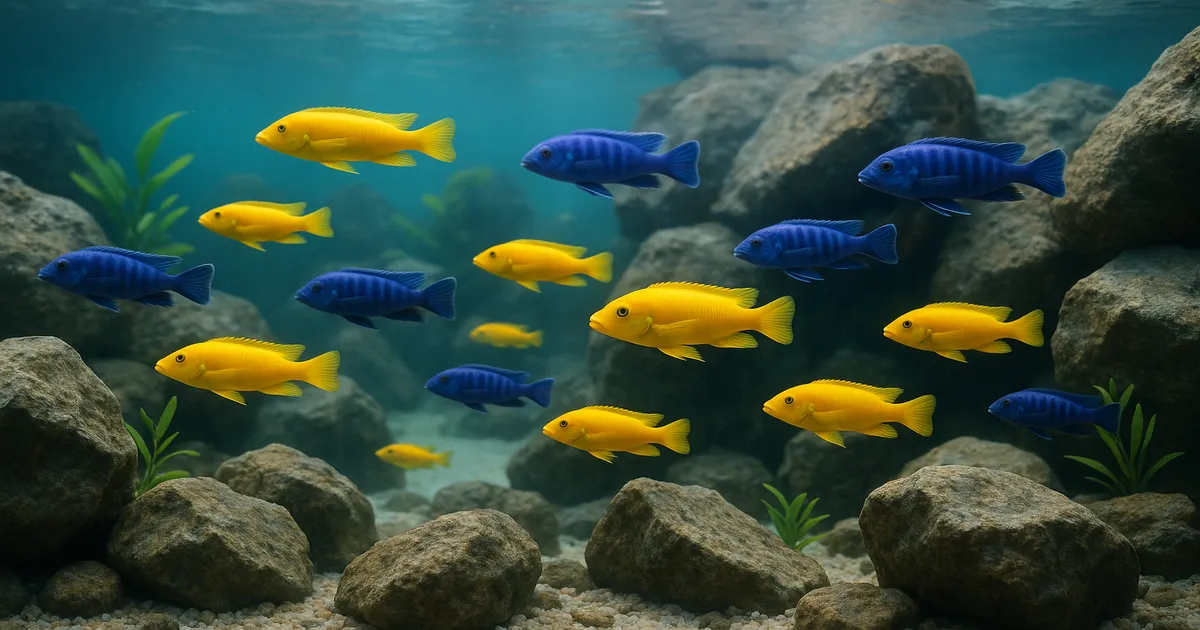
Quick Answer: Feed adult mbuna cichlids twice daily — once in the morning and once in the evening — offering only what they’ll consume within 2–3 minutes. Juveniles benefit from three small feedings per day to support healthy growth. Diet quality matters just as much as frequency: mbuna need a high-vegetable, low-protein diet, and feeding the wrong foods can be fatal.
Knowing how often to feed mbuna cichlids is only half the battle. These rock-dwelling Lake Malawi natives have a digestive system built for grazing algae, not processing the protein-heavy foods that suit other cichlids. Get the frequency and the food right, and you’ll have a thriving, colorful colony. Get it wrong, and you risk one of the hobby’s most feared conditions: Malawi Bloat.
Understanding Mbuna Feeding Behaviour in the Wild
What Do Mbuna Eat Naturally?
Mbuna (pronounced “em-BOO-nah”) are endemic to the rocky shorelines of Lake Malawi in East Africa. In the wild they’re almost exclusively herbivores and algivores — grazers, not hunters. They spend their daylight hours slowly working across rock surfaces, scraping up whatever they can find.
Their primary food source is aufwuchs — a German term for the complex biological mat that coats submerged rocks. It’s not just algae. Aufwuchs includes diatoms, bacteria, microorganisms, and organic detritus, all compressed into a thin, nutrient-dense layer. Mbuna have specialised bicuspid or tricuspid teeth designed specifically for rasping this material off hard surfaces, and they graze almost continuously throughout the day. That near-constant, low-intensity feeding pattern is the biological template you’re trying to replicate in your tank.
Why Mbuna Digestive Systems Are Different
Mbuna have longer intestinal tracts than predatory cichlids — an adaptation for extracting nutrition from fibrous plant material. This is exactly why high-protein foods cause so much damage. A diet loaded with animal protein sits in that long gut and ferments, creating the conditions for Malawi Bloat. What’s perfectly fine for an Oscar is genuinely dangerous for a Yellow Lab.
How Often to Feed Mbuna Cichlids: A Practical Schedule
Twice Daily: The Recommended Standard for Adults
Two feedings per day — morning and evening — is the schedule most experienced mbuna keepers settle on. It mirrors the natural daylight grazing pattern, keeps metabolism ticking steadily, and reduces aggression at feeding time. A hungry mbuna is a more aggressive mbuna, so consistent feeding genuinely helps tank harmony.
Feeding Juvenile Mbuna
Young mbuna need more frequent meals to fuel rapid growth. Three small feedings per day works well for grow-out tanks. The key word is small — you’re not tripling the food volume, just spreading the same daily amount across more sessions so juveniles can compete and eat their fill without stress.
Quick Comparison of Common Feeding Schedules
| Schedule | Best For | Notes |
|---|---|---|
| Once daily | Mature, established tanks | Acceptable; watch for increased aggression |
| Twice daily | Most hobbyist tanks | ✅ Recommended standard |
| 3× daily (small amounts) | Juveniles, grow-out tanks | Best for young fish development |
| Every other day | Vacation/temporary only | Not ideal long-term; fish lose condition |
Once daily can work in a well-established tank with calm, settled fish, but it’s not the ideal starting point for most keepers.
How Much to Feed at Each Sitting
The 2–3 minute rule is your best guide. Add food gradually and stop when fish begin ignoring it — that point should arrive within two to three minutes. Any food that sinks and sits uneaten is decomposing in your tank, spiking ammonia and nitrates. When in doubt, underfeed slightly. Mbuna are hardy grazers; a little hunger won’t hurt them, but chronic overfeeding absolutely will.
What to Feed Mbuna Cichlids
Staple Foods for Daily Feeding
Your daily staple should be a high-quality spirulina-based pellet or flake, with spirulina listed as the first or second ingredient. Look for a protein content of around 30–40%, ideally sourced from plant material rather than fish meal. Solid options include New Life Spectrum Cichlid Formula, Hikari Cichlid Excel, and Northfin Cichlid Formula. Algae wafers are a good daily addition too, particularly for fish that graze along the substrate.
Vegetables and Plant-Based Supplements
Two to three times a week, supplement with fresh or blanched vegetables:
- Blanched zucchini, spinach, cucumber, or kale — blanch briefly to soften, then clip or weigh down in the tank
- Shelled peas — excellent for digestive health
- Nori (dried seaweed) clipped to the glass with a veggie clip — mbuna go absolutely crazy for it
- Repashy Soilent Green — a gel food with an outstanding plant-based nutrition profile
Occasional Treats
Once a week or less, you can offer:
- Brine shrimp (live or frozen) — low nutritional density but great enrichment
- Daphnia (live or frozen) — acts as a natural laxative and supports digestive health
- Mysis shrimp (frozen) — acceptable in very small amounts
Keep these genuinely occasional. The moment protein-heavy foods become a regular part of the diet, you’re heading toward trouble.
Foods You Must Never Feed Mbuna
This list is non-negotiable:
- ❌ Bloodworms — the most common feeding mistake; directly linked to Malawi Bloat
- ❌ Tubifex worms — high disease transmission risk
- ❌ Beef heart or any mammalian protein — mbuna cannot process it; causes serious gut damage
- ❌ Generic tropical flakes or carnivore cichlid foods with high animal protein
- ❌ Feeder fish — disease risk and completely wrong nutrition profile
Malawi Bloat: What Every Mbuna Keeper Needs to Know
What Is Malawi Bloat?
Malawi Bloat is a serious, often fatal internal condition affecting mbuna and other Lake Malawi cichlids. It’s characterised by rapid abdominal swelling caused by fluid accumulation and gut inflammation. Without fast intervention, it kills within days.
The condition is strongly associated with high-protein foods — bloodworms in particular — combined with elevated nitrates and stress. The exact mechanism isn’t fully understood, but the pattern is consistent enough that experienced keepers treat bloodworms as essentially toxic for mbuna. Nitrates above 40 ppm compound the risk significantly, which is why water quality and diet are inseparable topics. (The original article cited 80 ppm as the risk threshold; most specialist sources and experienced keepers place it considerably lower.)
Early Warning Signs
Catch it early and you have a fighting chance. Watch for:
- Visibly swollen or distended abdomen
- Loss of appetite or food being spat out
- Clamped fins and lethargy
- Hovering near the surface or resting on the bottom
Any mbuna showing these signs should be isolated immediately. Treatment typically involves Metronidazole, but by the time bloat is visually obvious the prognosis is often poor. Prevention — a plant-based diet and clean water — is far more effective than any cure.
Tank Setup That Supports Healthy Feeding
Tank Size and Aggression
Aggression spikes at feeding time, and in a cramped tank there’s nowhere for subordinate fish to retreat. The minimum workable size is 55 gallons with a 48-inch footprint, but 75–125 gallons is where mbuna keeping really comes into its own. Tank length matters more than volume — a tall 55-gallon is significantly worse than a standard-footprint 55-gallon.
Dense rockwork gives subordinate fish escape routes so they can still reach food without being constantly chased off. Build rock piles that rise from the substrate toward the surface, creating caves and overhangs at multiple levels. This isn’t just decoration — it’s functional infrastructure that directly affects whether every fish in the tank gets fed.
Filtration and Water Parameters
Mbuna are constant grazers and produce substantial waste. Target filtration rated at 2–3× your actual tank volume — a 75-gallon tank needs equipment rated for 150–225 gallons. Canister filters are excellent for biological and mechanical filtration. (Fluval 407) Prioritise high-surface-area biological media like ceramic rings or Matrix to handle the ammonia load from a heavily stocked tank.
Maintain these water parameters to keep mbuna healthy:
| Parameter | Target Range |
|---|---|
| pH | 7.8–8.5 |
| GH | 10–20 dGH |
| KH | 10–18 dKH |
| Temperature | 76–82°F (24–28°C) |
| Ammonia / Nitrite | 0 ppm |
| Nitrate | Below 20 ppm ideally; 40 ppm maximum |
Weekly 25–30% water changes are your primary tool for nitrate management. Uneaten food spikes ammonia fast in a heavily stocked mbuna tank — another reason the 2–3 minute feeding rule matters beyond just avoiding waste. A reliable liquid test kit makes it easy to track nitrates and catch problems before they affect your fish.
Feeding Mbuna in a Community Tank
Managing Feeding Aggression
In a mixed mbuna community, dominant males will often try to monopolise feeding time. The simplest fix is spreading food across multiple areas simultaneously — drop some near one end of the tank, some near the other, and let fish disperse naturally rather than clustering at one point.
Ensuring Every Fish Gets Fed
Watch every fish during feeding, not just the dominant males. A fish that consistently hangs back, looks thin, or has a pinched belly is either being excluded from food or is unwell — and the two can be hard to distinguish at first. Synodontis catfish, the most popular mbuna tank mates, are largely self-sufficient; they’ll clean up sinking pellets and algae wafers from the substrate. Place a few wafers near the bottom at feeding time to make sure they’re getting enough without competing in the water column.
Regular observation during feeding is one of the most valuable health-monitoring habits you can build.
Frequently Asked Questions About Feeding Mbuna Cichlids
Can you overfeed mbuna cichlids?
Yes, easily. Excess food decomposes quickly, spiking ammonia and nitrates — both of which contribute to stress and Malawi Bloat risk. Stick to the 2–3 minute rule and only feed what fish consume completely.
Why are bloodworms bad for mbuna cichlids?
Bloodworms are high in protein and fat — the opposite of what mbuna’s plant-adapted digestive system is designed to handle. Feeding them regularly is one of the most reliably documented triggers for Malawi Bloat. Many experienced keepers cut bloodworms from their mbuna routine entirely and never look back.
How long can mbuna cichlids go without food?
Healthy adult mbuna can go 5–7 days without food without serious harm, provided water quality is good. They’ll graze on algae growing in the tank in the meantime. For vacations longer than a week, an automatic feeder or a trusted fish-sitter is a better option than simply skipping feedings.
How do I know if my mbuna is getting enough food?
A well-fed mbuna is active, has a slightly rounded (but not swollen) belly, and shows bright, consistent coloration. If a fish looks pinched behind the pectoral fins, appears hollow-bellied, or is noticeably less active than tank mates, it may not be getting enough food — possibly because it’s being outcompeted at feeding time. Observing every individual during feedings is the most reliable way to catch this early.
Can mbuna cichlids eat vegetables?
Not only can they — they should. Blanched zucchini, cucumber, spinach, shelled peas, kale, and nori are all excellent additions. Vegetables help replicate the plant-heavy aufwuchs mbuna graze on in the wild and support healthy digestion. Aim to offer them two to three times per week alongside staple pellets.