Quick Answer: Cloudy aquarium water is a symptom, not a disease — and the colour tells you almost everything. Milky white usually means a bacterial bloom, green means algae, yellow/brown points to tannins, and chalky white suggests mineral precipitation. Most causes are harmless and self-resolving once you identify the trigger and make a targeted fix.
If you’re asking “why is my tank cloudy?”, you’re in good company — it’s one of the most searched questions in the hobby, and it trips up beginners and experienced keepers alike. The good news: cloudiness almost always has a clear, fixable cause. The key is reading the colour correctly before reaching for a water clarifier that may only mask the real problem.
Why Is My Tank Cloudy? Start With the Colour
The Four Colours of Cloudy Water and What They Mean
| Colour | Most Likely Cause |
|---|---|
| Milky white / grey | Bacterial bloom, microbubbles, or dissolved minerals |
| Green | Free-floating algae bloom (phytoplankton) |
| Yellow / brown | Tannins from driftwood or dissolved organics |
| Chalky white | Mineral precipitation (calcium/magnesium) |
Each colour points to a completely different problem — and a completely different fix. Treating a tannin issue like a bacterial bloom won’t help and could make things worse.
Is Cloudy Water Dangerous to Your Fish?
It depends entirely on the cause. A bacterial bloom during a new tank cycle, or a tannin tint from fresh driftwood, is mostly harmless and often self-resolving. But cloudiness paired with fish gasping at the surface, clamped fins, or red-streaked gills is a different story — that signals an ammonia or nitrite spike that can kill fish within hours.
The rule of thumb: check your fish first, then test your water. If your fish look fine and are behaving normally, you have time to diagnose calmly. If they’re in distress, act immediately.
Milky White Cloudiness: Bacterial Blooms and New Tank Syndrome
What Is a Bacterial Bloom?
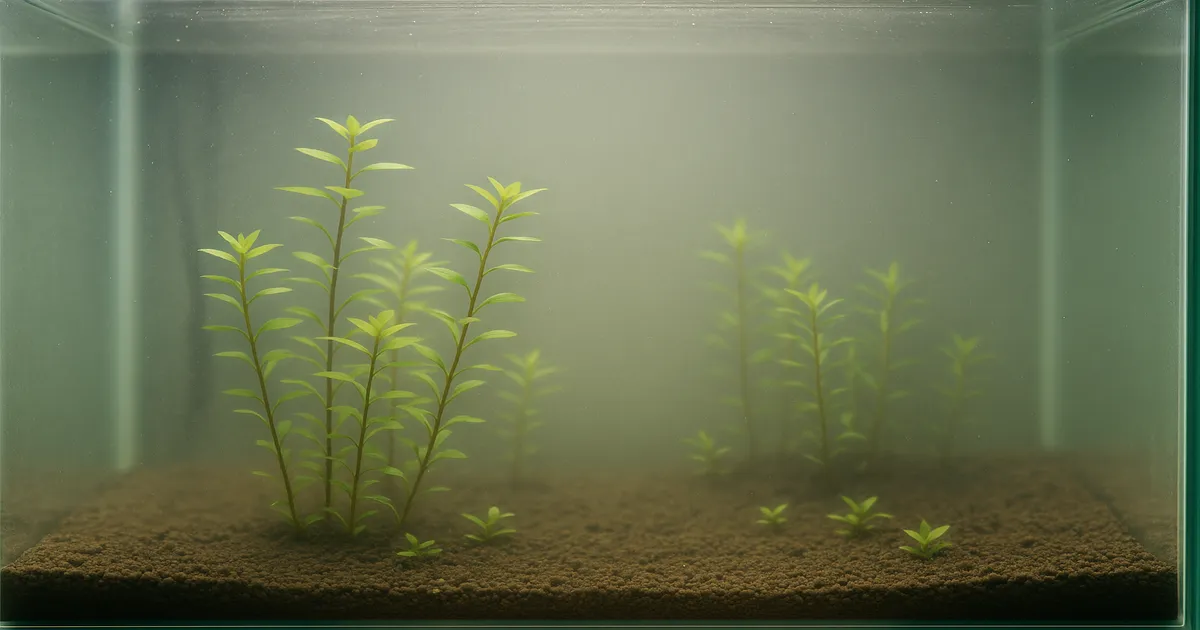
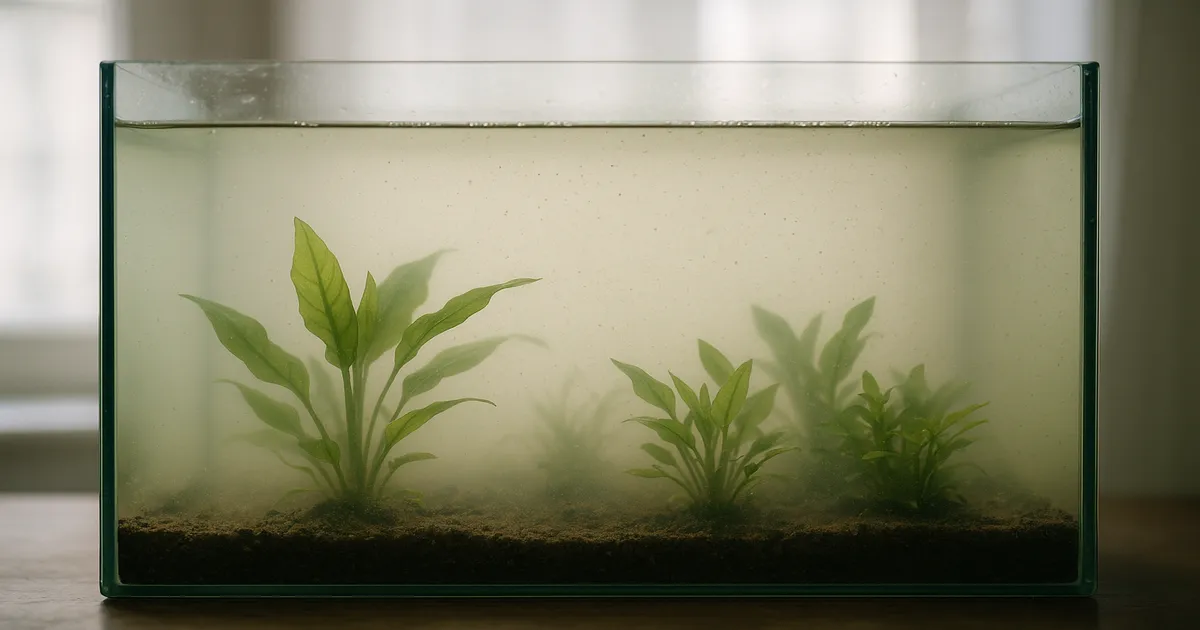
A bacterial bloom is an explosive population surge of heterotrophic bacteria feeding on organic waste or elevated ammonia. The water takes on a hazy, diluted-skim-milk appearance — and no amount of water changes seems to clear it, because the bacteria are suspended throughout the water column and reproducing faster than you can remove them.
Bacterial blooms are the most common cause of milky white cloudiness. They’re not inherently dangerous to fish, but they’re a reliable sign that something in the nitrogen cycle is out of balance.
New Tank Syndrome: The Cycling Phase
When you set up a new aquarium, there are no established colonies of beneficial bacteria (Nitrosomonas and Nitrospira species) to process fish waste. Ammonia builds up first, then nitrite spikes roughly one to two weeks later as bacteria begin converting it — and during this four-to-eight-week window, bacterial blooms are almost inevitable.
Watch for these warning signs during cycling:
- Milky or hazy water
- Fish gasping near the surface
- Red-streaked fins or lethargy
- Ammonia or nitrite readings above 0 ppm
Patience is the most important tool here. The cycle cannot be rushed, only supported.
Accuracy note: The original article cited Nitrobacter as the primary nitrite-oxidising bacteria in aquaria. Current research shows Nitrospira is the dominant genus in most freshwater tanks. Nitrobacter does appear but is less significant in typical hobby conditions.
What Triggers a Bacterial Bloom in an Established Tank?
If your tank has been running fine for months and suddenly goes cloudy, something disturbed the biological balance. Common culprits include:
- Overfeeding — uneaten food decomposes and spikes ammonia
- A dead fish left in the tank — even overnight
- Cleaning filter media under the tap — chlorine kills beneficial bacteria instantly
- Large water changes over 50% — dilutes bacteria and destabilises the cycle
- Adding too many fish at once — overwhelms the existing bacterial capacity
How to Clear a Bacterial Bloom
First, find and remove the organic source — the decomposing food, the dead fish, whatever triggered it. Then:
- Reduce feeding to once daily, tiny amounts
- Add a bottled bacteria supplement to support the cycle (Seachem Stability)
- Improve surface agitation for better oxygenation
- Avoid large water changes during the bloom — small 20–25% changes every few days are safer
- Test ammonia and nitrite daily with a liquid test kit
Most blooms resolve within 3–10 days once the organic source is removed and filtration is running well.
Green Cloudy Water: Algae Blooms Explained
What Causes Green Water in a Fish Tank?
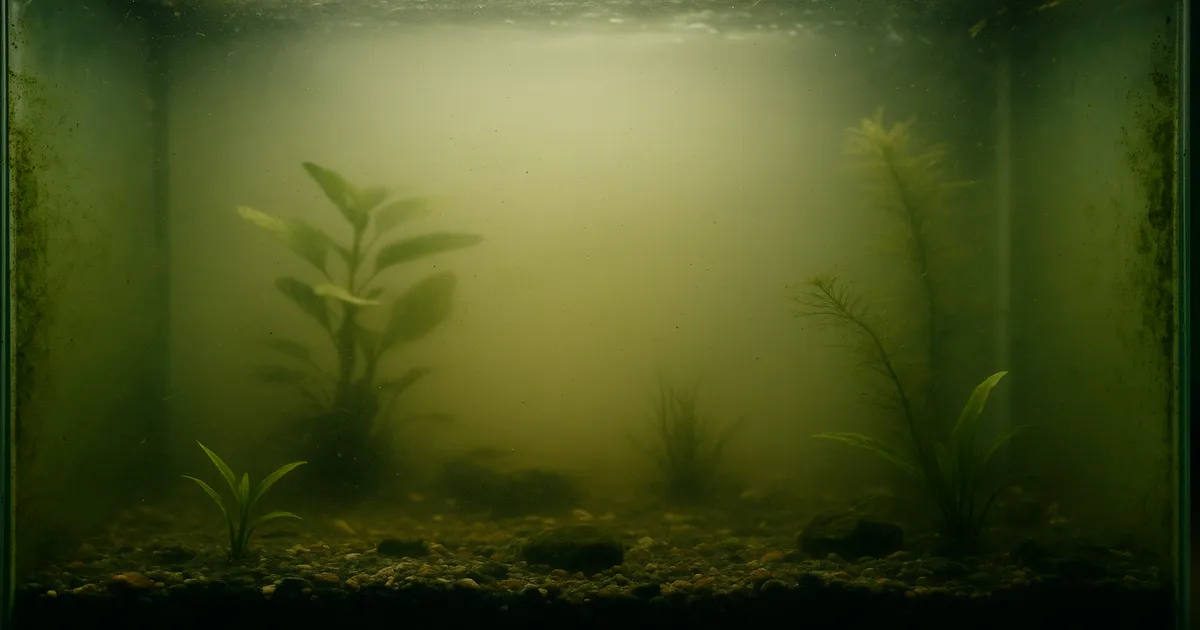
Green water is caused by a population explosion of free-floating single-celled algae — typically Chlorella or Euglena species. These phytoplankton multiply so rapidly that the water can turn a dense pea-soup green, sometimes becoming completely opaque within days.
The primary triggers are:
- Lighting beyond 8–10 hours per day — the single biggest driver
- Direct sunlight hitting the tank — even an hour of direct sun can trigger a bloom
- Nitrates above 20–40 ppm — algae thrive on excess nutrients
- High phosphates from overfeeding or tap water
The Blackout Method: Step-by-Step
The blackout method is fast, free, and surprisingly effective.
- Turn off all lights and unplug any timers
- Cover the entire tank with black bin bags or a thick blanket — no light gaps
- Leave it for 3–5 days without peeking
- Maintain normal filtration; keep feeding minimal
- Remove the cover and do a 30% water change
Algae starve without light. Your fish, plants, and beneficial bacteria will tolerate the darkness far better than the algae will.
UV Sterilisers: The Most Reliable Long-Term Fix
A UV steriliser passes tank water through an ultraviolet light chamber, destroying the DNA of free-floating algae cells without harming fish, plants, or your biological filter. It won’t fix the underlying nutrient problem, but it’s the most reliable way to prevent green water from returning. (Aqua UV Advantage 2000+ Hang-On Sterilizer) Run it continuously for 3–5 days during an active bloom, then as needed for prevention.
Preventing Green Water
- Use a timer to keep your photoperiod at exactly 8 hours per day
- Keep nitrates below 20 ppm with regular water changes
- Block any direct sunlight from reaching the tank — move it or cover the window
- Add fast-growing stem plants like hornwort or water sprite to compete with algae for nutrients
Yellow, Brown, or Chalky Cloudiness: Tannins and Mineral Issues
Yellow or Brown Water: Tannins from Driftwood and Botanicals
Tannins leach naturally from driftwood, seed pods, catappa leaves, and other botanicals. The result is a tea-coloured tint that many blackwater fish — bettas, discus, cardinal tetras — actually thrive in, but it can alarm keepers who expect crystal-clear water.
The fix is straightforward. Pre-soak new driftwood in a bucket for one to two weeks, changing the water daily. Boiling it for one to two hours dramatically accelerates tannin release. Once the wood is in the tank, activated carbon in your filter will pull out dissolved tannins within a few days.
Chalky White Cloudiness: Mineral Precipitation After Water Changes
This one catches people off guard. If your water turns a chalky, almost milky white specifically after a water change, you’re likely dealing with calcium carbonate precipitation. It happens when very hard tap water (above 20 dGH) meets a high-pH tank (above 7.8–8.0) — the minerals fall out of solution and create a white haze. It’s not dangerous and usually settles within 24–48 hours, but it’s a signal that your water chemistry is worth monitoring closely.
How pH and Hardness Interact to Cause Cloudiness
KH (carbonate hardness) is your tank’s pH buffer. Low KH — below 3 dKH — means pH can crash suddenly, killing beneficial bacteria overnight and triggering a bacterial bloom that looks identical to new tank syndrome. High KH combined with high pH causes the carbonate cloudiness described above.
When diagnosing any white cloudiness, test GH, KH, and pH together. A liquid test kit that covers all three parameters will give you a far clearer picture than guessing from appearance alone.
Why Is My Tank Cloudy? Testing and Fixing the Root Cause
The Essential Parameters to Test
Don’t guess — test. Check these parameters in order:
- Ammonia — should be 0 ppm; above 0.25 ppm causes fish stress; above 1.0 ppm is potentially lethal
- Nitrite — should be 0 ppm; above 0.25 ppm is toxic and interferes with oxygen transport
- Nitrate — keep below 20 ppm; above 40 ppm fuels algae blooms
- pH — ideal range 6.8–7.4 for most community tanks
- GH and KH — especially important if you suspect mineral cloudiness
Strip tests are notoriously unreliable for ammonia and nitrite. A liquid reagent kit is worth the investment and will pay for itself in fish you don’t lose.
Ammonia and Nitrite: The Danger Thresholds
Any detectable ammonia in an established tank is a red flag. At higher pH levels, ammonia becomes significantly more toxic — the equilibrium shifts from the relatively harmless ionised form (NH₄⁺) toward the lethal un-ionised form (NH₃). The same ammonia reading at pH 8.0 is far more dangerous than at pH 7.0. Nitrite typically spikes one to two weeks after ammonia during a new tank cycle. Both should read 0 ppm in any healthy, established aquarium.
Temperature and Dissolved Oxygen
Most tropical freshwater fish do best at 76–80°F (24–27°C). Below 65°F (18°C), beneficial bacteria slow dramatically, extending cycling time. Above 86°F (30°C), water holds less dissolved oxygen, organic matter decomposes faster, and bacterial blooms intensify.
Dissolved oxygen ideally sits at 7–9 mg/L. Cloudiness combined with fish gasping at the surface is a critical emergency — increase surface agitation immediately by adjusting your filter outlet, adding an airstone, or raising the water level to create more surface disturbance.
Common Setup Mistakes That Cause Cloudy Water
Undersized or Poorly Maintained Filters
An undersized or clogged filter is the number-one mechanical cause of persistent cloudiness. Your filter should turn over the entire tank volume 4–10 times per hour — so a 50-gallon tank needs a filter rated for at least 200–500 GPH. (Fluval 307)
The most common mistake? Cleaning filter media under the tap. Chlorine kills beneficial bacteria instantly. Always rinse media gently in a bucket of old tank water removed during your water change, and never replace all media at once — stagger replacements so you always retain a seeded colony.
New or Disturbed Substrate
New unwashed gravel or sand releases fine particles that create temporary mechanical cloudiness — this clears within 24–48 hours with good filtration and is nothing to worry about. Planted tank substrates can cloud for 24–72 hours after setup; that’s completely normal. Always rinse substrate thoroughly before adding it to the tank.
Lighting Duration and Placement
More than 8–10 hours of light per day is the primary driver of green water. A simple outlet timer solves this completely and costs almost nothing. Direct sunlight is the worst offender — even a tank near a window that receives just an hour of direct morning sun can trigger a persistent algae bloom.
Overfeeding and Overstocking: The Human Causes
Uneaten food begins decomposing within minutes of hitting the water, spiking ammonia and fuelling bacterial blooms. The golden rule: feed only what your fish consume in two to three minutes, once or twice daily. Frozen foods like bloodworms and brine shrimp should be thawed and rinsed in a fine net before feeding — the nutrient-rich packing liquid adds a hidden phosphate load and clouds water noticeably.
More fish means more waste, more ammonia, and more bacterial activity. Goldfish produce roughly three to five times more waste than equivalent-sized tropical fish and should never be kept in a tropical community tank. A single common pleco in a 55-gallon tank can produce enough waste to cloud the water regularly. If you keep high-waste species like oscars or large cichlids, heavy-duty filtration isn’t optional.
When Cloudy Water Signals Disease
Cloudiness on its own is usually environmental. The distinction comes from looking at your fish. A bacterial bloom affects the water uniformly — fish may be slightly stressed but show no spots, patches, or lesions. Disease-related cloudiness tends to be localised or accompanied by visible symptoms on the fish themselves.
- Ich (Ichthyophthirius multifiliis): heavy infestations can cause faint cloudiness from free-swimming theronts, alongside classic white salt-grain spots. Treat by gradually raising temperature to 82–86°F (28–30°C) and using a copper-based medication.
- Columnaris (Flavobacterium columnare): causes cloudy patches on skin and fins, sometimes a saddle-shaped lesion behind the dorsal fin. Treat with kanamycin or nitrofurazone and improve water quality immediately.
- Velvet (Oodinium spp.): appears as a gold or rust-coloured dust on fish — easily mistaken for cloudiness in the water. Treat with copper-based medication and keep the tank dark, as the parasite is photosynthetic.
- Fungal infections: white cotton-like growths on fish or decorations. These are attached, not suspended — distinct from bacterial bloom cloudiness. Treat with methylene blue or malachite green.
If the water is cloudy and your fish show physical abnormalities, treat both the water quality and the disease simultaneously.
Frequently Asked Questions About Cloudy Aquarium Water
How long does it take for cloudy aquarium water to clear on its own?
It depends on the cause. A bacterial bloom typically resolves in 3–10 days once the organic trigger is removed and filtration is running well. Mechanical cloudiness from new substrate usually clears in 24–48 hours. Green water from an algae bloom can persist for weeks without intervention — the blackout method or a UV steriliser will speed things up significantly.
Is cloudy water harmful to fish?
Not always. A tannin tint or a mild bacterial bloom during cycling is usually harmless. The danger comes when cloudiness is caused by — or accompanied by — ammonia or nitrite spikes, low dissolved oxygen, or disease. Always test your water and observe your fish’s behaviour before deciding how urgent the situation is.
Why did my fish tank turn cloudy after a water change?
A few possibilities. Chalky white cloudiness after a water change usually means mineral precipitation from very hard tap water meeting a high-pH tank. Milky cloudiness can occur if the water change was large enough to disturb the biological filter. If you added new substrate or decorations at the same time, mechanical particles are the likely culprit — this clears on its own within a day or two.
Can I use a water clarifier to fix cloudy water?
Water clarifiers work by clumping fine particles together so your filter can catch them — they’re effective for mechanical cloudiness but do nothing for bacterial blooms or algae. Using one without identifying the root cause is like treating a symptom while ignoring the illness. Fix the underlying problem first; use a clarifier as a finishing touch if needed.
Why does my tank keep going cloudy even after I clean it?
Recurring cloudiness almost always points to a persistent imbalance — overfeeding, overstocking, undersized filtration, or too much light. If your tank clouds up every few days, run through the checklist: reduce feeding, check your stocking level, verify your filter turnover rate, and set a timer on your lights. One of those four is almost certainly the culprit.