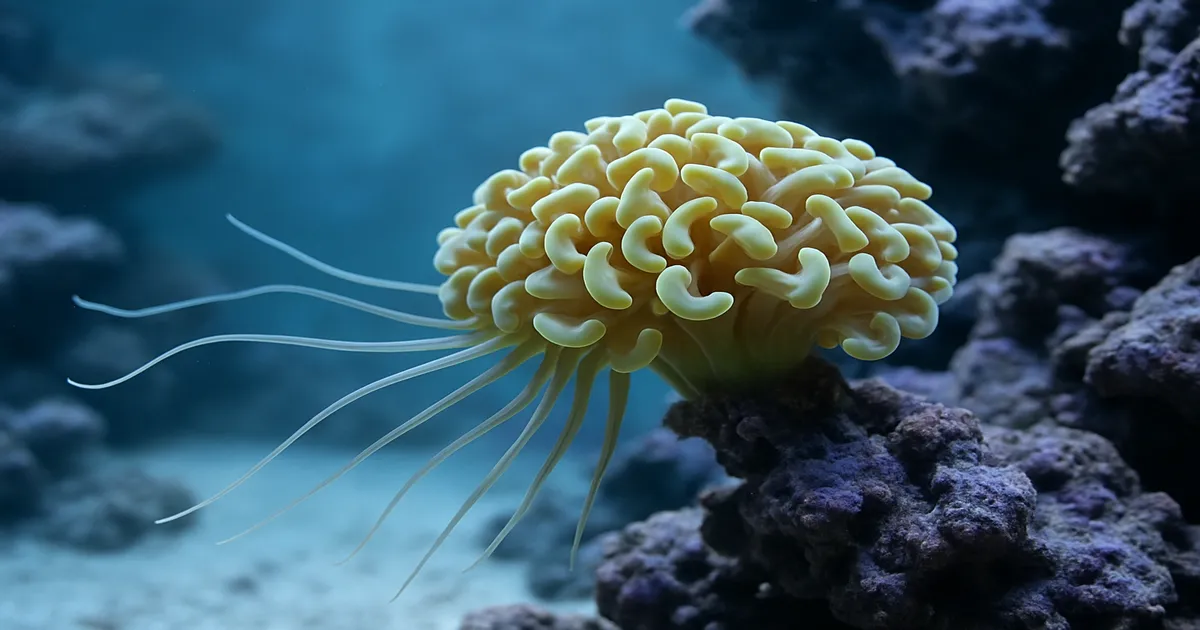
Quick Answer: That long, flat, translucent or whitish bubble-like structure extending from your hammer coral is almost certainly a sweeper tentacle — a completely normal, healthy behavior. Hammer corals deploy these specialized tentacles for territorial defense, most often at night. It is not a sign of disease or a dying coral, but you do need to make sure neighboring corals are out of reach.
If you’ve ever peered into your tank after lights out and asked “what is this long flat bubble part like in my hammer coral?” — you’re not alone. It’s one of the most common questions new hammer coral owners ask, and the answer is almost always reassuring. What you’re seeing is a sweeper tentacle. It means your coral is alive, active, and doing exactly what it’s supposed to do.
That said, sweeper tentacles can cause real damage to neighboring corals. Understanding them fully is worth your time.
Quick Takeaways
- Sweeper tentacles are normal and healthy — not a sign of disease
- They extend 4–6+ inches beyond the coral’s normal reach, appearing flat and translucent
- Most commonly deployed at night or when neighboring corals are too close
- They can and will sting nearby corals, causing tissue death
- Solution: give your hammer coral 6–8 inches of clear space in all directions
What Is That Long Flat Bubble Part on Your Hammer Coral?
Normal Feeding Tentacles vs. Sweeper Tentacles
Your hammer coral’s everyday tentacles are the ones that give it that distinctive hammer or anchor shape — rounded, relatively short, and evenly spread across the polyps. These are feeding tentacles, used to capture passing zooplankton and organic particles.
Sweeper tentacles are something else entirely. They’re dramatically elongated — often 4–6 inches (10–15 cm) or more beyond the coral’s normal reach — and they look noticeably different: flattened, ribbon-like, and translucent to pale white. If you’ve never seen them before, it’s easy to mistake them for something alarming. They’re not.
Why Are They Loaded With Nematocysts?
Sweeper tentacles are biological weapons. They’re densely packed with cnidocytes — stinging cells containing nematocysts, specifically spirocysts and basitrichous isorhizas. When a sweeper tentacle contacts a neighboring coral, it delivers a concentrated sting that can cause necrosis and tissue death in the competitor. On a wild reef, this is how corals compete for space. In your aquarium, it means an unsuspecting neighbor can wake up seriously damaged.
E. ancora vs. E. parancora: Does Species Matter?
Both main hammer coral species produce sweeper tentacles. Euphyllia ancora (the wall or ridge hammer, where corallites form a continuous meandering ridge) is generally considered slightly hardier and more forgiving of parameter swings. Euphyllia parancora (the branching hammer, with individual corallites on separate branches) is slightly more sensitive but easier to frag. Both deploy sweeper tentacles under the right conditions, so species doesn’t change how you manage them.
When and Why Does Your Hammer Coral Deploy Sweeper Tentacles?
Nighttime Aggression
Hammer corals are largely nocturnal aggressors. Most hobbyists spot sweeper tentacles during a late-night tank check — in the wild, reef competition for space is most active after dark. If you’re only seeing them after lights out, that’s entirely normal.
A Neighbor Is Too Close
The most common trigger is a neighboring coral getting within reach. Even corals that look well-separated during the day can end up in sweeper range once the tentacles extend at night. If you’ve recently rearranged your tank or added a new coral, that’s often what sets it off.
Stress and Parameter Swings
Stress can also prompt deployment — a sudden alkalinity shift, a temperature swing, or the disruption of being moved. New additions to the tank, even fish, can trigger a defensive response. If you’re seeing sweepers more than usual after a tank change, your coral noticed.
A Sign of a Healthy Coral
Here’s the counterintuitive part: a hammer coral actively extending sweeper tentacles is often a healthy one. A well-fed, thriving coral has the energy reserves to mount a territorial defense. Take it as a positive sign — just make sure its neighbors are safely out of reach.
Placement and Tank Setup
How Much Space Does a Hammer Coral Need?
Budget 6–8 inches (15–20 cm) of clear space in all directions. Sweeper tentacles regularly extend 4–6 inches and can reach further in stronger flow. Many reefers underestimate this and end up with a mystery coral death that’s actually sweeper damage.
A 40-gallon breeder is a more practical minimum than the 30-gallon sometimes cited — the extra footprint gives you room to space corals properly and provides the water volume stability that hammer corals need. Fifty gallons or more is better still.
Best Position: Height, Flow, and Substrate
Place your hammer coral in the lower to middle third of the tank. This keeps it in gentler flow and away from the most intense light near the surface. Many reefers rest them on a small rock or plug on the sandbed, which mimics their natural habitat on sheltered reef slopes near reef bases.
Make sure the mount is stable. A hammer coral that tips over repeatedly is a stressed hammer coral, and physical trauma is one of the leading triggers for Brown Jelly Disease.
Lighting: Finding the Sweet Spot
Hammer corals thrive in the 50–150 PAR range — moderate light, not the intense output you’d target for SPS. Full-spectrum LEDs work well, with an emphasis on blue and violet wavelengths (420–450 nm) for zooxanthellae health and color. A fixture like the (AI Hydra 32 HD) gives you the spectrum control and dimming capability to dial this in precisely.
Always light-acclimate a new specimen. Start at lower intensity and ramp up gradually over 2–4 weeks. Signs you’ve gone too bright: bleaching or tissue recession. Too dim: the coral browns out or starts stretching toward the light.
Flow: Gentle Sway, Not a Blast
Aim for 10–20× total tank volume per hour in turnover, but the key word is indirect. Your hammer coral should gently sway — not get blown flat or retract. Direct laminar flow from a powerhead aimed straight at it is one of the top causes of hammer coral decline in home aquariums.
A wavemaker (Jebao OW-25) set to random or reef mode is ideal. Variable, indirect flow mimics the gentle surge of a sheltered reef and keeps your coral happy without hammering it (pun intended).
Water Parameters
Parameter Cheat Sheet
| Parameter | Ideal Range | Acceptable Range |
|---|---|---|
| Temperature | 78–80°F (25–27°C) | 76–82°F (24–28°C) |
| Salinity | 1.025–1.026 | 1.024–1.026 |
| pH | 8.1–8.3 | 8.0–8.4 |
| Alkalinity | 8–10 dKH | 7–11 dKH |
| Calcium | 420–440 ppm | 400–450 ppm |
| Magnesium | 1,280–1,320 ppm | 1,250–1,350 ppm |
| Nitrate | 5–15 ppm | 2–25 ppm |
| Phosphate | 0.05–0.08 ppm | 0.03–0.10 ppm |
| Ammonia | 0 ppm | 0 ppm |
| Nitrite | 0 ppm | 0 ppm |
Stability Matters More Than Perfect Numbers
A hammer coral living at 8.5 dKH consistently will outperform one bouncing between 8 and 11 dKH every few days. Rapid alkalinity swings — even within the “acceptable” range — cause alkalinity shock, which shows up as tissue recession and browning. Test regularly with a reliable kit and make any adjustments slowly, no more than 0.5 dKH per day.
Don’t Chase Ultra-Low Nutrients
This surprises many newer reefers: hammer corals actually need some nitrate and phosphate. A target of 5–15 ppm nitrate and 0.05–0.08 ppm phosphate is ideal. Ultra-low nutrient systems designed for SPS can cause LPS to pale, bleach, and decline. If your hammer coral looks washed out and your nutrients are undetectable, that may be the problem — not the solution.
Compatibility
Corals That Can Coexist
Within the Euphyllia genus there’s natural cross-compatibility — frogspawn (E. divisa) and torch corals (E. glabrescens) can often share space with hammer corals without triggering aggression. Monitor any Euphyllia-to-Euphyllia pairing closely, especially torch corals, which are notably aggressive themselves. Soft corals like mushrooms and leathers are fine as long as they’re placed well outside sweeper range.
Corals to Keep Well Away
- Acropora and other SPS — sweeper tentacles will devastate them
- Zoanthids and Palythoa — vulnerable to stinging
- Elegance coral — aggressive itself; territorial conflicts get messy
- Any coral within 6–8 inches — regardless of species
Fish and Invertebrates
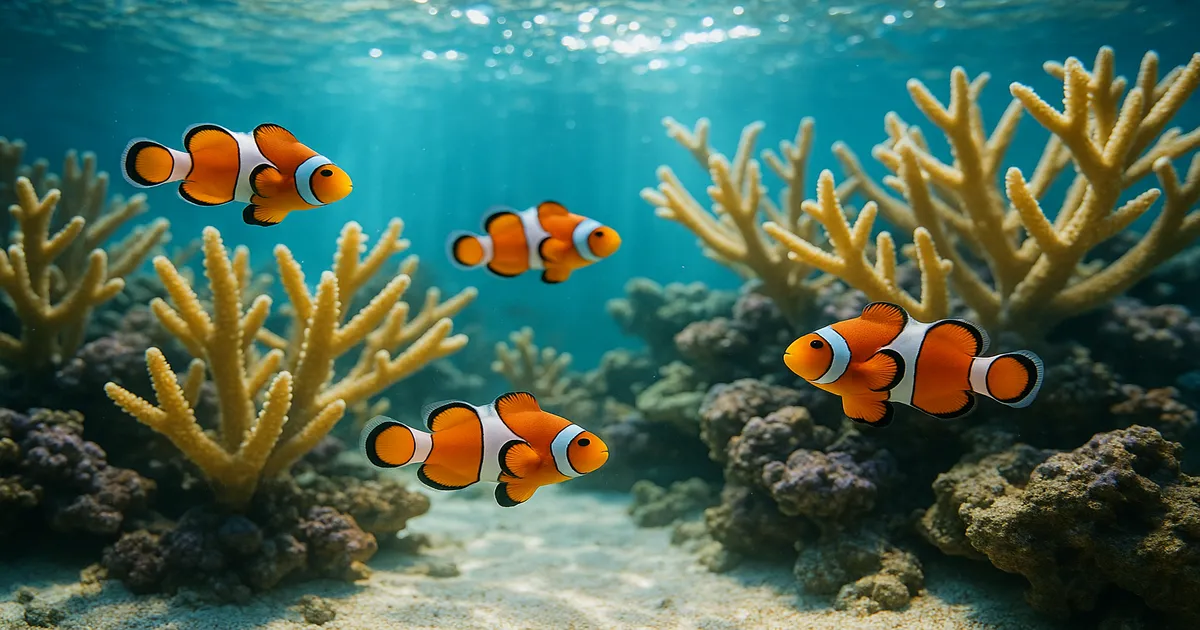
The clownfish–hammer coral pairing is iconic for good reason. In the absence of an anemone, clownfish (Amphiprion spp.) will often adopt a hammer coral as their host. Their constant movement aerates the coral and their presence may deter curious fish. Ocellaris and percula clownfish are the most popular choices and the least likely to be rough with their host.
Other good tankmates include chromis, cardinalfish, dartfish, firefish, small wrasses, royal grammas, and tangs for algae control. Avoid large angelfish, butterflyfish, pufferfish, and triggerfish — all are known coral nippers. Watch peppermint shrimp closely; some individuals develop a taste for Euphyllia polyps.
Feeding Your Hammer Coral
Hammer corals are mixotrophic — their symbiotic zooxanthellae provide an estimated 70–90% of their energy through photosynthesis, and the rest comes from active predation. Good lighting handles the photosynthesis side. Target feeding handles the rest, and it makes a noticeable difference in growth rate and color.
Best foods:
- Mysis shrimp — top choice; high protein, appropriately sized
- Enriched brine shrimp — good supplement, less complete than mysis alone
- Cyclops — excellent for smaller polyps or younger frags
Feed 1–2 times per week. To target-feed, turn off your return pump and powerheads, wait for the polyps to extend fully (evening is ideal), then use a pipette or turkey baster to deliver food directly to the tentacles. Wait 10–15 minutes before restoring flow. (Julian Sprung’s Two Little Fishies Coral Feeder)
Common Problems and Fixes
Bleaching
Bleaching means the coral is expelling its zooxanthellae. Most common causes: excessive light, a temperature spike, or ultra-low nutrients. Reduce PAR gradually, check for temperature swings, and verify that nitrate and phosphate aren’t bottomed out. Never make sudden adjustments.
Brown Jelly Disease (BJD)
BJD is a bacterial infection that appears as a brown, mucus-like slime spreading across the tissue. It’s often triggered by physical trauma — tipping over, fish nipping, or rough handling. Act fast: it can consume an entire colony in days.
Emergency response:
- Remove the affected coral from the display tank immediately
- Frag any visibly healthy tissue, cutting well back from the infection
- Dip in a coral dip solution for 10–15 minutes (Seachem Reef Dip)
- Place healthy frags in a clean, well-oxygenated quarantine system
Tissue Recession (RTN/STN)
Both forms of tissue necrosis usually trace back to parameter instability — especially sudden alkalinity swings. The tissue peels back from the skeleton, exposing white calcium carbonate beneath. Stabilize your parameters immediately and consider fragging above the recession line if it’s spreading. Speed matters with RTN especially.
Polyps Not Opening
A hammer coral that stays retracted during the day is telling you something is wrong. Work through this checklist:
- Flow: Is a powerhead aimed directly at it? Redirect or reduce.
- Light: Did you recently increase intensity? Back off and re-acclimate.
- Parameters: Test everything — alkalinity swings are the most common culprit.
- Acclimation: New corals often need 1–2 weeks to settle before opening fully.
- Neighbors: Is another coral stinging it, or is it spending energy on sweeper deployment?
Frequently Asked Questions About That Long Flat Bubble Part on Hammer Coral
Is the long flat bubble part on my hammer coral a sign of disease?
Almost certainly not. Long, flat, translucent sweeper tentacles are a sign of a healthy, active coral — not a diseased one. If your coral opens well during the day, has good color, and your parameters are stable, there’s nothing to worry about. The only action needed is making sure neighboring corals are safely out of reach.
Why does my hammer coral only show these long tentacles at night?
Hammer corals are largely nocturnal aggressors. In the wild, reef competition for space is most active after dark, so sweeper tentacle deployment evolved as a nighttime behavior. Seeing them only after lights out is completely normal — it doesn’t mean anything is wrong during the day when they’re retracted.
Can sweeper tentacles hurt other corals in my tank?
Yes — genuinely. Sweeper tentacles are packed with concentrated nematocysts that can cause necrosis and tissue death in neighboring corals. SPS corals like Acropora are especially vulnerable, but even other LPS can be damaged if they’re within reach. Always maintain 6–8 inches of clear space around your hammer coral.
How much space should I leave around my hammer coral?
Leave at least 6–8 inches (15–20 cm) of clear space in all directions. Sweeper tentacles can extend 4–6 inches or more beyond the coral’s normal diameter, and flow can carry them even further. Many hobbyists underestimate this and only discover the problem after a neighboring coral is already damaged.
Can hammer coral sweeper tentacles hurt my clownfish?
Generally no. Fish are mobile enough to avoid sustained contact, and clownfish that host in hammer corals develop a protective mucus coating. Very small or slow-moving fish could theoretically be irritated by repeated contact, but this is uncommon in practice.