Quick Answer: If your female betta looks like she’s been dusted with gold or rust-colored powder, she almost certainly has velvet disease (Oodinium pilularis). Shine a flashlight at a low angle across her body in a darkened room — if you see a shimmering gold sheen, start treatment immediately. Velvet is highly contagious and can kill fish within days, so there’s no time to wait and see.
Asking “does this betta look like she has velvet?” is one of the most urgent questions a new betta keeper can face — and for good reason. Velvet disease moves fast, and female bettas are especially vulnerable, particularly those kept in sorority tanks where stress and close quarters accelerate the spread. This guide walks you through how to diagnose it, treat it, and stop it from coming back.
Does Your Betta Have Velvet? Start Here
The Flashlight Test: Your Fastest Diagnostic Tool
Turn off every light in the room and let your eyes adjust. Then shine a small flashlight or phone torch at a low angle directly across your betta’s body — almost parallel to the water surface, not from above. Oodinium parasites contain chlorophyll and reflect light, appearing as a shimmering gold or rust-colored dust that’s nearly invisible under normal aquarium lighting.
If you see that telltale sheen — especially around the head, gill covers, and body — you’re dealing with velvet.
Key Warning Signs at a Glance
- Gold, rust, or yellow dust coating the skin, most visible on the head and gills
- Clamped fins held tightly against the body
- Flashing — rubbing against gravel, plants, or tank walls to relieve irritation
- Rapid gill movement or labored breathing
- Lethargy and loss of appetite
If you’re seeing three or more of these together, treat for velvet now. Waiting even 24 hours can make a real difference in outcome.
What Is Velvet Disease in Betta Fish?
The Parasite Behind Velvet: Oodinium pilularis
Oodinium pilularis is a dinoflagellate parasite — not a true protozoan, despite what older fishkeeping guides may say. It’s photosynthetic, meaning it contains chlorophyll and can sustain itself partly through light. That’s why darkening the tank is part of treatment. In marine tanks, the related species O. ocellatum causes the same disease; in freshwater bettas, O. pilularis is the culprit.
The Velvet Life Cycle Explained
Understanding the life cycle explains why treatment needs to run longer than symptoms last:
- Trophont stage — The parasite attaches to the fish’s skin and gills, feeding on host tissue. This is the visible stage you detect with the flashlight test.
- Tomont stage — The parasite detaches, drops to the substrate, encysts, and divides into hundreds of daughter cells called dinospores.
- Dinospore stage — Free-swimming infectious cells that must find a host within 24–48 hours or die.
The full cycle completes in as little as 3–14 days. Warmer water — around 82–86°F (28–30°C) — accelerates it, which is useful during treatment because it pushes the parasite through vulnerable stages faster.
How to Identify Velvet on a Female Betta
Visual Symptoms of Velvet Disease
The gold or rust dust is the defining symptom, concentrated most heavily on the head, body, and gill covers. In early infections it can be subtle — a faint shimmer you might mistake for natural iridescence. As the infection progresses, the coating becomes more obvious and behavioral changes follow: clamped fins, flashing, and labored breathing.
In advanced cases, look for skin that appears to peel or slough off, severe lethargy, and visible weight loss. By this stage the gills are often heavily infected, causing rapid breathing even in a fish sitting completely still.
Velvet vs. Ich vs. Fungal Infection
| Condition | Appearance | Key Distinguishing Feature |
|---|---|---|
| Velvet (Oodinium) | Fine gold/rust dust on head and body | Glows under flashlight; gold sheen |
| Ich (Ichthyophthirius) | White spots like grains of salt | Larger, distinct white dots; not gold |
| Epistylis | White/gray tufts near wounds | Often near injuries; bacterial origin |
| Fungal infection | White/gray cotton-like patches | Fluffy texture, not dusty |
| Columnaris | White/gray saddle patches, fraying fins | Often near dorsal fin; bacterial |
| Stress stripes | Horizontal dark lines on body | No texture change; no physical irritation |
| Breeding stripes | Vertical bars on female | Normal coloration; no behavioral distress |
Stress Stripes vs. Velvet: Don’t Confuse Them
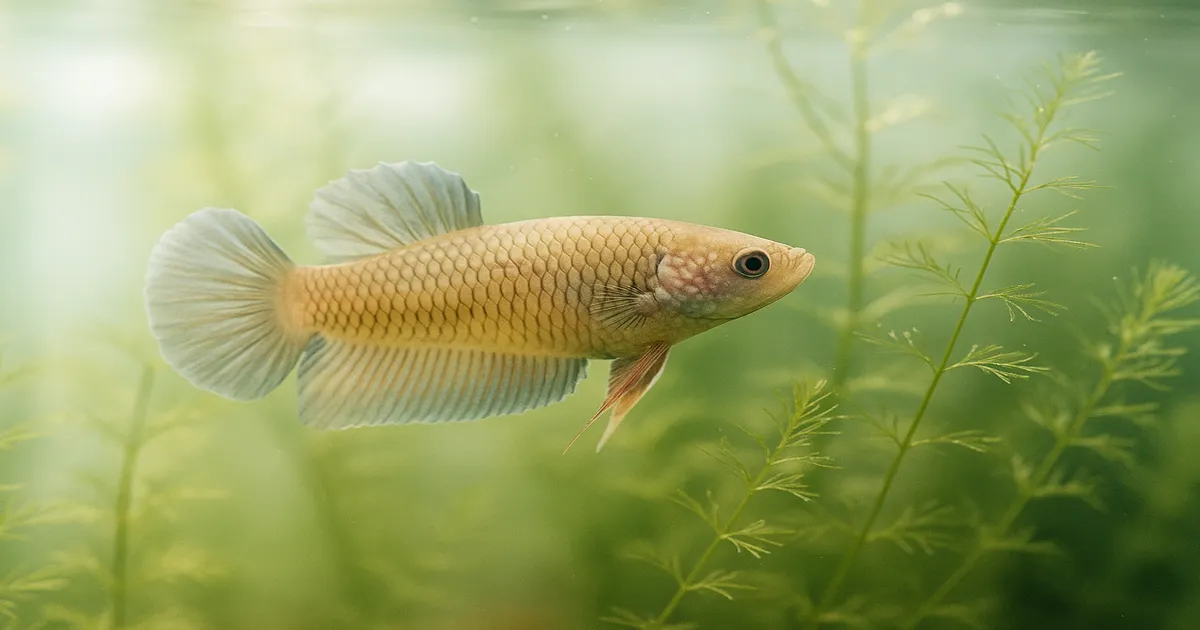
Female bettas display two stripe patterns that have nothing to do with disease. Stress stripes are horizontal dark lines running the length of the body, appearing when a betta is frightened or in poor conditions. Breeding stripes (also called breeding bars) are vertical bars that appear when a female is ready to spawn — you may also notice the ovipositor, a small white dot between the ventral and anal fins, which is completely normal.
Neither pattern involves any texture change on the skin. If the stripes you’re seeing come with a dusty coating, clamped fins, or flashing, you’re not looking at a coloration quirk — you’re looking at velvet.
How to Treat Betta Velvet Disease
Step 1: Quarantine and Darken the Tank
If you have a hospital tank, move the infected fish immediately. That said, if velvet is confirmed, every fish in the display tank has already been exposed — so you’ll likely need to treat the whole tank anyway. Cover it completely with a dark cloth or blanket to block all light. Darkness weakens Oodinium by cutting off its photosynthetic energy source.
Step 2: Raise the Water Temperature Safely
Gradually raise the temperature to 82–86°F (28–30°C), increasing no more than 2°F (1°C) per hour to avoid shocking your fish. Warmer water accelerates the parasite’s life cycle, pushing it through its most vulnerable free-swimming stage faster. Because warm water holds less dissolved oxygen, add an air stone or increase surface agitation to compensate.
Step 3: Choose the Right Medication
Copper-based treatments are the gold standard for velvet:
- Cupramine (Seachem) — chelated copper, highly reliable, and safer than ionic copper when dosed correctly. Follow the instructions precisely; copper becomes toxic at elevated levels.
- Copper Power (Blue Life) — another effective option with a good safety margin.
Before using copper:
- Remove all invertebrates — snails and shrimp are killed by copper.
- Remove activated carbon from your filter — it binds copper and renders treatment ineffective.
Chloroquine phosphate is a popular alternative that works well against Oodinium and is gentler on biological filtration. Acriflavine and formalin-based treatments like Quick Cure are secondary options if copper isn’t available, but require careful dosing.
Aquarium salt at 1–3 teaspoons per gallon can support the fish during treatment, but it is not a standalone cure.
Step 4: Treatment Duration and Water Changes
Treat for a minimum of 14 days, continuing for 3–5 days after all visible symptoms have cleared. This ensures you’ve addressed every life cycle stage, including encysted tomonts that medications can’t directly reach.
Perform 25–30% water changes every 2–3 days throughout treatment. This removes dead parasites and keeps water quality stable in a stressed, medicated tank. Re-dose medication after each water change according to the product label.
Step 5: Post-Treatment Recovery
Once treatment is complete, bring the temperature back down to 78–80°F (25.5–26.7°C) over 24–48 hours — the same slow pace as the increase. Reintroduce activated carbon to remove medication residue. Monitor closely for 2–4 weeks, because velvet can recur if the underlying cause — stress or poor water quality — isn’t resolved.
Water Parameters and Velvet Prevention
Ideal Water Parameters for Betta splendens
| Parameter | Ideal Range | Notes |
|---|---|---|
| Temperature | 76–82°F (24–28°C) | Optimal 78–80°F (25.5–26.7°C) |
| pH | 6.5–7.5 | Optimal 7.0 |
| GH | 3–12 dGH | Optimal 4–8 dGH |
| KH | 3–8 dKH | Helps stabilize pH |
| Ammonia | 0 ppm | Any detectable level is harmful |
| Nitrite | 0 ppm | — |
| Nitrate | Below 20 ppm | Below 40 ppm acceptable short-term |
How Poor Water Quality Triggers Velvet Outbreaks
Ammonia is particularly dangerous because it directly damages gill tissue — the same tissue Oodinium targets first. A fish with ammonia-burned gills is far more susceptible to velvet taking hold. Temperature swings below 74°F (23°C) suppress immune function in a similar way. The two most common scenarios before a velvet outbreak are an uncycled tank and a sudden temperature drop.
Test your water weekly under normal conditions and daily during any illness or tank change. A liquid test kit is far more accurate than strip tests.
A reliable heater with a built-in thermostat is equally important — heater failures are a leading cause of the temperature drops that trigger outbreaks.
Tank Setup to Reduce Velvet Risk
Tank Size, Filtration, and Stress Reduction
A single female betta needs at least 5 gallons; 10 gallons is a much more comfortable setup. For a sorority of 5–6 females, start at 20–30 gallons — cramped sororities are stressed sororities, and stress is a direct pathway to disease.
Sponge filters are ideal for betta tanks. They provide gentle biological filtration without the strong current that exhausts bettas. If you use a hang-on-back filter, baffle the output with a piece of sponge or position it to break against the tank wall.
Dense planting with Java fern, Anubias, and floating plants like frogbit creates visual breaks and hiding spots that are essential in sorority tanks. Caves, PVC pipes, and coconut shell hides give subdominant fish somewhere to retreat. Less stress means a stronger immune system — and a fish that can fight off early-stage infections before they become crises.
The Quarantine Tank: Non-Negotiable
A bare-bottom 5–10 gallon quarantine tank is one of the most valuable things a betta keeper can own. New fish go in for 4 weeks before entering your display tank. Sick fish go in for treatment without medicating your entire setup. If you’re serious about preventing velvet, this isn’t optional.
Every new fish goes into quarantine — no exceptions. New plants should be rinsed thoroughly; a brief potassium permanganate dip kills hitchhiking parasites. Oodinium dinospores can also arrive through live food, water transfers, and shared equipment, so treat all of these as potential vectors.
Never share nets, buckets, or siphons between tanks without sterilizing them first. A dilute bleach solution (1 part bleach to 9 parts water, followed by thorough rinsing and air-drying) does the job.
Feeding a Sick Betta During Treatment
Offer food once daily in very small amounts, and remove anything uneaten after a few minutes. Uneaten food degrades water quality fast — the last thing you need in a hospital tank.
Stick to highly digestible options: frozen daphnia, frozen brine shrimp, or a few pellets of a high-quality betta food. Avoid freeze-dried foods entirely during illness — they can cause bloating and add unnecessary stress to a fish that’s already struggling. Once your betta has recovered, live blackworms and live daphnia are excellent for rebuilding condition.
Frequently Asked Questions: Does This Betta Look Like She Has Velvet?
What does velvet disease look like on a betta fish?
Velvet appears as a fine gold, rust, or yellow dust coating the fish’s skin, most visible on the head, body, and gill covers. It can be subtle in early stages. The best way to see it is to shine a flashlight at a low angle across the fish’s body in a darkened room — the parasites reflect light as a shimmering gold sheen.
How do I tell the difference between velvet and ich in bettas?
The key difference is texture and color. Ich appears as distinct white spots that look like grains of salt — larger and clearly defined. Velvet looks like fine gold or rust-colored dust, not individual spots, and is most visible under a flashlight in a dark room. White and grainy means ich; shimmery golden coating means velvet.
Can a betta survive velvet disease without medication?
It’s unlikely. Velvet progresses quickly, and the parasite load on the gills can cause respiratory failure within days. Some fish with very mild infections and excellent water conditions may survive, but relying on that is a gamble. Copper-based medication or chloroquine phosphate gives your fish a genuine chance of recovery.
How long does velvet treatment take?
Treat for a minimum of 14 days, continuing 3–5 days past the point when all visible symptoms have cleared. This accounts for encysted parasites that medications can’t reach directly. Rushing treatment is one of the most common reasons velvet comes back.
How did my betta get velvet if I haven’t added any new fish?
Oodinium can be introduced through new plants, live food, shared equipment, or even water transferred from another tank. It can also be present at very low levels in an established tank and flare up when a fish becomes stressed or water quality drops. A sudden temperature drop or ammonia spike is often the trigger.