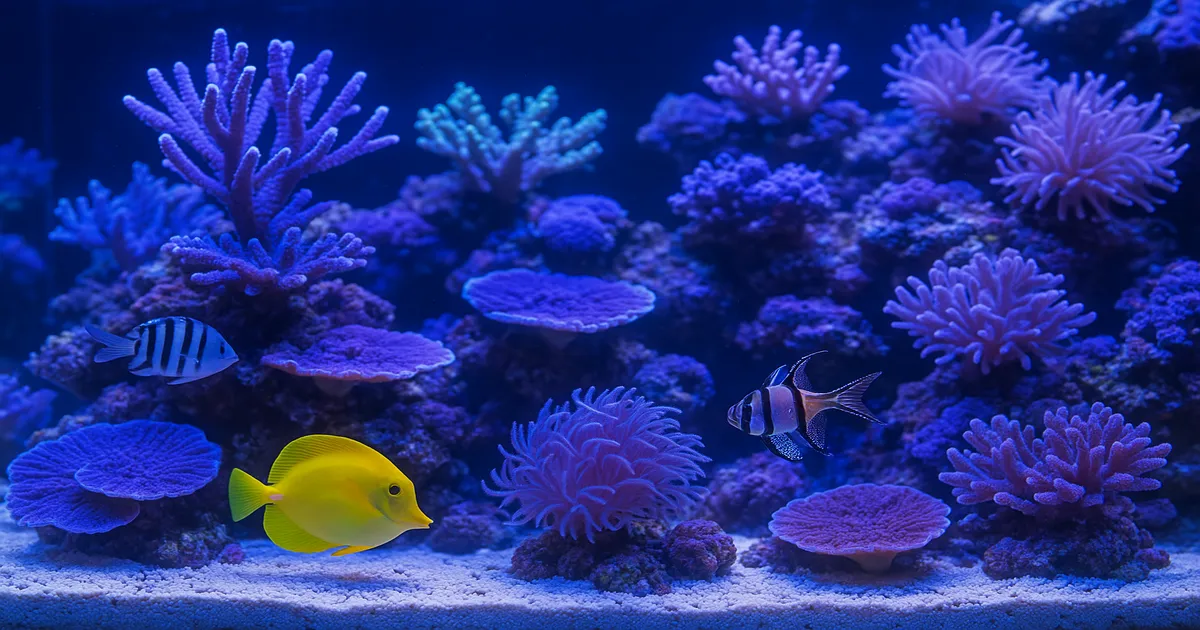
Quick Answer: Reef corals fall into five main groups — SPS, LPS, soft corals, zoanthids, and mushroom corals. Knowing which group (and ideally which genus) a coral belongs to directly determines its lighting, flow, water parameters, and placement in your tank. Misidentifying a coral is one of the most common reasons beginners lose livestock. This guide walks you through how to identify every major group by sight and how to care for each one correctly.
What Is the Name of This Coral? How to Identify Any Reef Coral by Sight
“What is the name of this coral?” is probably the most common question asked at a frag swap or fish store. The answer matters far more than most beginners realize. A coral’s identity tells you whether it needs intense light or shade, high flow or gentle current, pristine water or a modest nutrient load.
The Five Major Coral Groups in the Hobby
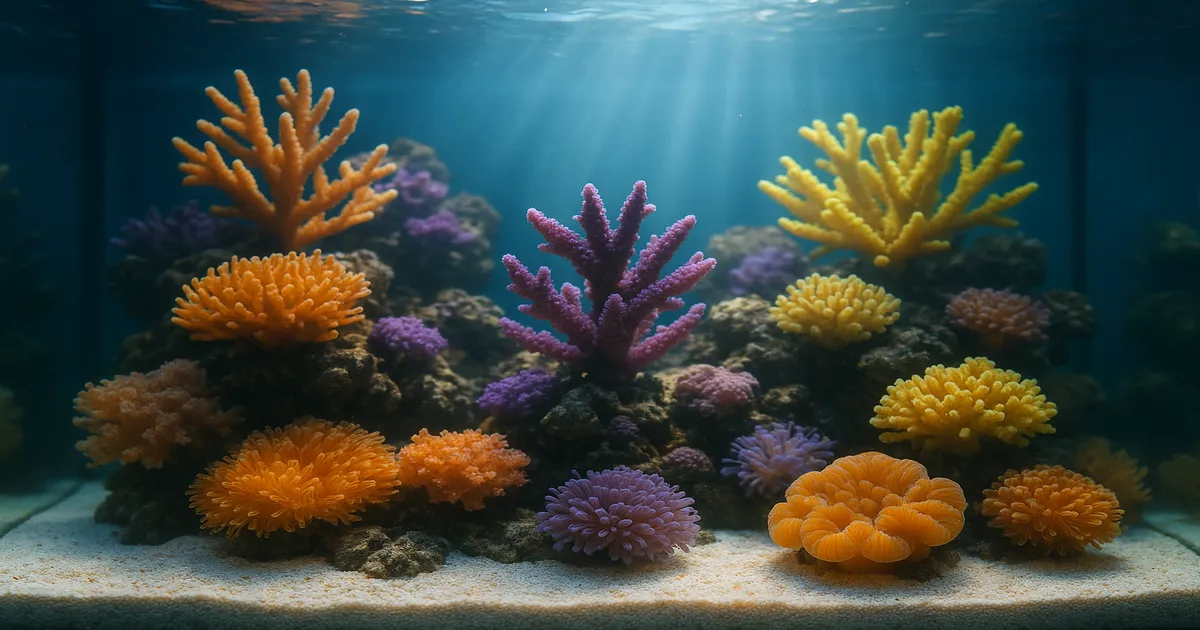
Every coral you’re likely to encounter fits into one of these categories:
- SPS (Small Polyp Stony): Fast-growing, skeleton-forming corals with tiny polyps — Acropora, Montipora, Pocillopora
- LPS (Large Polyp Stony): Skeleton-forming corals with large, fleshy polyps — Euphyllia, Trachyphyllia, Fungia
- Soft Corals: No rigid skeleton; flexible, often leathery — Sarcophyton, Sinularia, Xenia
- Zoanthids & Palythoa: Colonial polyps, intensely colorful, chemically potent
- Mushroom Corals (Corallimorpharia): Flat, disc-shaped, skeleton-free — Discosoma, Ricordea
Place an SPS coral where a mushroom coral belongs and it will bleach. Put a torch coral next to a hammer coral without enough spacing and sweeper tentacles will cause real damage overnight. Every care decision flows from knowing what you have.
Coral Identification Guide: Names, Looks, and Groups
What Is a Coral? Taxonomy Basics
Corals belong to the phylum Cnidaria, class Anthozoa — the same group as sea anemones. Each coral is made up of individual polyps: tiny, mouth-bearing animals. Some species are solitary, but most form colonies of thousands.
The two major divisions you’ll work with:
- Scleractinia (stony corals): Secrete a rigid calcium carbonate skeleton. This group includes both SPS and LPS corals.
- Octocorallia (soft corals and gorgonians): No rigid skeleton. Supported by internal protein structures and tiny calcium spicules, making them far less demanding on your tank’s calcium and alkalinity levels.
Inside the tissues of most reef-building corals live microscopic symbiotic algae called zooxanthellae (Symbiodinium spp.). These algae photosynthesize and pass sugars and lipids directly to the coral host, providing 70–90% of its energy needs. This is why lighting quality is the single most critical variable in reef keeping. When water temperature spikes or conditions deteriorate, corals expel their zooxanthellae and turn ghostly white — a process known as bleaching.
SPS Corals: Acropora, Montipora, Pocillopora, and More
SPS corals are defined by their tiny polyps and rapid calcification. Up close, the skeletal surface looks almost fuzzy when polyps are extended. Growth forms vary enormously — Acropora produces branching, table, and staghorn shapes; Montipora encrusts flat surfaces or forms plating layers; Pocillopora grows in tight, cauliflower-like heads.
Common SPS genera:
- Acropora — the iconic branching reef-builder; extremely demanding; found in shallow, high-energy reef zones
- Montipora — encrusting and plating forms; slightly more forgiving than Acropora; a great entry-level SPS
- Pocillopora — compact, warty branches; very hardy for SPS; often the first SPS a hobbyist keeps
- Stylophora and Seriatopora — finger-like and needle-branching forms; moderate difficulty
SPS corals are naturally found in the shallow Indo-Pacific at 0–25 metres depth, where light is intense and water moves constantly.
LPS Corals: Euphyllia, Trachyphyllia, Fungia, and More
LPS corals are hard to miss. Their large, fleshy polyps extend dramatically during the day, often hiding the skeleton entirely. Colors range from neon green and gold to deep purple and electric blue.
Key LPS genera:
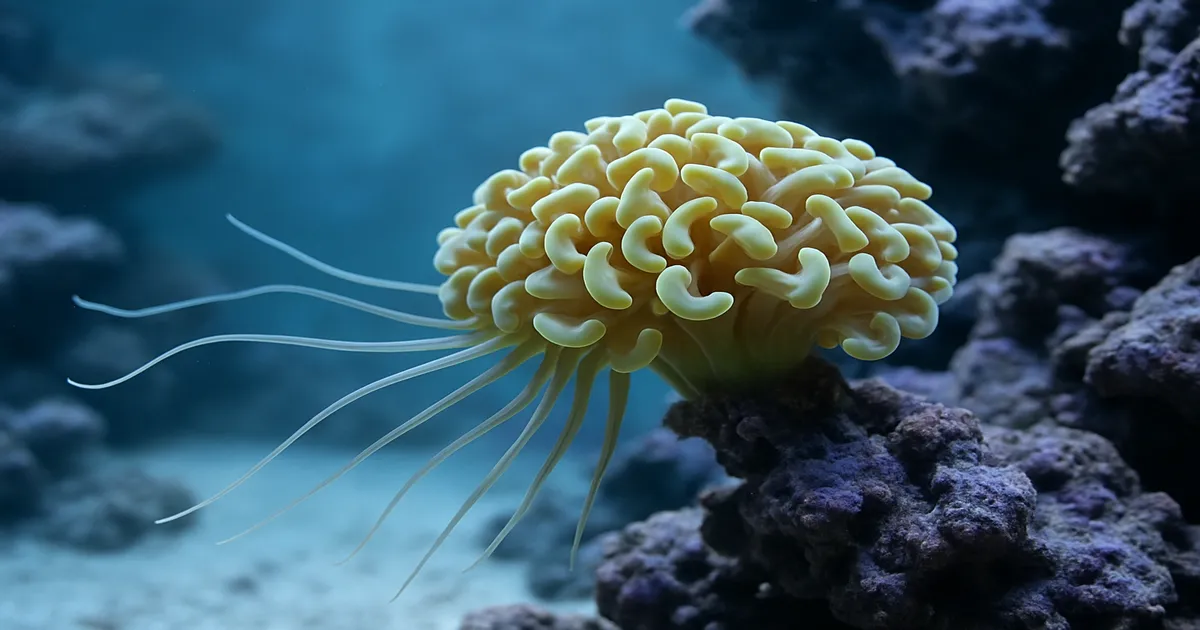
- Euphyllia — hammer, torch, and frogspawn corals; long flowing tentacles with rounded or branched tips; among the most popular corals in the hobby
- Trachyphyllia (open brain coral) — a single large polyp with a deeply folded surface; place on sandy substrate, not rock
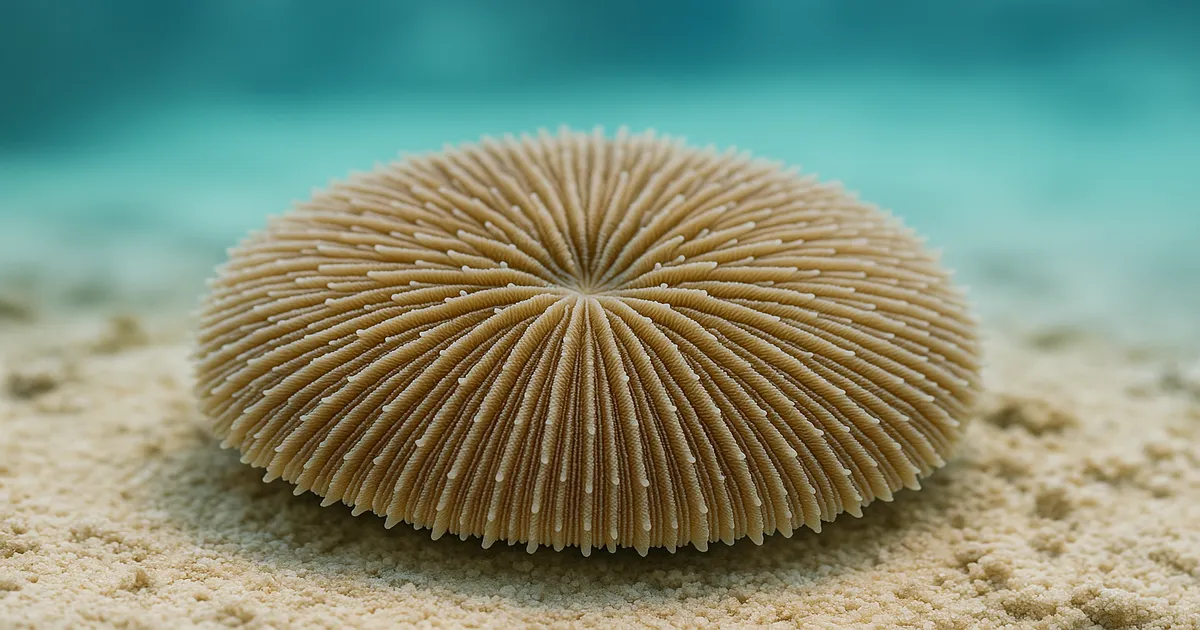
- Fungia (plate coral) — solitary, disc-shaped, and free-living; can right itself if flipped; place on sand
- Goniopora — long-stalked polyps that extend like a field of flowers; notoriously tricky to keep long-term
- Catalaphyllia (elegance coral) — sweeping tentacles with distinctive white or pink tips; requires sandy bottom placement
Soft Corals: Sarcophyton, Sinularia, Xenia, and More
Soft corals are typically the easiest corals to keep. They’re identifiable by their lack of a hard skeleton and their leathery or rubbery texture.
- Sarcophyton (toadstool leather) — mushroom-shaped cap with polyps on top; periodically sheds a waxy film and closes up — this is completely normal
- Sinularia — bushy, finger-like lobes; one of the most common leather corals in the hobby
- Xenia — pulsing, rhythmic polyps; grows fast and can overrun a tank if not managed
- Clavularia (clove polyps) — long, daisy-like polyps on a spreading mat; very hardy
One important note: soft corals release terpene-based chemicals that can inhibit nearby stony coral growth. Running activated carbon helps neutralize these compounds. (Two Little Fishies HydroCarbon 2)
Zoanthids and Palythoa: Colorful but Potentially Toxic
Zoanthids are colonial polyps — technically closer to anemones than true corals, but universally kept alongside corals in the hobby. They come in an almost infinite variety of color morphs, which is why they’re so heavily traded. Each polyp has a flat disc face surrounded by a ring of short tentacles.
⚠️ Safety Warning: Palythoa species contain palytoxin, one of the most potent natural toxins known to science. Never handle Palythoa with open cuts, never expose them to heat, and always wear gloves when fragging. Palytoxin can be absorbed through skin and mucous membranes.
- Zoanthus — smaller polyps, generally lower toxicity, extremely colorful
- Palythoa and Protopalythoa — larger polyps, often brownish-green with colored skirts; handle with caution
Mushroom Corals (Corallimorpharia): Discosoma, Rhodactis, Ricordea
Mushroom corals are flat, disc-shaped, and completely skeleton-free. They’re among the hardiest animals in the reef hobby and an excellent starting point for beginners. They spread by splitting and can become invasive in a well-fed tank.
- Discosoma — smooth or bumpy disc surface; comes in blue, red, green, and spotted patterns
- Rhodactis — fuzzy or hairy surface texture; can reach 4–6 inches across
- Ricordea — covered in bubble-like vesicles; R. florida from the Caribbean and R. yuma from the Pacific; among the most visually striking mushrooms
Water Parameters by Coral Type
Salinity, Temperature, and pH
Keep salinity at 1.025–1.026 specific gravity (34–36 ppt) to match natural seawater. Temperature should sit at 76–82°F (24–28°C) for most reef corals. SPS corals prefer the cooler end of that range — 76–79°F (24–26°C). Soft corals and LPS tolerate up to 82°F (28°C) more readily. Above 84°F (29°C), bleaching risk rises sharply. Target a pH of 8.1–8.3; anything below 7.9 impairs calcification.
Alkalinity, Calcium, and Magnesium
These three parameters work together to support skeletal growth. Think of them as a system, not three separate numbers.
- Alkalinity: 8–12 dKH for most systems; 9–11 dKH for SPS-dominant tanks. Swings greater than 1–2 dKH per day can trigger rapid tissue necrosis in SPS.
- Calcium: 380–450 ppm. Supplement via two-part dosing, kalkwasser, or a calcium reactor.
- Magnesium: 1,250–1,350 ppm. Low magnesium causes both calcium and alkalinity to crash simultaneously.
Nitrate and Phosphate Targets
| Coral Type | Nitrate | Phosphate |
|---|---|---|
| SPS | 1–5 ppm | 0.02–0.05 ppm |
| LPS | 5–20 ppm | up to 0.1 ppm |
| Soft corals & zoanthids | 10–25 ppm | up to 0.1 ppm |
Zero nitrate sounds ideal but it isn’t. Nutrient-starved corals bleach just as surely as overloaded ones. The goal is a low, stable nutrient level — not sterile water.
Stability beats precision every time. A tank holding steady at 9 dKH is far healthier than one swinging between 8 and 11 dKH while you chase a perfect number. Test consistently, change gradually, and resist the urge to over-correct. (Hanna Instruments HI755 Checker)
Tank Setup: Lighting, Flow, and Filtration
Minimum Tank Size
- Soft corals and mushrooms: 20 gallons minimum; 40+ gallons is more stable
- LPS-dominant reef: 40–75 gallons
- SPS or mixed reef: 75–180+ gallons — larger water volume buffers parameter swings
PAR Targets by Coral Type
PAR (Photosynthetically Active Radiation) measures usable light intensity:
- SPS: 200–400+ µmol/m²/s — high intensity, toward the top of the tank
- LPS: 50–150 µmol/m²/s — mid-tank placement works well
- Soft corals and zoanthids: 25–100 µmol/m²/s — lower placement, indirect light
LED fixtures are now the standard for reef tanks. They’re energy-efficient, fully customizable in spectrum, and programmable for gradual ramp-up/ramp-down cycles that mimic natural sunrise and sunset. (Kessil A360X Tuna Blue)
Water Flow by Coral Type
- SPS: 20–50× tank volume per hour; high, random, turbulent flow
- LPS: 10–20× turnover; indirect, moderate flow — direct strong flow damages fleshy polyps
- Soft corals: 10–20× turnover; gentle, wave-like motion is ideal
Wavemakers set to pulse or random modes prevent dead spots and more closely mimic natural reef surge. (Maxspect Gyre XF350)
Filtration Essentials
A complete reef filtration setup typically includes:
- Protein skimmer — removes dissolved organics before they break down into nitrate and phosphate (Reef Octopus Classic 110-INT)
- Refugium with macroalgae (Chaetomorpha or Caulerpa) — exports nutrients naturally and stabilizes pH
- Mechanical filtration — filter socks or roller filters; clean every 1–3 days to prevent nutrient buildup
- Activated carbon — removes yellowing compounds and soft coral terpenes
- GFO (granular ferric oxide) — controls phosphate in SPS systems
Some LPS corals — Trachyphyllia, Fungia, and elegance corals — must be placed on sand, not rock, to avoid skeletal damage. Aragonite sand buffers pH naturally and is the standard substrate choice.
Coral Compatibility: Aggression and Spacing
How Corals Fight
Corals compete aggressively for space using three main weapons:
- Sweeper tentacles — extended at night to sting neighbors; Euphyllia sweepers can reach 6+ inches (15 cm)
- Mesenterial filaments — extruded digestive tissue that dissolves neighboring coral on contact; common in brain corals and Lobophyllia
- Allelopathy — chemical warfare; soft corals release terpenes that inhibit stony coral growth throughout the water column
Keep at least 6 inches (15 cm) of clear space between Euphyllia species and any neighbors. Where possible, zone your reef — soft corals on one side, stony corals on the other — and run activated carbon continuously when mixing both. Zoanthids look small and harmless, but their mesenterial filaments can kill adjacent LPS corals.
Reef-Safe Fish and Invertebrates
Good choices:
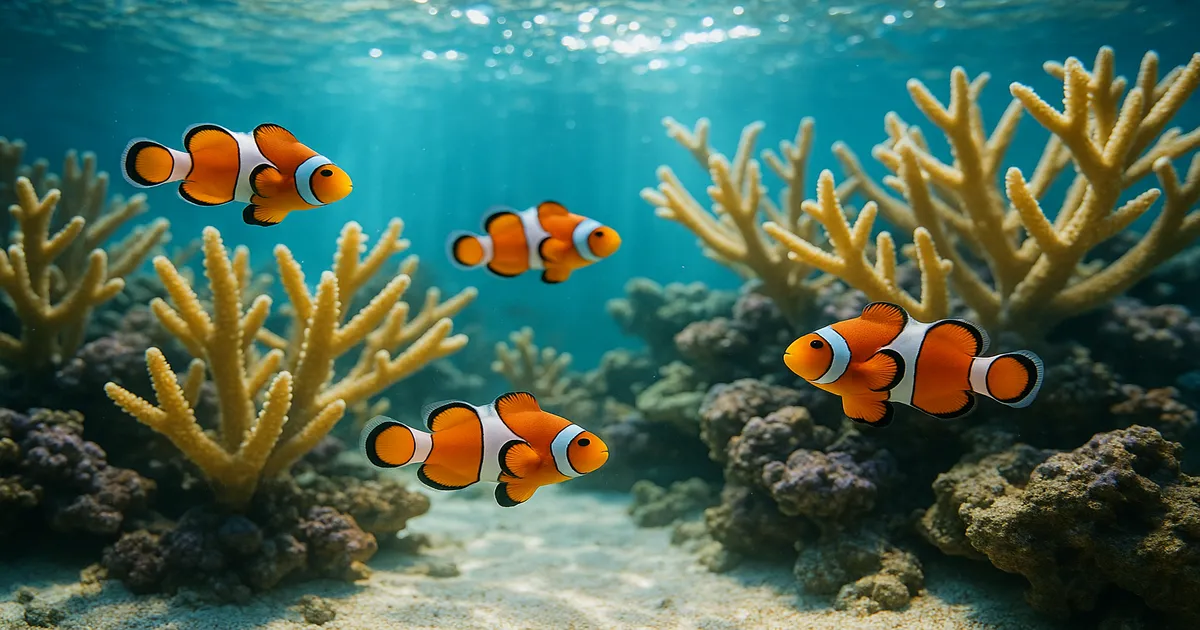
- Clownfish, royal gramma, firefish — peaceful and unobtrusive
- Tangs (Zebrasoma, Paracanthurus spp.) — reef-safe and excellent for algae control
- Wrasses (many species) — reef-safe; actively hunt flatworms and pyramidellid snails
- Cleaner shrimp (Lysmata spp.) — safe and beneficial
Avoid:
- Butterflyfish — obligate coral feeders
- Large angelfish (Pomacanthus, Holacanthus) — notorious coral nippers
- Pufferfish and triggerfish — destructive to coral skeletons and invertebrates
Feeding Corals: What, How Much, and How Often
Most reef corals are mixotrophic — they get 70–90% of their energy from zooxanthellae photosynthesis, but they also actively capture particulate food. Direct feeding accelerates growth, improves color, and supports corals during periods of lower light.
| Coral Type | Best Foods | Frequency |
|---|---|---|
| LPS | Frozen mysis shrimp, enriched brine, coral powders | 1–3× per week |
| SPS | Coral-specific powders, live copepods, amino acid supplements | 2–3× per week |
| Soft corals | Phytoplankton, dissolved organics | 1–2× per week |
| Zoanthids/mushrooms | Coral powders, small meaty foods | 1–2× per week |
| Filter feeders (Goniopora, gorgonians) | Phytoplankton, marine snow | Daily if possible |
Turn off flow for 10–15 minutes when feeding LPS so polyps can capture food before it blows away. Target feeding with a pipette or turkey baster lets you deliver food directly to individual polyps without overloading the water column. (Polyp Lab Reef-Roids)
FAQ: Identifying and Caring for Reef Corals
Q: What is the name of this coral — how do I identify an unknown frag? Start with the group: does it have a hard skeleton or not? If yes, are the polyps tiny (SPS) or large and fleshy (LPS)? If no skeleton, is it disc-shaped (mushroom coral), colonial with flat polyp faces (zoanthid), or leathery and branching (soft coral)? Once you’ve narrowed down the group, search by growth form and color within that group. Apps like iNaturalist and reef forums like Reef2Reef are reliable for species-level ID.
Q: Can I keep SPS and soft corals in the same tank? Yes, but it requires planning. Soft corals release terpenes that can stress or inhibit stony corals. Run activated carbon continuously, maintain good flow to dilute chemical output, and keep physical separation between the two groups. Many successful mixed reefs exist — it just takes more active management.
Q: Why is my coral not opening? The most common causes are: poor water quality (check alkalinity, nitrate, and phosphate), inadequate or excessive flow, incorrect lighting intensity, chemical aggression from a nearby coral, or stress from a recent move. Give a newly placed coral 5–7 days to acclimate before drawing conclusions.
Q: Are zoanthids safe to handle? Zoanthus species carry low toxicity and are generally safe with basic precautions. Palythoa and Protopalythoa are a different matter — they contain palytoxin, which is genuinely dangerous. Always wear nitrile gloves when fragging any zoanthid, avoid touching your face, and never heat or boil rock that has Palythoa on it.
Q: What is the easiest coral for a beginner? Mushroom corals (Discosoma, Rhodactis) and soft corals like toadstool leathers (Sarcophyton) are the most forgiving. They tolerate imperfect water, lower light, and beginner mistakes better than any other group. Zoanthids are a close second. Start with these before attempting LPS, and leave SPS until your tank parameters are rock-solid and stable for several months.