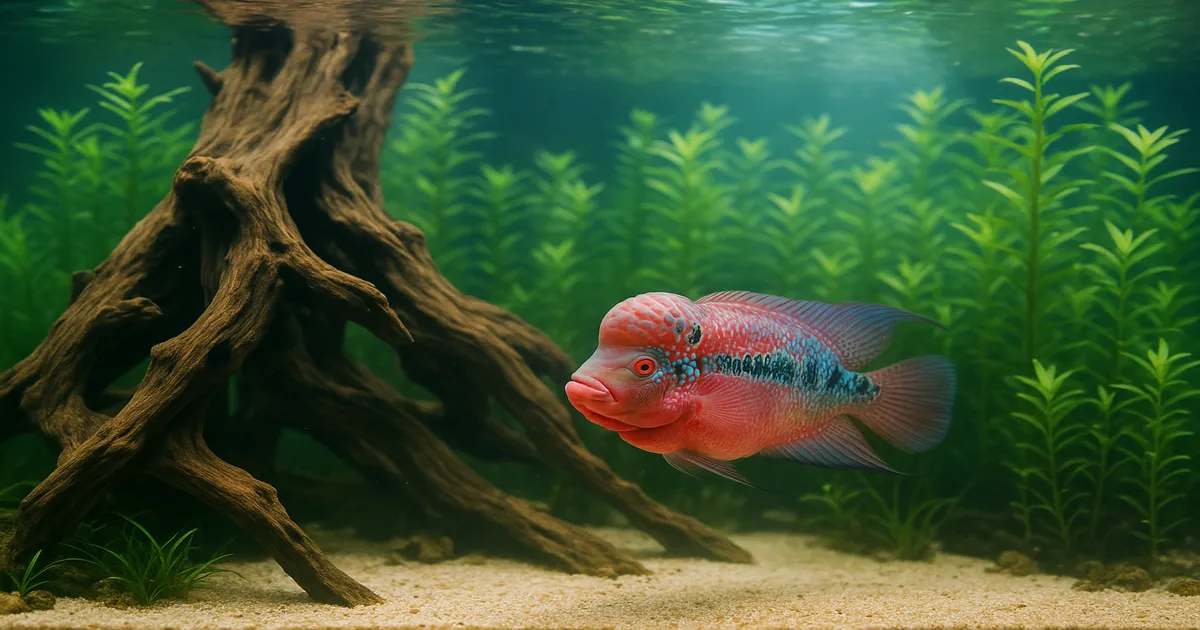
Quick Answer: Flowerhorn cichlids need a minimum 75-gallon tank (125 gallons preferred), warm water at 78–86°F (25–30°C), a pH of 7.0–8.0, and powerful filtration to handle their heavy bioload. They’re best kept alone, fed a high-protein cichlid pellet diet, and can live 10–12 years with proper care. This is an advanced fish — rewarding, but not forgiving of beginner mistakes.
Learning how to take care of a flowerhorn cichlid is one of the more demanding commitments in the freshwater hobby — and one of the most rewarding. These bold, interactive fish recognize their owners, respond to hand feeding, and develop striking personalities that make solo keeping genuinely entertaining. But they also produce enormous waste, destroy tank mates, and punish poor water quality fast. Get the fundamentals right, and a flowerhorn will thrive for over a decade.
What Is a Flowerhorn Cichlid?
Origins and Hybrid Genetics
Flowerhorns aren’t found in any river or lake. They were created by breeders in Malaysia during the 1990s and early 2000s through selective crossing of several Central and South American cichlid species. The primary contributors include Amphilophus citrinellus (Midas cichlid), Amphilophus labiatus (Red Devil cichlid), Cichlasoma trimaculatum, and Vieja synspilum. Because they’re man-made hybrids, flowerhorns carry no formal scientific name and aren’t recognized as a species in scientific literature. Most are infertile, though certain Zhen Zhu lines can reproduce.
The Nuchal Hump (Kok)
The forehead protrusion that makes flowerhorns instantly recognizable is called the kok or nuchal hump. It’s composed of fatty tissue and fluid — not bone — and its size fluctuates throughout the fish’s life based on genetics, diet, water quality, and age. In the hobby and in Feng Shui culture, a large, rounded kok is the most prized aesthetic trait a flowerhorn can have.
Popular Flowerhorn Strains
| Strain | Key Characteristics |
|---|---|
| Zhen Zhu | Pearl-like scales, rounder body, most common; some lines fertile |
| Kamfa | Square body, sunken white eyes, large kok, fan-shaped tail |
| Golden Monkey | Rare and highly prized; gold coloration with bold black markings |
| Thai Silk | Metallic blue/gold/white; no visible black markings |
| Faders | Fade to black as juveniles before developing vibrant adult color |
| King Kamfa | Kamfa sub-strain with highly developed kok; white or yellow eyes |
| Red Dragon | Intense red/orange body; derived from Zhen Zhu lines |
Cultural Significance
In Southeast Asia, flowerhorns are deeply tied to Feng Shui beliefs. The flower-like markings along the lateral line are said to resemble lucky Chinese characters, and the fish is believed to bring prosperity to its owner. Prices reflect this status — from a few dollars for common juveniles to thousands for prize-quality specimens.
Flowerhorn Water Parameters and Tank Setup
Temperature, pH, and Hardness
Flowerhorns thrive at 78–86°F (25–30°C). Temperatures below 75°F suppress immune function and leave the fish vulnerable to disease. Stability matters just as much as the number — a swing of more than 2–3°F can trigger stress and ich outbreaks, so always verify your heater’s accuracy with a separate thermometer.
Aim for neutral to slightly alkaline water: pH 7.0–8.0, moderately hard water (GH 9–20 dGH), and a carbonate hardness of KH 9–18 dKH. KH is especially critical because it acts as a pH buffer. A flowerhorn’s heavy bioload depletes KH quickly, which can lead to dangerous pH crashes. Crushed coral, aragonite substrate, or a commercial buffer can help stabilize it. Test weekly with a liquid test kit — strips aren’t accurate enough for a fish this sensitive.
Ammonia, Nitrite, and Nitrate
- Ammonia: 0 ppm at all times
- Nitrite: 0 ppm at all times
- Nitrate: below 20 ppm ideally; above 80 ppm is dangerous
Even brief ammonia exposure can cause permanent gill damage and trigger Head and Lateral Line Erosion (HLLE). Weekly 25–40% water changes are your primary nitrate management tool.
Tank Size and Layout
A single adult flowerhorn needs at least 75 gallons, but 125 gallons is strongly preferred. Adults routinely reach 12–16 inches (30–40 cm), and cramped quarters amplify aggression, stress, and water quality problems. Choose a long, wide tank over a tall one — flowerhorns are mid-to-bottom dwellers that need horizontal swimming space.
For substrate, bare bottom is the top choice for serious keepers: easy to clean, waste stays visible, and there’s no buildup. Fine sand works too and allows natural digging behavior — just vacuum it weekly. Avoid sharp gravel or small pebbles that could injure the fish’s belly or be accidentally swallowed.
Keep the layout simple. A large PVC pipe or ceramic cave gives the fish a sense of security. Smooth rocks work well as decoration and potential spawning surfaces. Skip live plants — flowerhorns will uproot them immediately. If you want greenery, attach Anubias to rocks or driftwood; it’s tough enough to survive.
Filtration: The Most Critical Equipment Decision
Filtration is where you cannot cut corners. Your filter system should turn over the tank volume 8–10 times per hour at minimum. Canister filters are an excellent choice for large tanks, offering strong mechanical and biological filtration. (Fluval FX6) Sump or wet-dry systems are the preferred option for serious keepers because they handle heavy bioloads even more effectively.
Many experienced flowerhorn keepers run two independent filters. If one fails, the biological colony in the second prevents an ammonia crash — and with a fish this large, that redundancy can be the difference between a minor inconvenience and a dead fish.
Heating and Other Equipment
For tanks over 75 gallons, use two heaters — each rated for the full tank volume — to ensure even heat distribution and a backup if one fails. Titanium heaters are worth the investment since large cichlids can crack glass heaters.
Lighting doesn’t need to be elaborate: 8–12 hours daily on a timer, with full-spectrum or color-enhancing bulbs (6,500–10,000K) to bring out the fish’s coloration. UV sterilizers are optional but genuinely useful for reducing free-floating bacteria and parasites in a high-bioload system.
Cycling Before You Add Your Fish
Never add a flowerhorn to an uncycled tank. Complete a fishless nitrogen cycle — typically 4–6 weeks — using pure ammonia before the fish goes in. Confirm that ammonia and nitrite both read 0 ppm and that nitrate is rising before you consider the tank ready.
Flowerhorn Compatibility: Why Solo Housing Wins
Flowerhorns are among the most aggressive freshwater fish in the hobby. They’re intensely territorial and will attack, injure, or kill most tank mates. A flowerhorn kept alone is healthier, less stressed, shows better coloration, and typically develops a larger kok than one constantly defending territory. For the vast majority of keepers, solo housing is the right call.
If you have a 125+ gallon tank and want to try companions, these species have the best odds — but nothing is guaranteed:
| Tank Mate | Notes |
|---|---|
| Large Plecos (Pterygoplichthys spp.) | Armored and often tolerated; good algae control |
| Oscar Fish | Possible in very large tanks; monitor closely |
| Jack Dempsey Cichlid | Similar aggression level; large tank essential |
| Large Bichirs | Bottom-dwelling; often ignored by flowerhorns |
Rearrange all decorations when introducing any new fish to disrupt the flowerhorn’s established territory. Never house flowerhorns with small fish, peaceful cichlids, other flowerhorns (males will fight to the death), goldfish, or invertebrates — all are either eaten or injured.
How to Take Care of a Flowerhorn’s Diet
Pellets: The Foundation
Pellets should make up 60–70% of your flowerhorn’s diet. Look for high-protein formulas (40–50%+ protein) with natural color enhancers like astaxanthin, spirulina, or krill meal — and avoid anything with artificial dyes. Reliable options include Hikari Cichlid Gold and New Life Spectrum Cichlid Formula. Match pellet size to the fish — juveniles need small pellets; adults can handle large pellets or sticks.
Kok-enhancing pellets like Humpy Head or Okiko Platinum are popular, but use them sparingly. Their higher fat content can cause obesity if they become a staple.
Protein Supplements and Live Foods
Frozen and fresh proteins should make up 20–30% of the diet. Good options include frozen bloodworms (best as a treat), frozen krill (excellent for color enhancement), frozen mysis shrimp, earthworms, and frozen silversides for larger fish. A small amount of plant matter — blanched spinach, zucchini, or shelled peas — rounds out the diet and supports digestive health.
Live foods like earthworms and crickets stimulate natural hunting behavior. Avoid feeder goldfish entirely — they carry a high disease risk and their fat content can cause fatty liver disease over time.
Feeding Schedule
Feed adult flowerhorns once or twice daily. Juveniles can be fed 2–3 times daily. Offer only what the fish can consume in 2–3 minutes, then remove any uneaten food immediately. Leftover food decays fast and spikes ammonia — a serious problem given this fish’s bioload.
Common Flowerhorn Health Issues
Head and Lateral Line Erosion (HLLE)
HLLE appears as pitting or cratering along the head and lateral line. It’s caused by poor water quality, chronic nitrate exposure, and nutritional deficiency. The fix is almost always the same: increase water change frequency, reduce nitrates, and improve diet quality.
Ich (White Spot Disease)
Ich shows up as tiny white dots on the fins and body, typically triggered by temperature drops or stress. Treat it by gradually raising the temperature to 86°F (30°C). If the heat method alone isn’t enough, add an ich medication. (Ich-X) Catch it early — it spreads fast.
Hole-in-the-Head Disease
This condition causes pitting around the head and is linked to poor water quality and the Hexamita parasite. It looks similar to HLLE but tends to be deeper and more localized. Improving water conditions is the first step; metronidazole-based medications are used in more advanced cases.
Bloat and Fin Rot
Bloat usually results from overfeeding or a diet too heavy in fatty foods. Fast the fish for 2–3 days and reassess what you’ve been feeding. Shelled peas can help move things along. Fin rot starts as ragged, fraying edges and progresses if water quality isn’t addressed. Mild cases often resolve with clean water alone; severe infections may require antibiotic treatment. (Seachem KanaPlex)
Prevention
Most flowerhorn diseases are preventable. Consistent water changes, robust filtration, a varied diet, and stable parameters eliminate the majority of health risks. Quarantine any new fish or equipment for 4–6 weeks before it goes near your flowerhorn’s tank. Keep a basic medication kit on hand — ich treatment, metronidazole, and an antibiotic — so you’re not scrambling when something goes wrong.
Routine Maintenance Schedule
Weekly:
- 25–40% water change
- Test ammonia, nitrite, nitrate, and KH
- Remove uneaten food and spot-clean substrate
- Wipe algae from glass
Monthly:
- Rinse filter media in used tank water (never tap water — it kills beneficial bacteria)
- Inspect heaters, thermometers, and all equipment
- Deep-clean substrate as needed
Signs of a Healthy vs. Stressed Flowerhorn
Healthy fish: vibrant coloration, active swimming, strong appetite, erect fins.
Stressed or sick fish: fading or darkening color, hiding, clamped fins, reduced appetite, labored breathing.
If you notice stress signs, check water parameters first — that’s the cause the vast majority of the time.
Frequently Asked Questions About How to Take Care of a Flowerhorn
What is the minimum tank size for a flowerhorn cichlid?
The minimum is 75 gallons for a single adult, but 125 gallons is strongly preferred. Adults commonly reach 12–16 inches and are highly territorial, so cramped conditions quickly lead to stress and water quality problems. Choose a long, wide tank over a tall one.
How do I make my flowerhorn’s kok grow bigger?
Genetics are the primary driver — if the fish doesn’t have the genetic potential, no supplement will produce a dramatic hump. That said, a high-quality varied diet (including krill and quality pellets), warm stable water, and a low-stress environment all support natural kok development. Kok-enhancing pellets can help marginally but shouldn’t become a staple due to obesity risk.
Can flowerhorn cichlids live with other fish?
Flowerhorns are highly aggressive and are best kept alone. Solo housing produces the healthiest, most colorful fish with the best kok development. In a 125+ gallon tank, large armored fish like plecos or similarly sized aggressive cichlids like oscars are sometimes tolerated — but always have a backup plan.
How often should I feed my flowerhorn?
Feed adults once or twice daily. Juveniles can be fed 2–3 times daily. Only offer what the fish can eat in 2–3 minutes, and remove any leftovers immediately to protect water quality.
How long do flowerhorn cichlids live?
With proper care — stable water parameters, a quality diet, and a large enough tank — flowerhorns commonly live 10–12 years. Some well-kept specimens reach 12–15 years. Poor water quality and overfeeding are the two biggest factors that shorten their lifespan.