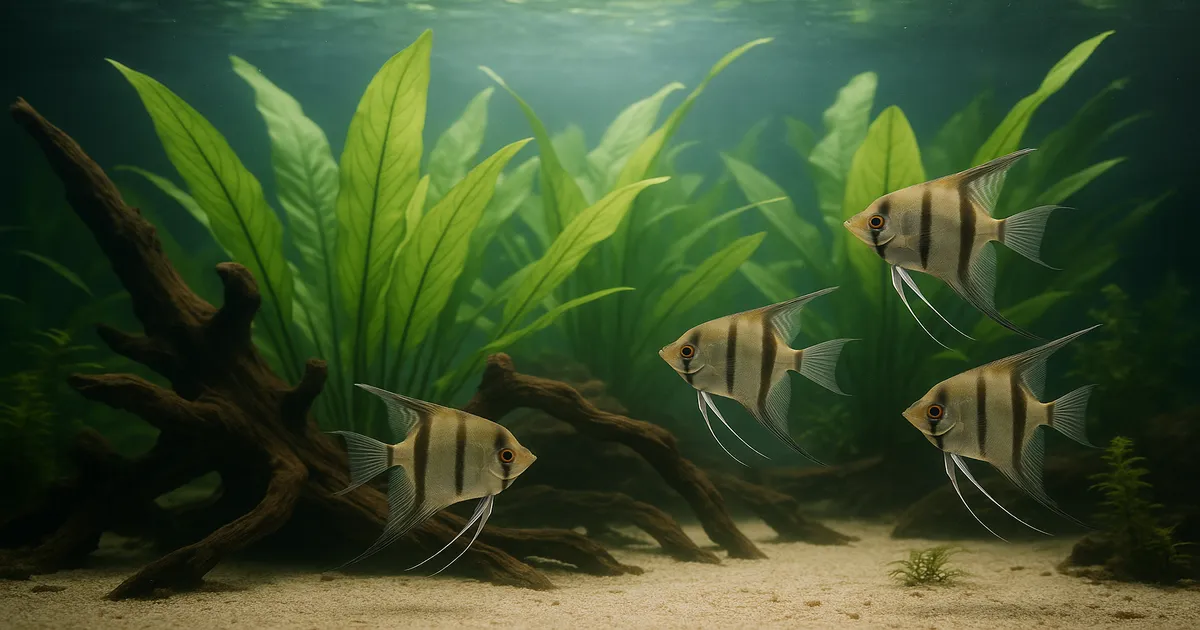
Quick Answer: Freshwater angelfish (Pterophyllum scalare) are stunning, long-lived cichlids that thrive in warm, slightly acidic water (pH 6.5–7.0) at 76–82°F (24–28°C). This angelfish care guide covers tank mates, feeding, water parameters, and health — get those fundamentals right and you can expect a healthy, vibrant fish for 10–15 years.
Angelfish Care at a Glance
Key Stats: Size, Lifespan, and Temperament
Pterophyllum scalare is the species you’ll find in virtually every fish store, and for good reason — it’s adaptable, visually striking, and genuinely rewarding to keep. Adults reach about 6 inches (15 cm) in body length but can stand up to 10 inches (25 cm) tall once you account for their dramatic fin extensions. That height matters more than most beginners realize.
Lifespan is one of the best arguments for doing this properly. A well-cared-for angelfish routinely lives 10–15 years, so this isn’t a casual commitment.
Temperament is best described as semi-aggressive. They’re generally peaceful with appropriately sized tank mates but will turn territorial during spawning, and they won’t hesitate to swallow anything small enough to fit in their mouth.
Essential Care Requirements
| Parameter | Ideal Range | Acceptable Range |
|---|---|---|
| pH | 6.5–7.0 | 6.0–7.8 |
| Temperature | 76–82°F (24–28°C) | 74–86°F (23–30°C) |
| GH | 3–8 dGH | 1–10 dGH |
| KH | 3–8 dKH | 1–10 dKH |
| Ammonia | 0 ppm | 0 ppm |
| Nitrite | 0 ppm | 0 ppm |
| Nitrate | <20 ppm | <40 ppm |
| Min. Tank Size | 55 gal (group) | 29 gal (single/pair) |
Species Overview
Taxonomy and the Genus Pterophyllum
The genus Pterophyllum contains three species, but only one dominates the hobby: P. scalare. The other two — P. altum (the Altum Angelfish) and P. leopoldi (the Roman-nosed Angelfish) — are occasionally available but significantly more demanding. P. altum requires ultra-soft, highly acidic blackwater conditions that are difficult to replicate, making it a fish for experienced specialists rather than community tanks.
Most angelfish sold today are captive-bred P. scalare or selectively bred color variants. That’s actually good news — captive-bred fish are far more adaptable to typical tap water than their wild-caught counterparts.
Natural Habitat: The Amazon Basin
In the wild, angelfish inhabit the slow-moving, heavily vegetated waterways of the Amazon, Essequibo, and Orinoco river systems — flooded forests, blackwater lagoons, and tributary streams choked with plants, submerged roots, and leaf litter. The water is warm, dimly lit by a forest canopy, and naturally soft and acidic from decomposing organic matter.
Their laterally compressed, disc-shaped body is a direct adaptation to this environment, allowing them to slip through dense vegetation and root tangles with ease.
Popular Color Morphs
Decades of selective breeding have produced a wide range of captive variants:
- Silver/Wild-type — silver body with bold black vertical stripes
- Marble — irregular black, silver, and gold patterning
- Koi — orange, black, and white; resembles koi carp
- Gold/Blushing — reduced melanin, warm golden-yellow body
- Black — heavily melanistic; striking in planted tanks
- Zebra — extra vertical stripes beyond the wild-type
- Veil/Superveil — dramatically elongated fins (beautiful but prone to damage)
- Platinum — near-white with a reflective sheen
- Ghost — pale silver with faint, soft striping
- Albino — no melanin, characteristic red eyes
- Pearlscale — bumpy scale texture with iridescence
Water Parameters and Maintenance
pH, Hardness, and Temperature
Captive-bred angelfish are flexible, but they still do best in slightly acidic to neutral water — pH 6.5–7.0 is the sweet spot. The critical rule isn’t hitting an exact number; it’s keeping that number stable. A fish living comfortably at pH 7.2 is far better off than one experiencing daily swings between 6.8 and 7.5.
Temperature should stay in the 76–82°F (24–28°C) range. Drop below 74°F (23°C) and you’re suppressing their immune system — ich outbreaks often follow. Push above 86°F (30°C) and dissolved oxygen drops while stress climbs. A reliable heater with a quality thermostat is non-negotiable.
Ammonia, Nitrite, and Nitrate
Ammonia and nitrite must be zero. Even brief spikes can cause gill damage with lasting consequences. Nitrate is more forgiving but still matters — keep it under 20 ppm ideally, and never let it climb above 40 ppm for extended periods. Chronic high nitrates dull coloration and contribute to HLLE (Head and Lateral Line Erosion).
Test your water weekly with a reliable liquid test kit. Strips are convenient but notoriously inaccurate; liquid reagent kits are worth the small extra effort.
Water Conditioning and Water Changes
Use a quality dechlorinator at every water change. Seachem Prime is a reliable choice that also temporarily detoxifies ammonia and nitrite — useful during cycling or emergencies.
If your tap water is very hard (above 10 dGH), consider blending with RO water remineralized with a product like Seachem Equilibrium to reach your target GH and KH. For a more natural blackwater setup, Indian almond leaves or peat filtration will gently lower pH, add tannins, and provide mild antibacterial benefits.
Weekly 25–30% water changes are the single most effective maintenance habit you can build. Biweekly is the absolute minimum.
Tank Setup: Size, Substrate, and Aquascaping
Tank Size and Why Height Matters
For a single angelfish or a bonded pair, 29 gallons is the practical minimum. For a group of four to six, start at 55 gallons — 75 to 90 gallons gives everyone room to establish territory and reduces aggression considerably.
The dimension most people overlook is height. A tank needs to be at least 18 inches tall; 24 inches is genuinely better. Standard 29-gallon tanks often fall short here. Look for “tall” or “show” style aquariums rather than standard-proportion tanks.
Substrate, Plants, and Décor
Fine-grain sand mirrors the silty riverbeds of the Amazon and is gentle on Corydoras and other bottom dwellers. Dark substrates — black or dark brown sand — enhance color contrast and reduce stress from bright, reflective backgrounds.
A planted tank isn’t just attractive; it genuinely reduces stress and encourages natural behavior. Good plant choices include:
- Amazon Sword (Echinodorus bleheri) — broad leaves, appropriate scale
- Vallisneria — tall, grass-like background plant
- Anubias — hardy, shade-tolerant, attaches to hardscape
- Java Fern — very forgiving, great on driftwood
- Cryptocoryne — excellent mid-ground filler
Driftwood (Malaysian, spider wood, or mopani) releases tannins that soften water chemistry and provides natural egg-laying surfaces. Floating plants like Amazon frogbit or water lettuce diffuse lighting and create the dappled, shaded conditions angelfish prefer.
Filtration, Flow, and Heating
Canister filters are the gold standard for angelfish tanks. They deliver excellent biological filtration, keep turnover in the 5–8× per hour range, and their output can be diffused easily with a spray bar or lily pipe. (Fluval 307) Angelfish are not built for strong currents — their tall, flat bodies make swimming against heavy flow exhausting and stressful.
For heating, use a single quality submersible heater in smaller tanks. In anything 55 gallons and above, run two heaters each rated for the full tank volume. If one fails in cold weather, the second buys you time. Titanium heaters are worth the investment — they won’t shatter if a fish knocks them around.
Angelfish Tank Mates: Who Works and Who Doesn’t
Understanding Angelfish Temperament
Angelfish are cichlids, which means they come with cichlid instincts — territorial, hierarchical, and capable of real aggression when provoked. Day-to-day, most are reasonably peaceful with similarly sized, non-threatening companions. Spawning season is a different story; a breeding pair will aggressively defend their territory against anyone who gets too close.
Group dynamics matter too. Keep four to six angelfish together and aggression distributes naturally across the group. Keep two or three and you often end up with one fish being bullied relentlessly. A single specimen or a proven bonded pair are both more stable arrangements than an awkward trio.
Best Tank Mates for Angelfish
These species share the same water parameter preferences and coexist reliably:
- Corydoras sterbai — the top Corydoras pick specifically because it thrives at the warmer temperatures angelfish prefer
- Bristlenose Plecos (Ancistrus spp.) — peaceful, stays 4–5 inches, excellent algae control
- Rummy Nose Tetras — tight schooling behavior discourages harassment; keep 10+
- Cardinal Tetras — a classic Amazon biotope pairing; keep schools of 10–15 (avoid very small juveniles)
- Lemon Tetras — peaceful, appropriately sized
- Keyhole Cichlids — one of the most underrated angelfish companions; genuinely non-aggressive
- Bolivian Rams — peaceful dwarf cichlid, slightly more temperature-flexible than German Blue Rams
- German Blue Rams — share identical water preferences; a stunning combination
- Pearl Gouramis — peaceful, similarly sized, beautiful contrast fish
- Otocinclus — excellent algae eaters; keep in groups of 6+
- Rainbowfish — active, similarly sized, generally compatible
Fish to Use Caution With
Black Skirt Tetras can work but have a reputation for fin nipping — watch them closely, especially in smaller groups. Dwarf Gouramis are usually fine, but individual personalities vary and aggression can develop. Neither is a guaranteed problem, but neither is a guaranteed success either.
Species to Avoid
- Serpae Tetras, Tiger Barbs, Buenos Aires Tetras — notorious fin nippers that will shred an angelfish’s long fins
- Oscars and other large aggressive cichlids — they’ll bully or injure angels
- Nano fish under 1 inch (Ember Tetras, Chili Rasboras) — adult angelfish will eat them, especially at feeding time
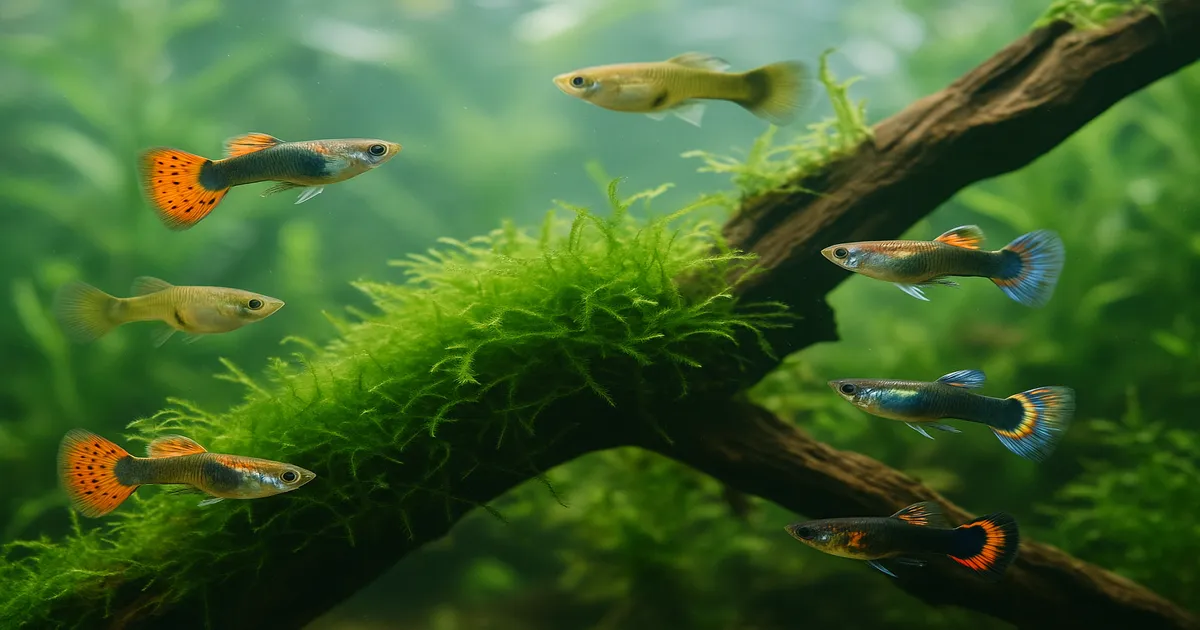
- Guppies and fancy livebearers — long fins attract nipping, and small individuals simply get eaten
- Bettas — territorial conflict is almost inevitable
- Goldfish — entirely incompatible temperature and chemistry requirements
Feeding Angelfish: Diet, Schedule, and Best Foods
What Angelfish Eat
In the Amazon, angelfish are visual ambush predators with a strong carnivorous bias. Their natural diet runs toward small invertebrates, insect larvae, zooplankton, aquatic worms, and the occasional small fish. Plant matter plays a minor supporting role. Protein is the priority in captivity, and variety matters.
Staple Foods
High-quality micro pellets or small floating pellets should form the core of their diet. Look for products where fish or shrimp meal appears as the first ingredient — not wheat or corn. Northfin Cichlid Formula, New Life Spectrum Cichlid, and Hikari Micro Pellets are all solid choices. Flake food is acceptable as a rotation option, but pellets win on nutritional density and water quality — flakes dissolve quickly and cloud the water if overfed.
Frozen and Live Foods
Frozen foods are where you really elevate health and coloration:
- Mysis shrimp — nutritionally superior to most other frozen options; an excellent regular supplement
- Brine shrimp — good protein source; opt for enriched varieties when available
- Bloodworms — highly palatable and great for encouraging reluctant feeders, but treat as an occasional treat rather than a staple
- Daphnia — useful for digestive health; acts as a gentle natural laxative, great after a fasting day
- Blackworms — highly nutritious and eagerly accepted
Rotate through these options rather than relying on any single food. Variety ensures a complete nutritional profile.
Feeding Schedule
Feed small amounts two to three times daily — only what your fish can consume in two to three minutes. Angelfish are visual hunters that naturally feed at the surface and mid-water column, so surface-floating or slowly sinking foods suit them well.
One habit worth building: fast your angelfish one day per week. It sounds counterintuitive, but it improves digestive health, reduces waste accumulation, and mirrors the natural feast-or-famine rhythm of wild feeding. Most experienced keepers swear by it.
Common Health Issues and Preventive Care
Signs of a Healthy vs. Stressed Fish
A healthy angelfish holds its fins erect, swims actively, shows vibrant coloration, and approaches feeding time with enthusiasm. Clamped fins, hiding, color loss, or refusal to eat are early warning signs — and the cause is water quality more often than not.
Most Common Diseases
Ich (White Spot Disease) is the most common issue, typically triggered by a temperature drop below 74°F or the introduction of infected fish. It presents as small white spots resembling grains of salt across the body and fins.
HLLE (Head and Lateral Line Erosion) appears as pitting or erosion around the head and along the lateral line. It’s strongly linked to chronic high nitrates and nutritional deficiencies.
Fin Rot is a bacterial infection causing fraying and discoloration of the fins. It’s almost always secondary to physical damage (fin nipping) or poor water quality — fix the root cause first.
Internal Parasites are particularly common in wild-caught fish and can cause wasting, bloating, or white stringy feces. A prophylactic treatment with Seachem Metroplex is often recommended when acquiring wild-caught specimens.
Hole-in-the-Head Disease presents as small pits or lesions on the head, similar to advanced HLLE. It’s associated with poor water quality, nutritional deficiency, and sometimes the protozoan Hexamita.
Prevention and Quarantine
Prevention is the whole game. Stable water parameters, zero ammonia and nitrite, nitrates below 20 ppm, and a varied diet will prevent the vast majority of health problems you’d otherwise encounter.
The other non-negotiable: quarantine every new fish for four to six weeks before introducing it to your display tank. A simple 10–20 gallon tank with a sponge filter and heater is all you need. It takes discipline, but one infected fish introduced to an established tank can wipe out a collection you’ve spent years building.
Frequently Asked Questions About Angelfish Care
How many angelfish can I keep in a 55-gallon tank?
A 55-gallon tank comfortably houses four to six angelfish, provided the tank is at least 18–24 inches tall. Keeping six rather than two or three actually helps distribute aggression more evenly. Add tank mates thoughtfully — total bioload matters as much as angelfish count.
What are the best tank mates for angelfish in a community tank?
The best tank mates are similarly sized, non-fin-nipping fish that share the same warm, slightly acidic water preferences. Top choices include Corydoras sterbai, Rummy Nose Tetras, Cardinal Tetras, Bristlenose Plecos, Keyhole Cichlids, Bolivian Rams, Pearl Gouramis, and Otocinclus. Avoid tiger barbs, serpae tetras, and any fish small enough to be eaten.
What do angelfish eat, and how often should I feed them?
Angelfish are primarily carnivorous. Feed a high-quality cichlid pellet as the staple, supplemented with frozen mysis shrimp, brine shrimp, bloodworms, and daphnia. Feed small amounts two to three times daily and fast them one day per week for best digestive health.
Can angelfish live with other cichlids?
Some dwarf cichlids — Bolivian Rams, German Blue Rams, and Keyhole Cichlids — make excellent companions. Avoid larger, aggressive cichlids like Oscars, Convicts, or Jack Dempseys, which will bully or injure angelfish. The key is matching temperament and size, not just species family.
Why are my angelfish fighting?
The most common causes are an unstable group size (two or three fish often leads to one being bullied), spawning behavior, or insufficient territory. Try keeping four to six fish rather than two or three, ensure the tank is large enough (55+ gallons), and add visual breaks — tall plants, driftwood — so fish can establish their own space.