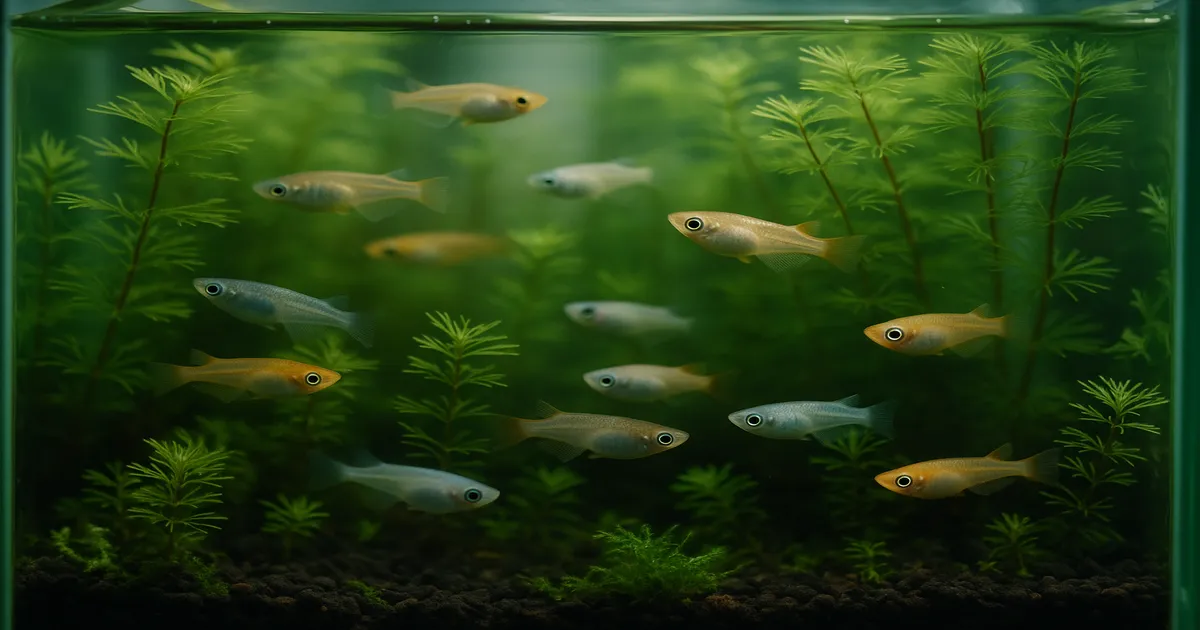
Quick Answer: Can you spot the O. dancena fry in this shoal of O. minutillus? The three fastest visual clues are a faint mid-lateral stripe on O. dancena fry, a slightly rounder caudal peduncle on O. minutillus, and a proportionally larger eye-to-body ratio in O. dancena fry. Newly hatched O. dancena measure just 4–5 mm — almost identical to adult O. minutillus — which is exactly why the challenge is real. Confident identification usually requires magnification and hands-on familiarity with both species.
Can You Spot the O. dancena Fry in This Shoal of O. minutillus?
If you’re hesitating, you’re in good company. These two ricefishes are so similar at the fry stage that even experienced hobbyists do a double-take. This guide covers visual ID markers, species profiles, water parameters, tank setup, feeding, and health care — everything you need to keep both species successfully, whether together or apart.
Why Spotting O. dancena Fry Among O. minutillus Is So Hard
Oryzias minutillus is one of the smallest vertebrates on Earth, maxing out at just 0.6–1.3 cm as an adult. O. dancena grows considerably larger at 2.5–4.0 cm — but that size advantage only appears later. At 4–5 mm, a freshly hatched O. dancena fry is essentially the same length as a full-grown O. minutillus. Add translucent bodies, near-identical fin placement, and the same surface-skimming behaviour, and you have a genuinely tricky puzzle.
The Three Fastest Visual Clues
- Mid-lateral stripe — O. dancena fry show a faint but detectable stripe along the flank, even at 4–5 mm. O. minutillus lacks this at the same stage.
- Caudal peduncle shape — O. minutillus tends to have a marginally rounder, deeper caudal peduncle. Subtle, but visible under magnification.
- Eye-to-body ratio — O. dancena fry have a slightly larger eye relative to body length. Once you know to look for it, this is one of the easier markers to spot.
Species Profiles: O. dancena and O. minutillus at a Glance
Oryzias minutillus — The Dwarf Medaka
Native to Myanmar and Thailand, O. minutillus inhabits warm, slow-moving lowland waters — rice paddies, roadside ditches, and shallow ponds thick with marginal vegetation. Adults are translucent to pale straw-yellow; males develop a subtle blue-green iridescent sheen. Females are rounder and more opaque, and you’ll often spot egg clusters attached near the vent before she deposits them on plants. This is a peaceful, surface-oriented shoaler that genuinely needs company to thrive.
Oryzias dancena — The Indian Medaka
O. dancena comes from coastal India, Bangladesh, Sri Lanka, and Myanmar — estuarine zones, mangrove creeks, and coastal rice paddies where salinity fluctuates seasonally. Adults are silvery-grey to pale olive with a faint lateral stripe and a dark-edged dorsal fin in males. They’re slightly bolder and more robust than O. minutillus, which makes behavioural observation a useful ID tool when watching a mixed group.
Adult Size Comparison: Why the Fry Stage Is the Great Equaliser
| Feature | O. minutillus | O. dancena |
|---|---|---|
| Adult size | 0.6–1.3 cm | 2.5–4.0 cm |
| Fry size at hatching | ~3–4 mm | ~4–5 mm |
| Native habitat | Freshwater | Brackish to freshwater |
| Lateral stripe (adult) | Absent | Present |
| Body shape | Deeper, rounder peduncle | Slimmer, more elongated |
A newly hatched O. dancena and an adult O. minutillus can be within a millimetre of each other in length — and both are translucent. That’s the root of the whole identification challenge.
Detailed Visual ID: How to Spot O. dancena Fry in a Shoal of O. minutillus
Body Shape and Depth
O. minutillus has a marginally greater body depth relative to its length — ever so slightly “chunkier” even as a fry. O. dancena fry are comparatively more elongated. This difference is subtle and easiest to see when both species are in the same frame, live or in a photograph.
The Mid-Lateral Stripe: O. dancena’s Earliest Giveaway
This is the most reliable marker. Even at 4–5 mm, O. dancena fry show a faint mid-lateral stripe running from behind the eye toward the caudal peduncle. It won’t be bold — think a whisper of pigmentation rather than a solid line — but it’s there. O. minutillus fry show no equivalent marking at this stage. Any hint of a stripe almost certainly means you’re looking at a dancena.
Eye Ratio and Caudal Peduncle Shape
Under a magnifying glass or macro lens, the eye of an O. dancena fry looks proportionally large — a common trait in fast-growing species where the eye develops early. The caudal peduncle of O. minutillus is rounder and slightly deeper, giving the tail base a different silhouette from the side. Neither marker is definitive alone, but together with the stripe they build a convincing case.
Behaviour Clues
O. dancena fry tend to be bolder and more active at the surface, investigating the glass and responding quickly to food. O. minutillus fry are active too, but slightly more skittish and prone to huddling near floating plants. Watch the group for five minutes before reaching for the magnifier — behaviour often gives you a head start.
Using a Macro Lens for Confident ID
Photograph your fry under a macro lens and compare to reference images. A jeweller’s loupe or clip-on smartphone macro lens works well. Transfer a few fry with a pipette into a small clear container against a white background and shoot from the side. The lateral stripe and eye ratio will both be far more apparent in a still image than in a moving tank.
| Feature | O. dancena Fry | O. minutillus Fry |
|---|---|---|
| Mid-lateral stripe | Faint but present | Absent |
| Eye-to-body ratio | Proportionally larger | Smaller |
| Caudal peduncle | Slimmer, more tapered | Rounder, slightly deeper |
| Body depth-to-length | More elongated | Marginally deeper |
| Surface behaviour | Bold, active | Active but shyer |
Water Parameters: Why Long-Term Cohabitation Doesn’t Work
O. minutillus Water Requirements
| Parameter | Acceptable Range | Ideal Range |
|---|---|---|
| pH | 6.5–7.5 | 6.8–7.2 |
| GH | 3–10 dGH | 4–8 dGH |
| KH | 2–8 dKH | 3–6 dKH |
| Temperature | 72–84°F (22–29°C) | 77–82°F (25–28°C) |
| Salinity | 0–0.3 ppt | 0 ppt |
| Ammonia / Nitrite | 0 ppm | 0 ppm |
| Nitrate | <20 ppm | <10 ppm |
Soft, slightly acidic to neutral water mirrors their native rice paddy habitat best. They tolerate low oxygen in the wild but respond well to gentle surface movement in captivity. Note that the original article listed a pH ceiling of 7.8 — in practice, O. minutillus shows stress above 7.5, so that upper limit has been corrected here.
O. dancena Water Requirements
| Parameter | Acceptable Range | Ideal Range |
|---|---|---|
| pH | 7.0–8.5 | 7.5–8.2 |
| GH | 10–25 dGH | 12–18 dGH |
| KH | 6–16 dKH | 8–12 dKH |
| Temperature | 72–88°F (22–31°C) | 77–84°F (25–29°C) |
| Salinity | 0–15 ppt | 2–8 ppt |
| Ammonia / Nitrite | 0 ppm | 0 ppm |
| Nitrate | <30 ppm | <15 ppm |
O. dancena can survive in freshwater but genuinely thrives at low-end brackish conditions (specific gravity 1.002–1.005). Best colouration and breeding behaviour appear consistently at 2–8 ppt. A reliable refractometer is worth having for this species — guessing salinity leads to problems.
Compromise Parameters for Short-Term Mixed Tanks
If you need to temporarily house both species while sorting fry, a workable short-term compromise looks like this:
- pH: 7.0–7.4
- Temperature: 78–82°F (25–28°C)
- Salinity: 0.5–1 ppt
- GH: 6–10 dGH
This is tolerable for O. minutillus short-term and sits at the low end for O. dancena, but neither species will be at its best. Separate them as soon as you can confidently identify each.
The salinity gap is the dealbreaker for permanent cohabitation. O. minutillus is a true freshwater fish — anything above 0.5 ppt for extended periods stresses the kidneys and immune system. O. dancena kept permanently in fresh water develops dull colouration, reduced disease resistance, and poor breeding success.
Tank Setup
O. minutillus Nano Tank
A 5-gallon (19 L) tank works for a small group, but a 10-gallon (38 L) is much better for a breeding colony. Use fine sand or bare bottom if you want to spot fry easily. Dark substrate makes the fish’s colouration pop.
Floating plants are non-negotiable. Salvinia, Riccia fluitans, and Lemna all work beautifully, providing surface cover, spawning sites, and natural light diffusion. Add Java moss or Ceratophyllum below for fry refuge. Indian almond leaves on the substrate soften the water and add beneficial tannins.
Run only a sponge filter — standard HOBs create dangerous flow for fish this tiny, and fry disappear into unguarded intakes instantly. A tight-fitting lid is essential; these fish jump.
O. dancena Brackish Tank
Start with at least a 10-gallon (38 L), ideally 20 gallons (76 L) for a colony. Use coral sand or aragonite as substrate — it buffers pH and KH naturally, which is exactly what a brackish setup needs.
Brackish-tolerant plants thrive here: Vallisneria, Java fern, Anubias, and Bacopa monnieri all do well at low salinity. Float some Pistia or Salvinia on the surface for cover. A sponge filter or a low-flow HOB with a pre-filter sponge on the intake keeps the water clean without endangering fry. Lid on, always — O. dancena are just as prone to jumping as their smaller cousin.
Plants by Species
| Species | Top Plant Choices |
|---|---|
| O. minutillus | Salvinia, Riccia fluitans, Lemna, Java moss, Ceratophyllum |
| O. dancena | Vallisneria, Java fern, Anubias, Bacopa monnieri, Pistia stratiotes |
Compatibility and Tank Mates
For O. minutillus (Freshwater Nano)
Keep groups of at least 8–12 individuals — smaller groups cause stress and washed-out colouration. Good companions:
- Boraras spp. (chili rasboras, exclamation point rasboras) — similar size, peaceful, same water preferences
- Pygmy Corydoras (C. pygmaeus, C. hastatus) — bottom dwellers that don’t compete at the surface
- Neocaridina shrimp — adult shrimp only; they will eat eggs and fry
- Neritina snails — excellent algae control, no threat to fish
Avoid anything over 3 cm. Bettas, gouramis, and boisterous species will either predate or outcompete O. minutillus at feeding time.
For O. dancena (Brackish Nano)
Groups of 6–10 minimum. Solid companions:
- Bumblebee gobies (Brachygobius spp.) — classic brackish nano fish, compatible salinity range
- Mollies (Poecilia spp.) — hardy, brackish-tolerant, similar temperament
- Clithon snails — excellent brackish-adapted algae eaters
- Neritina snails — also brackish-tolerant and useful
Avoid figure-eight puffers unless you’re watching closely — they nip fins. Larger predatory brackish species like archerfish are a hard no.
Feeding: Micro Predators With Big Appetites
What Both Species Eat
Both are opportunistic micro-predators. Zooplankton, copepods, insect larvae, small worms, and aquatic microcrustaceans make up the bulk of their diet. O. dancena in estuarine habitats also picks off small crustacean larvae. Biofilm and algae supplement the diet of O. minutillus in particular.
Feeding O. minutillus
The mouth gape of adult O. minutillus is under 0.3 mm — this hard constraint shapes everything about feeding this species. Best options for adults:
- Microworms (Panagrellus redivivus) — ideal size, easy to culture
- Baby brine shrimp (newly hatched Artemia nauplii)
- Daphnia pulex or moina — Daphnia magna is often too large
- Vinegar eels — great for juveniles transitioning from fry foods
- Crushed micro pellets — grind finer before feeding
Feeding O. dancena
O. dancena has more flexibility. Adults handle baby brine shrimp (nauplii and adults), full-size Daphnia, small bloodworms, mosquito larvae, and 0.5–1 mm pellets. New Life Spectrum Small Fish Formula is a solid staple.
Feeding Fry
O. minutillus fry need food under 0.1 mm — paramecium and infusoria are essential. Keep a live culture running continuously; there’s no practical substitute at this stage. O. dancena fry can take vinegar eels and baby brine shrimp nauplii from hatching, which makes them considerably easier to raise.
Feed adults 2–3 times daily and remove uneaten food within 2–3 minutes. Feed fry 4–6 times daily. Fast metabolisms mean multiple small meals genuinely matter — one large feeding a day leads to water quality problems and hungry fish.
Health and Preventive Care
Both species are hardy when water parameters are stable, but small body mass means they deteriorate quickly once illness takes hold. Prevention is far more effective than treatment.
Common issues to watch for:
- Velvet (Oodinium) — the most frequent problem in both species. Look for a gold-dust sheen and rapid gill movement. Treat with copper-based medication at the lowest effective dose; O. minutillus is sensitive to copper, so dose carefully.
- Bacterial infections — usually secondary to stress or poor water quality. Frayed fins and lethargy are early signs. Improve water quality first; antibacterial treatment if symptoms persist.
- Egg fungus — common in breeding setups. Remove unfertilised eggs promptly. A small amount of methylene blue in the breeding container helps.
- Osmotic stress in mixed tanks — if you’ve housed both species together at a compromise salinity, watch for clamped fins, loss of appetite, and reduced activity. Separate and adjust parameters immediately.
Test water parameters weekly with a reliable liquid test kit. Stability matters more than hitting exact numbers — sudden swings in pH, temperature, or salinity cause more harm than parameters that sit slightly outside the ideal range.
FAQ
Can you spot the O. dancena fry in this shoal of O. minutillus without a magnifier? It’s very difficult. The mid-lateral stripe is the most visible naked-eye clue, but even that is easier to confirm under a jeweller’s loupe or macro lens. A smartphone macro clip-on lens is the most practical tool for most hobbyists.
At what age do O. dancena fry become easy to distinguish from adult O. minutillus? By around 3–4 weeks, O. dancena juveniles begin to outgrow adult O. minutillus noticeably. The lateral stripe also becomes bolder. Before that point, magnification and the visual markers above are your best tools.
Can O. dancena and O. minutillus interbreed? There are no confirmed reports of natural hybridisation between these two species. Their different salinity preferences and the size gap at adulthood make successful spawning between them unlikely under normal conditions.
How long do these species live? O. minutillus typically lives 1–2 years in captivity. O. dancena is slightly longer-lived at 2–3 years with good care. Both benefit from varied live foods and stable water conditions.
What is the easiest way to separate mixed fry once identified? Use a fine pipette or turkey baster to transfer fry individually into a separate container. Work under good lighting with a magnifier. Moving fry in small batches reduces stress and gives you time to double-check each one before committing to a tank.