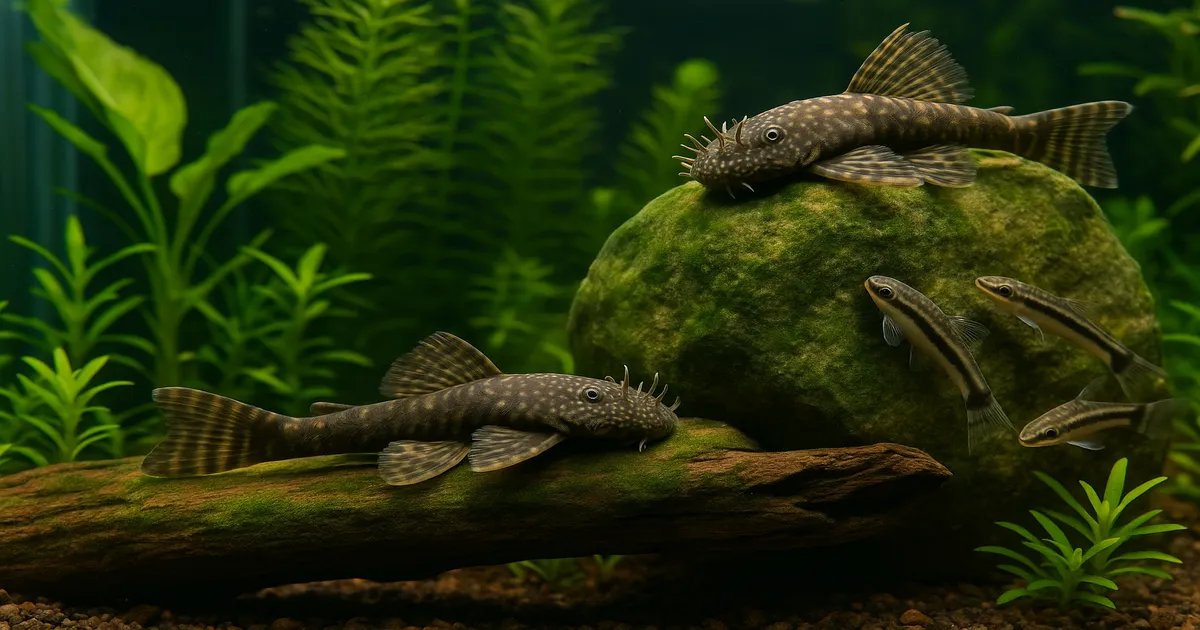
Quick Answer: The Bristlenose Pleco is the best all-around algae-eating fish for most freshwater tanks — manageable size, peaceful temperament, and a 10–15 year lifespan make it a genuinely long-term solution. For planted nano tanks, Otocinclus Catfish are unbeatable grazers of soft green algae and diatoms, though they require a mature, established tank to thrive.
Choosing the best fish for eating algae isn’t as simple as grabbing whatever your local fish store labels “algae eater.” Different species target different algae types, and the wrong choice can mean an overgrown fish terrorizing your community tank — or a sensitive species dying within weeks. This guide covers eight of the most popular algae-eating fish so you can match the right species to your specific problem.
Best Algae-Eating Fish at a Glance
Top Pick: Bristlenose Pleco
The Bristlenose Pleco (Ancistrus spp.) earns the top spot because it works reliably across the widest range of setups. It stays under 6 inches, rasps green algae and biofilm from glass, wood, and décor around the clock, and adapts to a broad range of water parameters. For most freshwater hobbyists, this is the one to get.
Runner-Up: Otocinclus Catfish
Otocinclus are the premier choice for planted tanks and nano setups. They’re tiny, completely peaceful, and relentless on soft green algae and diatoms — including the film that builds up on plant leaves. The catch: they’re delicate and demand a mature, fully cycled tank.
One important caveat applies to this entire guide: no single fish eats every type of algae. A Bristlenose Pleco won’t touch black beard algae. Otocinclus won’t make a dent in hair algae. Matching the species to your specific algae problem is the central principle here.
What to Look For in an Algae-Eating Fish
Algae Type Compatibility
This is the single most important criterion. Green spot algae, brown diatoms, black beard algae (BBA), and hair algae each require different solutions. Otocinclus and Bristlenose Plecos excel on soft green algae and diatoms. The Siamese Algae Eater is the only widely available fish that reliably tackles BBA. Florida Flagfish are your best bet for hair algae. Know what you’re fighting before you buy.
Adult Size and Tank Requirements
The “algae eater” label on a 2-inch juvenile tells you nothing about what that fish will look like in two years. The Common Pleco is the classic trap — sold at 3 inches, it grows to 18–24 inches and needs 100+ gallons. Always research adult size first.
Temperament and Community Compatibility
Some algae eaters are genuinely peaceful; others become problems as they mature. The Chinese Algae Eater starts docile and turns aggressive. Florida Flagfish will shred the fins of long-finned species like bettas or fancy guppies. Check compatibility before adding anything new.
Water Parameter Overlap
Mollies thrive in hard, alkaline water that would stress soft-water species like Otocinclus. Always check pH, GH, and temperature ranges before mixing species — your new algae eater’s requirements need to overlap with your existing community’s parameters.
Long-Term Commitment
Some species are long-term commitments (Bristlenose Plecos live 10–15 years; Common Plecos 15–20+). Others, like the Chinese Algae Eater, shift away from algae entirely as they mature — making them useless for their intended purpose and a hazard to tank mates. Factor in both lifespan and whether the fish will still be doing its job at age five.
Algae-Eating Fish Compared
| Species | Max Size | Algae Types Eaten | Min Tank | pH Range | Temperament | Beginner Friendly | Lifespan |
|---|---|---|---|---|---|---|---|
| Bristlenose Pleco | 4–6 in | Green algae, biofilm | 30 gal | 6.5–7.5 (to 8.0) | Peaceful (males territorial) | ✅ Yes | 10–15 yrs |
| Otocinclus Catfish | 1–2 in | Soft green algae, diatoms | 10 gal (group of 6) | 6.0–7.5 | Completely peaceful | ⚠️ Intermediate | 3–5 yrs |
| Siamese Algae Eater | Up to 6 in | BBA, brush algae, green algae | 30 gal | 6.5–7.5 | Peaceful; mildly territorial | ✅ Yes | 8–10 yrs |
| Florida Flagfish | 2–2.5 in | Hair algae, filamentous algae | 20 gal | 7.0–8.0 | Males territorial; fin-nippy | ⚠️ Intermediate | 2–3 yrs |
| Mollies | 3–5 in | Soft green algae, biofilm | 20 gal | 7.0–8.5 | Generally peaceful | ✅ Yes | 3–5 yrs |
| Twig Catfish | 4–6 in | Soft green algae, biofilm | 30 gal | 6.5–7.5 | Peaceful | ❌ Advanced | 7–10 yrs |
| Chinese Algae Eater | 10–11 in | Green algae (juvenile only) | 55 gal (adult) | 6.5–8.0 | Aggressive as adult | ❌ No | 10+ yrs |
| Common Pleco | 18–24 in | Green algae (juvenile only) | 100+ gal | 6.5–7.5 | Semi-aggressive as adult | ❌ No | 15–20+ yrs |
| Nerite Snail (invertebrate) | 1 in | Green spot algae, diatoms | 5 gal | 7.0–8.5 | Peaceful | ✅ Yes | 1–3 yrs |
| Amano Shrimp (invertebrate) | 2 in | Hair algae, thread algae, biofilm | 10 gal | 6.5–7.5 | Peaceful | ✅ Yes | 2–3 yrs |
Bristlenose Pleco (Ancistrus spp.)
The Bristlenose Pleco is the gold standard for freshwater algae control, and it’s not a close competition. Unlike its giant cousin the Common Pleco, it stays under 6 inches and lives comfortably in a 30-gallon tank for its entire 10–15 year life. It rasps green algae and biofilm from glass, wood, rocks, and décor with impressive efficiency — and it actually gets better at the job as it matures, unlike some species that abandon algae-eating altogether.
Key specs:
- Size: 4–6 in (10–15 cm)
- pH: 6.5–7.5; adaptable to 8.0
- Temperature: 73–82°F (23–28°C)
- GH: 2–20 dGH
- Min tank size: 30 gallons
- Lifespan: 10–15 years
- Variants: albino, longfin, super red, blue-eyed lemon
Provide driftwood — Bristlenose Plecos rasp it as a dietary supplement, and the cellulose genuinely aids digestion. Malaysian driftwood or spider wood both work well.
Supplement their diet with algae wafers and blanched vegetables (zucchini, cucumber) a few times per week, especially in tanks with limited natural algae growth.
Pros
- Manageable adult size; no nasty surprises a year from now
- Highly adaptable water parameters — works in most community tanks
- Excellent on green algae and biofilm; one of the most productive grazers available
- Peaceful with virtually all community fish; breeds readily in captivity
Cons
- Males are territorial with each other — keep one per tank unless you have 75+ gallons
- May uproot delicate stem plants while foraging
- Produces significant waste relative to its size; strong filtration is non-negotiable
Best for: The vast majority of freshwater community tanks — this is the default recommendation for most hobbyists.
Otocinclus Catfish (Otocinclus spp.)
Otocinclus are tiny — topping out at 1–2 inches — but they’re extraordinarily effective on the soft green algae and diatoms that coat plant leaves and glass in planted tanks. They’re completely safe with dwarf shrimp, nano fish, and even the most delicate plants.
The critical caveat: nearly all Otos sold in the hobby are wild-caught, and the stress of capture and shipping means mortality in the first 2–4 weeks is genuinely high. A mature, fully cycled tank — ideally 6+ months old — with established algae growth is not optional. It’s the difference between success and a frustrating loss. Buy from a reputable source, acclimate slowly using the drip method, and always keep them in groups of six or more; they’re social fish that decline in isolation.
Once tank algae is depleted — which happens faster than you’d expect — supplement with algae wafers and blanched vegetables like zucchini or cucumber to keep them fed.
Key specs:
- Size: 1–2 in (2.5–5 cm)
- pH: 6.0–7.5; optimal 6.5–7.0
- Temperature: 72–82°F (22–28°C)
- GH: 3–12 dGH (soft to moderately hard water)
- Min tank size: 10 gallons (group of 6+)
- Lifespan: 3–5 years
Pros
- Completely safe with shrimp, snails, and delicate nano fish
- Won’t damage plants — ideal for high-tech planted tanks
- Outstanding on diatoms and soft green algae, including film on plant leaves
- A group of six fits comfortably in a 10-gallon tank
Cons
- Extremely sensitive to water quality; even minor parameter swings cause casualties
- High initial mortality rate — source carefully and acclimate slowly
- Require supplemental feeding once they’ve cleared the tank’s natural algae
- Not effective on BBA, hair algae, or green spot algae
Best for: Established planted tanks and nano setups with stable, mature water chemistry.
Siamese Algae Eater (Crossocheilus oblongus)
The Siamese Algae Eater has one claim to fame no other commonly available fish can match: it reliably eats black beard algae. BBA is notoriously stubborn — most fish and invertebrates ignore it entirely — which makes the true SAE genuinely valuable for planted tank owners dealing with this problem. They’re active, entertaining swimmers that also graze green algae and brush algae, and they stay peaceful in most community setups.
The identification problem is real and worth stressing. The Flying Fox (Epalzeorhynchos kalopterus) and the False Siamese Algae Eater (Garra cambodgiensis) are routinely mislabeled and sold as SAEs. Neither eats BBA. The true Crossocheilus oblongus has a solid black stripe running continuously through the tail fin all the way to the tip — the imposters’ stripes stop at the base of the tail. Check before you buy.
Key specs:
- Size: up to 6 in (15 cm)
- pH: 6.5–7.5
- Temperature: 75–82°F (24–28°C)
- GH: 5–15 dGH
- Min tank size: 30 gallons
- Lifespan: 8–10 years
Pros
- The only reliable fish solution for black beard algae
- Eats a wide range of algae types; active grazer throughout the tank
- Peaceful with tetras, rasboras, corydoras, and most livebearers
- Can be kept in groups of 4–6 without significant aggression issues
Cons
- Identification at point of sale is frequently wrong — verify the species carefully
- Becomes less interested in algae as it matures and is well-fed on prepared foods
- Active swimmer needs open space; unsuitable for heavily planted tanks with no swimming room
Best for: Planted tanks or community tanks battling black beard algae or brush algae.
Florida Flagfish (Jordanella floridae)
The Florida Flagfish is the most underrated algae eater in the freshwater hobby. It’s a native North American species that does something almost nothing else will do effectively: eat hair algae and filamentous algae. These stringy, mat-forming algae types are a nightmare for planted tank owners, and the Flagfish tears through them with genuine enthusiasm.
Its cooler temperature preference — 66–78°F (19–26°C) — makes it a natural fit for unheated or subtropical setups alongside white cloud mountain minnows, weather loaches, or goldfish ponds. The downside is temperament. Florida Flagfish are notorious fin nippers, and males are territorial toward each other. Keep them away from bettas, fancy guppies, angelfish, or any long-finned variety.
Key specs:
- Size: 2–2.5 in (5–6 cm)
- pH: 7.0–8.0
- Temperature: 66–78°F (19–26°C)
- GH: 8–20 dGH (moderately hard water preferred)
- Min tank size: 20 gallons
- Lifespan: 2–3 years
Pros
- Outstanding on hair algae and filamentous algae — genuinely effective where most fish fail
- Small size; works in 20-gallon setups
- Native species; no ecological concerns if responsibly rehomed
- Excellent for cooler or subtropical community tanks
Cons
- Serious fin nipper — incompatible with long-finned species
- Males are territorial; keep one male to two or three females
- Not widely stocked; may need to source from specialty stores or online
Best for: Hair algae problems, especially in cooler subtropical tanks — keep away from long-finned tank mates.
Mollies (Poecilia sphenops / P. latipinna)
Mollies rarely appear on algae-eater lists, which is a shame. They’re surprisingly effective grazers of soft green algae and biofilm, and they do it continuously throughout the day. Their real advantage is the water chemistry they prefer: hard, alkaline conditions (pH 7.0–8.5, GH 12–30 dGH) that many dedicated algae eaters struggle with. In a hard-water community tank where a Bristlenose Pleco might feel stressed, mollies are right at home and grazing constantly.
That said, mollies are a supplement, not a solution. They won’t clear a serious algae outbreak on their own, and they need to be fed a varied diet — including quality flake or pellet food — to stay healthy and keep grazing.
Key specs:
- Size: 3–5 in (7–13 cm)
- pH: 7.0–8.5
- Temperature: 75–82°F (24–28°C)
- GH: 12–30 dGH (hard water required)
- Min tank size: 20 gallons
- Lifespan: 3–5 years
Pros
- Widely available and inexpensive; easy to find in any fish store
- Continuous grazers on soft green algae and biofilm
- Thrive in hard, alkaline water where other algae eaters struggle
- Peaceful with most community fish; breed readily
Cons
- Algae grazing is supplemental — won’t solve a serious algae problem alone
- Require hard water; incompatible with soft-water setups
- Males will harass females; keep one male to three or more females
Best for: Hard-water community tanks as a secondary algae grazer alongside a dedicated species like a Bristlenose Pleco.
Chinese Algae Eater (Gyrinocheilus aymonieri)
The Chinese Algae Eater is one of the most commonly regretted purchases in the freshwater hobby. As a juvenile it’s an effective grazer, and it’s cheap and widely available — which is exactly why so many people buy it without doing their research first. The problem is what it becomes. By the time it reaches adult size (up to 10–11 inches), it’s territorial, aggressive, and has largely abandoned algae in favor of a more carnivorous diet. Worse, it’s notorious for latching onto the sides of flat-bodied fish — angelfish, discus, goldfish — and causing serious injuries.
Key specs:
- Size: up to 10–11 in (25–28 cm)
- pH: 6.5–8.0
- Temperature: 74–82°F (23–28°C)
- GH: 5–19 dGH
- Min tank size: 55 gallons (adult)
- Lifespan: 10+ years
Pros
- Effective algae grazer as a juvenile
- Widely available; tolerates a broad pH and hardness range
- Hardy and adaptable to a range of water conditions
Cons
- Becomes aggressive and territorial as an adult — a real danger to tank mates
- Attacks and injures flat-sided fish (angelfish, discus, goldfish)
- Shifts away from algae diet with age, defeating the purpose of keeping it
- Grows too large for most community tanks; frequently returned or rehomed
Best for: Honestly? There’s almost no scenario where this is the right choice — there’s a better alternative for every use case.
Common Pleco (Pterygoplichthys pardalis)
The Common Pleco is the most important species to actively avoid for the average hobbyist. It’s sold by the millions in big-box stores as a cute 2–3 inch “algae eater” for a few dollars, and it grows to 18–24 inches. That’s not a typo. A fish that needs 100+ gallons as an adult produces waste loads that would overwhelm a typical home aquarium filter. It also shifts to a largely carnivorous diet as it matures, making it useless for the job it was sold to do. It’s an ecological pest when released into warm waterways — established feral populations exist in Florida, Texas, and parts of Asia.
Key specs:
- Size: 18–24 in (45–60 cm)
- pH: 6.5–7.5
- Temperature: 72–86°F (22–30°C)
- GH: 3–20 dGH
- Min tank size: 100+ gallons
- Lifespan: 15–20+ years
Pros
- Extremely hardy; survives a wide range of conditions
- Effective algae grazer as a juvenile
- Widely available
Cons
- Outgrows virtually every home aquarium
- Produces massive waste; will overwhelm filtration in standard setups
- Becomes largely carnivorous as an adult — poor long-term algae control
- Significant ecological pest risk if released; responsible rehoming is extremely difficult
Best for: Only consider this fish if you have a 100+ gallon tank and a genuine long-term plan. The Bristlenose Pleco is a far better choice for 99% of hobbyists.
Our Verdict: Best Fish for Eating Algae by Use Case
Best Overall: Bristlenose Pleco
For the majority of freshwater tanks, the Bristlenose Pleco is the answer. It’s adaptable, productive, long-lived, and peaceful. If you have a 30+ gallon community tank and green algae or biofilm is your problem, start here.
Best for Planted Nano Tanks: Otocinclus Catfish
Nothing else comes close for a mature, planted tank under 20 gallons. Make sure your tank is fully cycled, has established algae, and buy from a reputable source to minimize initial losses.
Best for Black Beard Algae: Siamese Algae Eater
The true Crossocheilus oblongus is the only fish that reliably handles BBA. Verify the species at purchase — this point cannot be overstated.
Best for Hair Algae: Florida Flagfish
If stringy, mat-forming hair algae is your nemesis, the Florida Flagfish is the most effective fish solution available. Keep it away from long-finned species.
Best for Hard-Water Tanks: Mollies
In hard, alkaline setups where other algae eaters struggle, mollies provide continuous soft algae grazing. Use them alongside a dedicated algae eater for best results.
Species to Avoid: Chinese Algae Eater and Common Pleco
Both are widely sold and both are poor choices for community tanks. The Chinese Algae Eater becomes aggressive; the Common Pleco becomes enormous. There are better options in every scenario.
A Note on Complete Algae Management
No fish eliminates algae entirely — nor should it. A healthy tank has some algae. What fish do is keep it controlled. For a complete strategy, pair the right algae eater with a consistent lighting schedule (6–8 hours per day), weekly water changes of 25–30%, and good biological filtration. A reliable canister filter makes a real difference in tanks with heavy algae grazers like plecos.
Nerite Snails and Amano Shrimp are excellent invertebrate companions to any algae-eating fish. Nerites are exceptional on green spot algae and diatoms on glass; Amano Shrimp are the best invertebrate option for hair algae and thread algae. Neither reproduces in freshwater, so populations stay manageable.
To monitor water quality — especially important when keeping sensitive species like Otocinclus — test your tank regularly for ammonia, nitrite, nitrate, and pH.
Frequently Asked Questions: Best Fish for Eating Algae
What fish eats the most algae in a freshwater aquarium?
For sheer volume consumed, the Bristlenose Pleco is the most productive option for most tanks — it rasps constantly and covers large surface areas of glass, wood, and décor. In planted tanks where you need gentler grazing on leaves and glass, a group of Otocinclus will collectively cover more ground on soft green algae and diatoms.
What is the best algae-eating fish for a small or nano tank?
Otocinclus Catfish are the best choice for tanks 10–20 gallons. Keep a group of at least six — they’re social and do poorly in isolation. The key requirement is a mature, cycled tank with established algae; don’t add them to a new setup. A small group of Nerite Snails makes an excellent companion in the same nano tank.
Is there a fish that will eat black beard algae?
Yes — the true Siamese Algae Eater (Crossocheilus oblongus) is the most reliable fish for black beard algae. The challenge is correct identification: the Flying Fox and False Siamese Algae Eater are commonly mislabeled as SAEs but won’t touch BBA. Look for the black stripe that runs continuously through the tail fin all the way to the tip — that’s the distinguishing mark of the real species.
Will algae-eating fish completely get rid of algae in my tank?
No — and that’s actually fine. A small amount of algae is a sign of a healthy, balanced tank. Algae eaters control growth; they don’t address the root causes of algae blooms, which are excess light, excess nutrients, and poor water circulation. If you have a serious outbreak, reduce your lighting period, cut back on feeding, and increase water change frequency before adding more fish.
Can I keep multiple algae-eating fish together?
Yes, with some planning. Combining species that target different algae types — for example, a Bristlenose Pleco for biofilm and green algae plus a Siamese Algae Eater for BBA — works well in tanks 40 gallons and larger. Avoid keeping two male Bristlenose Plecos together unless you have 75+ gallons, and never combine a Chinese Algae Eater with flat-bodied species like angelfish or discus.