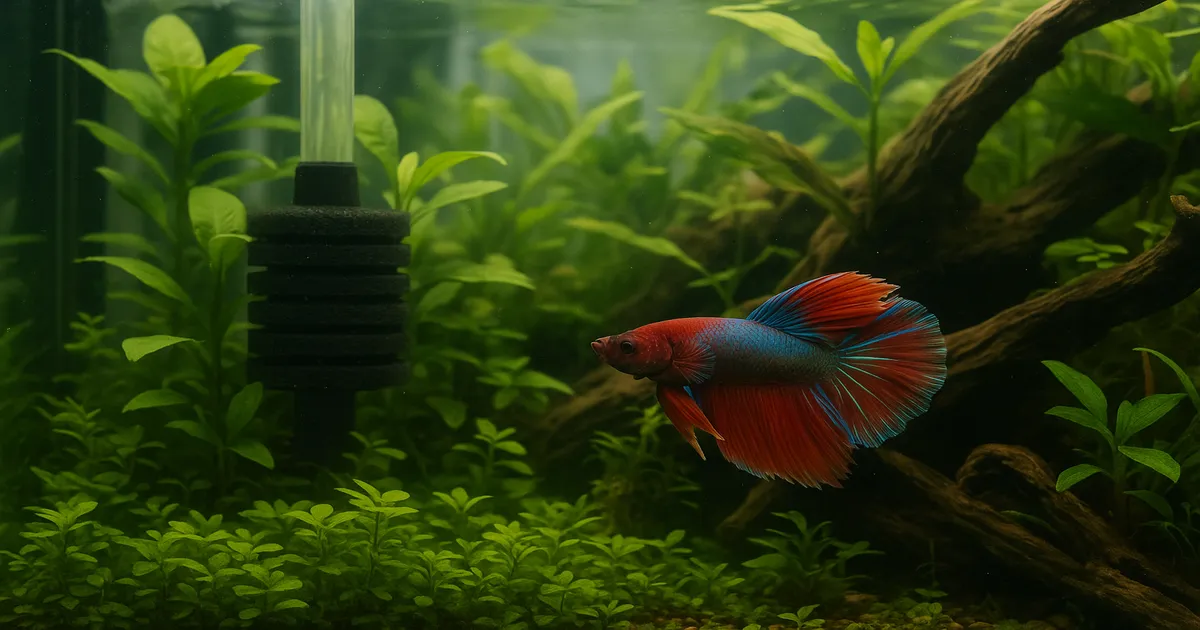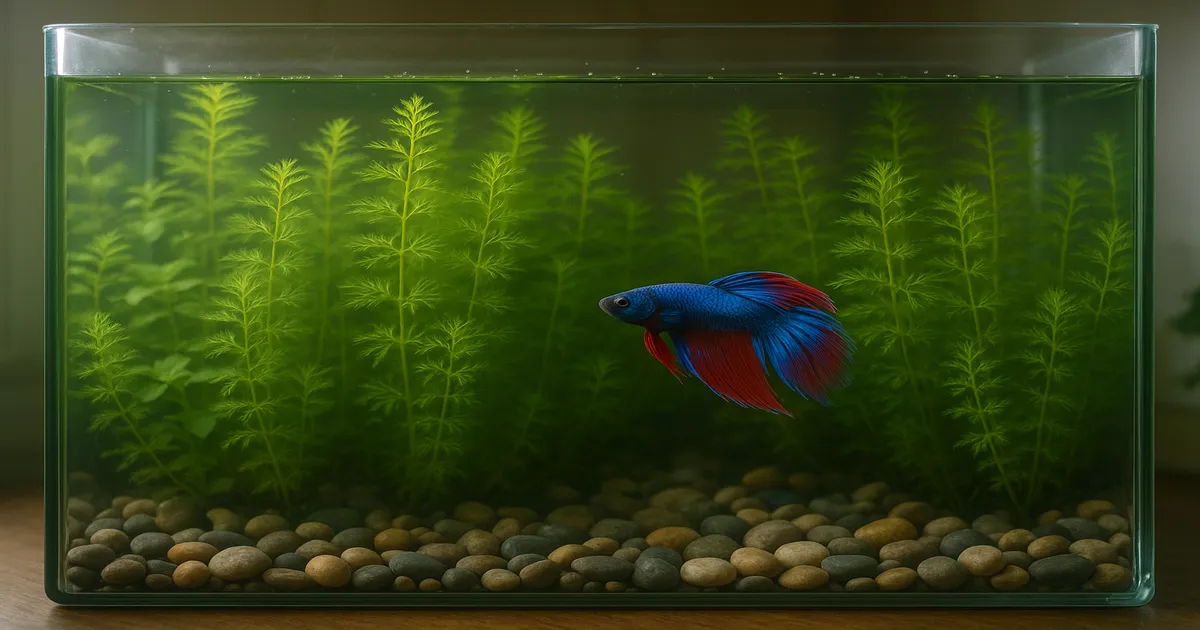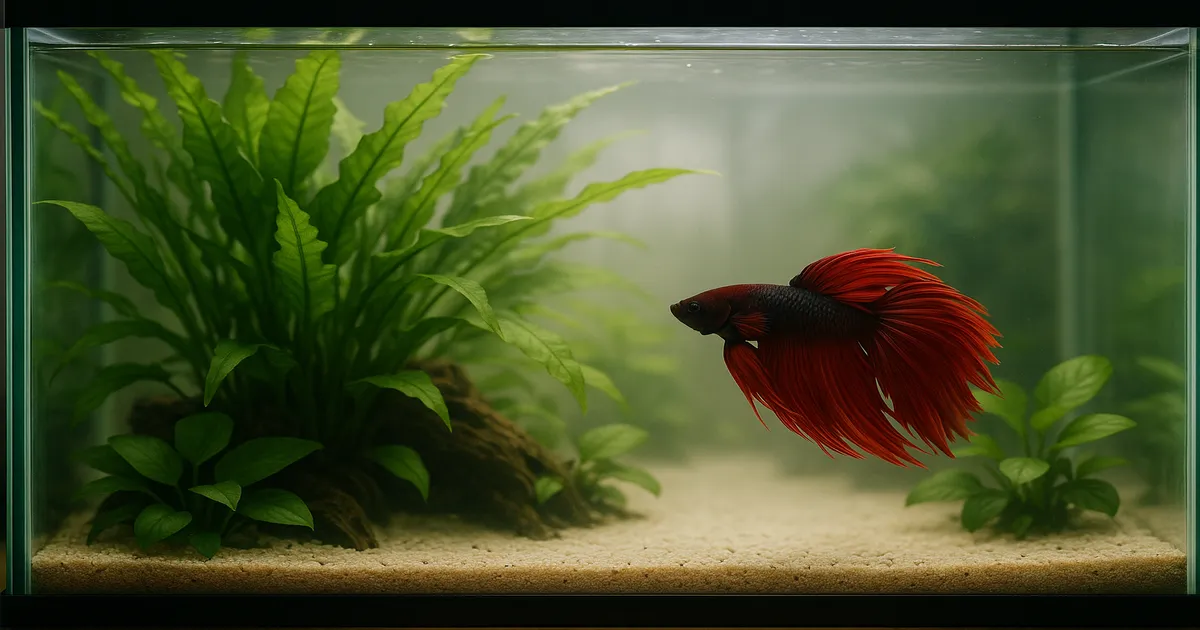
Quick Answer: The best setup for a longfin betta is a 10-gallon planted tank with an Aquaneat Double Sponge Filter for ultra-gentle flow, a Fluval E-Series heater for rock-solid temperature stability, and Indian almond leaves to protect those delicate fins naturally. If space is tight, a baffled Fluval Spec V 5-Gallon kit works as a solid runner-up — just add a flow baffle before you put your fish in.
So what’s the best for a longfin betta? The honest answer is that it’s less about any single product and more about a system. Longfin bettas aren’t just regular bettas with prettier fins. Those elaborate fins create real drag, tire the fish out faster, and expose far more surface area for fin rot to take hold. Get the setup wrong and you’ll spend more time treating disease than enjoying your fish.
This guide covers every element of that system: filtration, tank size, substrate, heating, food, and a few inexpensive additions that make a surprisingly big difference. Everything here is grounded in the biology of the fish, not hobbyist folklore.
What Makes the Best Setup for a Longfin Betta Different?
Before you buy anything, understand what separates longfin care from keeping a standard short-fin plakat. These six criteria should guide every purchase decision.
Flow Rate: Low Current Is Non-Negotiable
A longfin betta swimming against even moderate filter flow is like a person jogging in a heavy winter coat — constantly. Over time, that exhaustion shows up as torn fins, chronic stress, and immune suppression. You want the water surface to show a gentle ripple, not a visible current across the tank. Sponge filters are the gold standard here. HOB filters can work, but only with a proper baffle on the outflow.
Tank Size: Bigger Is Better for Fin Health
Five gallons is the absolute minimum, but 10 gallons is where longfin bettas genuinely thrive. More water volume means more stable temperature and chemistry, more swimming room at the fish’s own pace, and easier maintenance of the sub-20 ppm nitrate level these fish need. A bigger tank also gives you the option of adding compatible tank mates later.
Water Quality: Parameters That Protect Delicate Fins
Target slightly acidic to neutral water — pH 6.5–7.5 — with soft to moderately hard conditions (3–12 dGH) and a temperature of 76–82°F (24–28°C). Ammonia and nitrite must be zero, always. Nitrate should stay below 20 ppm. This isn’t aspirational; it’s the baseline that keeps fin rot from becoming a recurring problem.
Decor Safety: The Pantyhose Snag Test
Before any decoration goes into a longfin betta tank, run a piece of pantyhose across every surface and edge. If the fabric snags, the fins will too. This rules out most cheap plastic plants and many ornaments with textured surfaces. Stick to live plants, smooth driftwood, and rounded ceramic caves.
Heating Consistency: Stability Over Exact Temperature
The target range is 76–82°F (24–28°C), but what really matters is stability. A swing of more than 2°F within 24 hours is enough to trigger ich and suppress the immune system. A quality heater with a reliable thermostat isn’t a luxury for longfin bettas — it’s essential.
Surface Access: The Labyrinth Organ Requirement
Bettas breathe atmospheric air through a specialized structure called the labyrinth organ. Block their path to the surface — with a strong filter output, a tight foam lid, or overly dense floating plants — and they’ll suffocate despite adequate dissolved oxygen in the water. Always leave a clear lane to the top, and always use a tight-fitting lid. Bettas jump, especially when stressed.
At-a-Glance Comparison: Best Products for a Longfin Betta
| Product | Category | Best For | Key Feature | Price | Longfin Rating |
|---|---|---|---|---|---|
| Aquaneat Double Sponge Filter | Filter | Any longfin tank | Zero direct flow output | $ | ⭐⭐⭐⭐⭐ |
| Fluval Spec V 5-Gallon Kit | Tank Kit | Tight spaces / budget | Compact all-in-one | $$ | ⭐⭐⭐ |
| Fluval Flex 15-Gallon | Tank Kit | Community / planted | Adjustable flow + RGB LED | $$$ | ⭐⭐⭐⭐⭐ |
| Northfin Betta Bits Pellets | Food | Daily staple feeding | 45%+ protein, no fillers | $$ | ⭐⭐⭐⭐⭐ |
| Fluval E-Series Heater | Heater | Temperature stability | Dual sensors + LCD alert | $$$ | ⭐⭐⭐⭐⭐ |
| Seachem Flourite Black Sand | Substrate | Planted tanks | Fin-safe, pH-neutral clay | $$ | ⭐⭐⭐⭐⭐ |
| SunGrow Indian Almond Leaves | Health Supplement | Fin rot prevention | Natural tannins + antifungal | $ | ⭐⭐⭐⭐⭐ |
Aquaneat Double Sponge Filter
The sponge filter is the community consensus best filter type for longfin bettas, and the Aquaneat Double Sponge is a reliable, inexpensive example of why. Air-driven and output-free, it circulates water through two sponge chambers without creating any directional current. Your betta can swim right up to it without being pushed aside. The dual sponge design also provides generous biological media surface area for beneficial bacteria to colonize.
Key specs:
- Air-driven (requires separate air pump and airline tubing)
- Dual sponge chambers
- Suitable for tanks up to 40 gallons depending on model
- Easy to squeeze-clean in old tank water during water changes
Pros
- Genuinely zero harmful flow — the safest filter option for longfin fins
- Inexpensive to buy and run; replacement sponges are easy to find
- Sponge acts as biological media and mechanical filtration
- Easy to seed with beneficial bacteria from an existing tank
Cons
- Requires a separate air pump purchase — budget accordingly
- Utilitarian appearance; not a showpiece for display tanks
- Surface agitation can be minimal in larger tanks, which may reduce gas exchange slightly
Best for: Any longfin betta keeper who wants the safest possible filtration without modification or guesswork.
Fluval Spec V 5-Gallon Aquarium Kit
The Fluval Spec V is one of the most popular betta starter kits on the market, and for good reason — it’s compact, well-built, and comes with decent lighting that supports low-light plants like java fern and anubias. The catch for longfin keepers: the stock pump output is too strong straight out of the box. You’ll need to baffle the outflow with a small piece of filter foam before adding your fish. That’s a five-minute fix, not a dealbreaker.
Key specs:
- 5-gallon capacity with integrated 3-stage filtration
- 7500K LED lighting (adequate for low-light plants)
- Aluminium trim, sleek low-profile design
- Heater sold separately
Pros
- Sleek, modern design fits well in small spaces
- Included lighting supports low-light planted setups right away
- Widely available in stores and online
- Solid build quality for the price
Cons
- Stock filter flow is too strong for longfins without a foam baffle modification
- 5 gallons is the bare minimum — less margin for error than a 10-gallon
- No heater included; the small footprint also limits heater options
Best for: Keepers with limited space who want a tidy, all-in-one kit and don’t mind a simple flow-baffle modification.
Fluval Flex 15-Gallon Aquarium Kit
The Fluval Flex 15-Gallon is the best mid-range tank option for a longfin betta. The extra volume means more thermal stability, more stable water chemistry, and enough room to add a small group of compatible tank mates like ember tetras or corydoras. The curved panoramic front glass reduces visual stress, and the internal filter has an adjustable flow dial you can turn down to longfin-safe levels — though adding a sponge pre-filter on the intake is still a smart move.
Key specs:
- 15-gallon capacity with multi-stage internal filter (adjustable flow)
- Full-spectrum RGB LED with app and remote control
- Curved panoramic front glass
- Heater sold separately
Pros
- Adjustable filter flow can be dialled down without any modification
- Ample space for a planted community setup with compatible tank mates
- Excellent, controllable lighting for planted tanks
- Genuinely attractive design that looks good in any room
Cons
- Higher price point than budget kits
- Internal filter still benefits from a sponge pre-filter on the intake
- No heater included — factor that into your total budget
Best for: Keepers who want a planted community tank with a longfin betta as the centrepiece and don’t want to compromise on aesthetics.
Northfin Betta Bits Pellets
Northfin Betta Bits are widely regarded as the best staple pellet for bettas, and they earn that reputation. Protein content sits at or above 45%, with whole krill and herring as primary ingredients — not corn meal or wheat filler. The 1mm pellet size suits a betta’s small mouth, which means less spitting and less wasted food clouding your water. For longfin bettas specifically, the lean, high-quality formula matters: overfeeding heavy-finned fish leads to swim bladder problems faster than it does in short-fin variants.
Key specs:
- ≥45% protein; primary ingredients whole krill and herring
- 1mm pellet size
- No artificial colours, flavours, or preservatives
- Suitable as a daily staple
Pros
- Premium ingredient list with no low-quality fillers
- Small pellet size minimises waste and water quality impact
- High palatability — most bettas accept them quickly
- Supports fin tissue regrowth during recovery from fin rot
Cons
- Premium price compared to grocery-store betta flakes
- Can be difficult to find locally; often requires online ordering
- Some bettas initially refuse new pellets — transition gradually if switching foods
Best for: Any longfin betta keeper wanting the best daily staple food. Pair with frozen daphnia and mysis shrimp two to three times per week for a complete diet.
Fluval E-Series Advanced Electronic Heater
Temperature stability is arguably the single most important environmental factor for longfin bettas, and the Fluval E-Series is the most reliable heater most hobbyists can buy without spending aquarium-club money. It uses dual temperature sensors — one on the heater body, one reading ambient water temp — and an LCD display that shows actual water temperature in real time. The fast-temp alert flashes red if the water climbs or drops outside your set range, which is genuinely useful for catching a failing heater before your fish gets sick.
Key specs:
- Dual temperature sensors for accurate, stable heating
- Real-time LCD display (shows actual water temp, not just set point)
- Fast-temp alert system (flashes red for dangerous fluctuations)
- Available in 50W (5–15 gallon) and 100W (15–40 gallon) variants
- Shatterproof housing
Pros
- Exceptional temperature accuracy — holds within 0.5°F of set point
- Visual alerts for dangerous temperature swings
- Two wattage options cover tanks from 5 to 40 gallons
- Long-term reliability backed by a strong warranty
Cons
- Significantly more expensive than basic preset heaters
- LCD display can be awkward to read through curved or tinted glass
- Bulkier profile than slim heaters — takes up more visual space in smaller tanks
Best for: Any longfin betta keeper who wants the peace of mind that their heater is doing exactly what it’s supposed to, every day.
Seachem Flourite Black Sand
Substrate might seem like an afterthought, but for longfin bettas it genuinely matters. Seachem Flourite Black Sand is a porous clay-based substrate that does three useful things at once: it supports rooted live plants without additional fertiliser, it maintains a pH-neutral to slightly acidic environment over time, and its fine smooth texture won’t snag fins when a longfin betta rests near the bottom. The dark colouration also mimics the shaded, tannin-stained environments these fish come from, which visibly reduces stress and brings out colour.
One important note on the specs: Flourite Black Sand is pH-neutral in most setups rather than actively acidic. It won’t push your pH down on its own — use Indian almond leaves or driftwood if you want a mild acidic drift.
Key specs:
- Porous clay gravel, fine grain
- pH-neutral; does not actively buffer acidic or alkaline
- Does not require replacement; lasts the life of the tank
- Supports rooted plants without additional substrate fertiliser
Pros
- Smooth, fine texture is genuinely fin-safe
- Excellent for planted tanks — roots anchor well, nutrients available
- Natural dark appearance reduces fish stress and enhances colour
- No chemical additives; safe for sensitive fish
Cons
- Requires very thorough rinsing before use — clouds water significantly if rushed
- Heavier than standard sand; harder to vacuum without disturbing
- Slightly higher cost than basic aquarium gravel
Best for: Longfin betta keepers setting up a planted tank who want a substrate that’s safe for fins, good for plants, and visually natural.
SunGrow Indian Almond Leaves (Catappa Leaves)
Indian almond leaves are the most impactful low-cost addition you can make to a longfin betta tank. Placed in the water, they slowly release tannins that lower pH slightly, create a natural amber tint, and provide mild antibacterial and antifungal properties. The effect on fish behaviour is noticeable — bettas become visibly more relaxed, spend more time exploring, and show better colour. For a fish as prone to fin rot as a longfin betta, the passive disease-prevention value alone justifies the cost.
Key specs:
- Natural dried leaves, typically 4–8 inches
- Release tannins over 1–2 weeks; fully biodegradable
- Use approximately 1 leaf per 10 gallons
- No chemical additives
Pros
- Inexpensive — one of the best value-for-money additions in the hobby
- Natural antibacterial and antifungal properties support fin rot prevention
- Bettas use decomposing leaves as resting spots, reducing stress
- Creates an enriching, naturalistic blackwater environment
Cons
- Tannins stain water amber — beautiful to some, unwanted by others
- Leaves decompose over 2–4 weeks and need periodic replacement
- May lower pH further in already-soft, acidic water — monitor parameters if your tap water is already below pH 6.8
Best for: Every longfin betta tank, but especially valuable during fin rot recovery or for fish that are newly introduced and stressed.
Our Verdict: Best Choices for a Longfin Betta by Use Case
Best Overall Setup: Fluval Flex 15-Gallon + Aquaneat Sponge Filter
The gold-standard setup looks like this: Fluval Flex 15-Gallon tank, Aquaneat Double Sponge Filter run alongside the internal filter on its lowest setting, Fluval E-Series 100W heater, Seachem Flourite Black Sand, a handful of live plants (java fern, anubias, floating frogbit), and two or three Indian almond leaves on the bottom. This combination addresses every vulnerability of the longfin betta — flow, temperature, fin safety, water chemistry, and enrichment — in one cohesive system.
Best Budget Setup: Fluval Spec V 5-Gallon (Baffled) + Sponge Filter
If budget or space is the constraint, the Fluval Spec V with a foam baffle on the outflow and a small sponge pre-filter on the intake is a workable solution. Add a Fluval E 50W heater, some Indian almond leaves, and a couple of anubias plants. It’s not ideal — 5 gallons leaves less margin for error — but it’s a respectable setup if maintained diligently with weekly water changes.
Best Food Routine: Northfin Betta Bits + Frozen Daphnia and Mysis Shrimp
Feed Northfin Betta Bits as the daily staple (2–4 pellets, once or twice a day), supplement with frozen daphnia and mysis shrimp three times per week, and fast one day per week. That’s the complete longfin betta diet — high protein, varied, and portion-controlled to protect against swim bladder issues.
Best for Fin Health and Disease Prevention: Indian Almond Leaves + Seachem Flourite Black Sand
No sharp edges, no fin nippers, smooth substrate, and a leaf or two on the bottom. These two products together address the two most common physical causes of fin damage in longfin bettas. They’re also the cheapest items on this list, which makes them easy wins.
Best Heater for Temperature Stability: Fluval E-Series
No competition here. For a fish where a 2°F temperature swing can trigger an ich outbreak, the Fluval E-Series’ dual-sensor accuracy and real-time alert system are worth every penny of the premium.
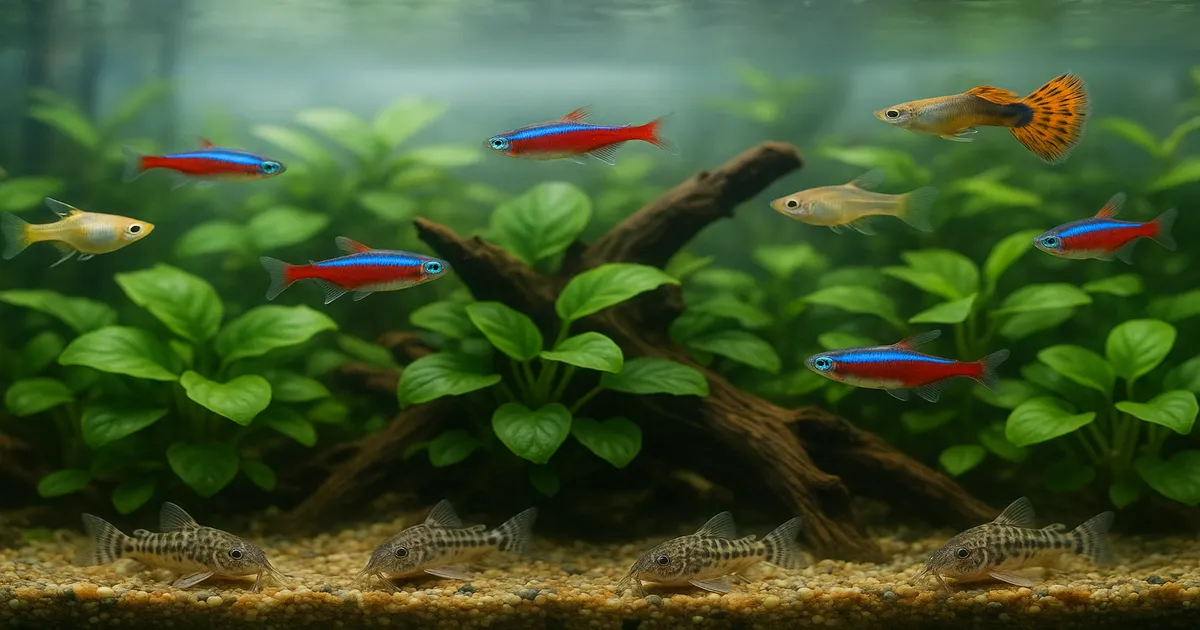
A final note: no product replaces consistent water changes, a fully cycled tank, and paying attention to your fish’s behaviour. A longfin betta in pristine water with a basic sponge filter will outlive and outshine one in an expensive tank with neglected parameters every time. Once you have the fundamentals dialled in, consider adding compatible tank mates — ember tetras, corydoras pygmaeus, and nerite snails all work beautifully in a 15-gallon planted setup without threatening your betta’s fins or territory.
Frequently Asked Questions: What’s the Best for a Longfin Betta?
What is the minimum tank size for a longfin betta?
Five gallons is the widely accepted absolute minimum — anything smaller creates rapid water quality decline, temperature instability, and chronic stress. Ten gallons is strongly recommended for a single longfin betta, as the additional volume provides more stable conditions and room for the fish to move at its own pace without fighting a current.
Can longfin bettas live with other fish?
Yes, with careful species selection. Ember tetras, harlequin rasboras, corydoras catfish, and nerite snails are all reliable choices in a 10-gallon or larger tank. Avoid fin-nipping species (tiger barbs, serpae tetras), fancy male guppies whose tails can trigger aggression, and other male bettas. Always have a backup tank or divider ready — individual betta personalities vary, and not every fish will tolerate company.
Why does my longfin betta rest at the bottom of the tank?
Check temperature first — cold water below 74°F (23°C) causes lethargy and bottom-sitting almost immediately. If temperature is fine, test for ammonia, nitrite, or elevated nitrate using a reliable liquid test kit . Strong filter current is another common culprit: a longfin betta exhausted from fighting flow will rest on the substrate. If all parameters are normal and flow is gentle, bottom-resting can signal early illness — watch for clamped fins or loss of appetite.
How do I treat fin rot in a longfin betta?
Start with an immediate 30–50% water change and check your parameters — fin rot is almost always rooted in water quality. Remove any sharp decorations and fin-nipping tank mates. Mild cases often respond well to Indian almond leaves and aquarium salt (1 teaspoon per gallon as a short-term treatment). Moderate to severe fin rot — where the fin edge is receding toward the body — requires antibiotics; Kanaplex or Maracyn 2 are the most commonly recommended options.
Do longfin bettas need a heater?
Always. Bettas are tropical fish from Southeast Asia and require water temperatures of 76–82°F (24–28°C). Room temperature in most homes sits around 68–72°F (20–22°C), which is cold enough to suppress a betta’s immune system and shorten its lifespan significantly. A reliable thermostat heater isn’t optional — it’s as fundamental as the tank itself.