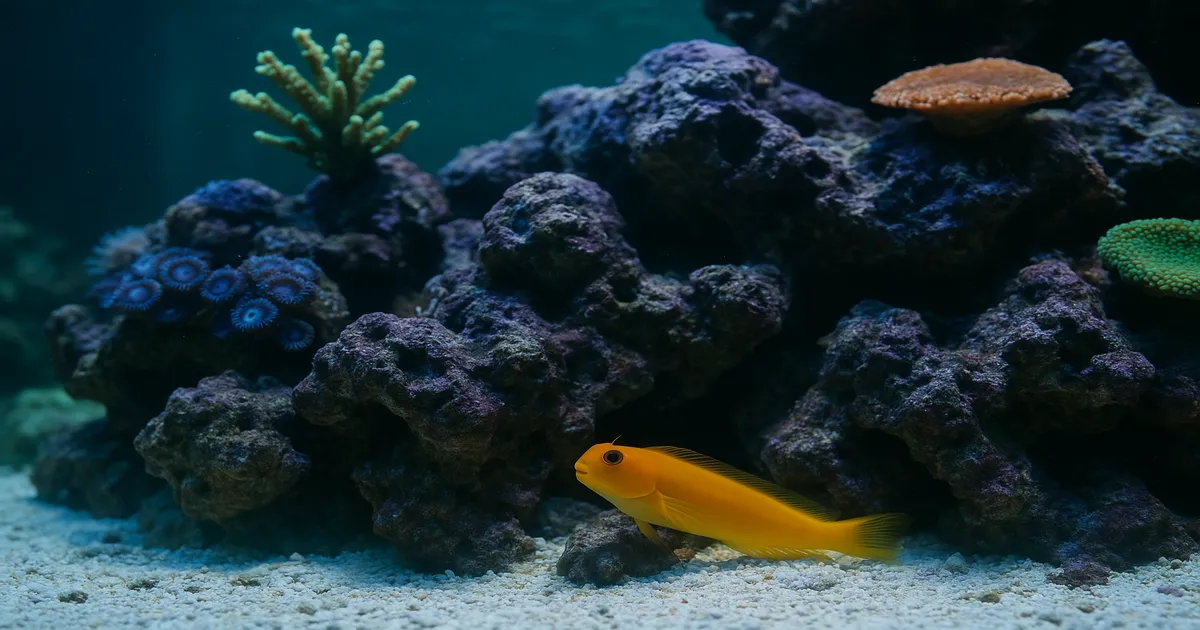
Quick Answer: A Midas blenny needs a minimum of 30 gallons, but 55 gallons is the real-world starting point for a single fish in a community reef. These are active, open-water swimmers that need horizontal tank length, strong flow, and dedicated bolt-hole rockwork to thrive.
Can I Fit a Midas Blenny? Tank Size at a Glance
| Setup | Tank Size |
|---|---|
| Single specimen | 30 gal (absolute floor) / 55 gal recommended |
| Mated pair | 75 gallons |
| Small group (1M + 2F+) | 150+ gallons |
The 30-gallon figure on many care sheets is technically survivable — but in practice, a single Midas blenny in a 30-gallon community tank often becomes a bully. Compressed territory triggers aggression toward tankmates. A 4-foot, 55-gallon tank gives the fish room to patrol, perch, and behave normally.
Who This Fish Is Best Suited For
The Midas blenny (Ecsenius midas) is a charismatic, golden fish that suits intermediate reef keepers well. It’s fully reef-safe, won’t nip corals or clams, and brings real personality to a display tank. The main requirements are adequate space, strong flow, and at least one bolt-hole in the rockwork. Get those three things right and this species is surprisingly hardy.
Midas Blenny Species Overview
Natural Habitat and Wild Behaviour
Ecsenius midas belongs to the family Blenniidae and ranges across the Indo-Pacific — from the Red Sea and East Africa through the Maldives, Sri Lanka, Indonesia, and out to the Pacific Islands. It lives on current-swept reef slopes at depths of roughly 6–130 feet (2–40 m), most commonly between 15–65 feet (5–20 m).
In the wild, the Midas blenny is a planktivore. It hovers above the reef, picks off zooplankton carried by the current, and darts back to a bolt-hole the moment it senses a threat. That cycle — rise, feed, retreat — repeats hundreds of times a day and explains almost everything about its captive care requirements.
Size, Coloration, and the Anthias Mimicry Trick
Adults reach 3.5–5 inches (9–13 cm), with most captive fish settling around 4 inches (10 cm). The body is brilliant golden-yellow to orange-yellow with blue-rimmed eyes and a forked, lyre-shaped tail — the source of its alternate name, the lyretail blenny. Red Sea specimens tend toward a deeper orange; Indian Ocean fish are often a brighter canary yellow.
Here’s where it gets genuinely fascinating: E. midas is one of the few fish with documented Batesian mimicry. When threatened, individuals rapidly shift from gold to blue-purple or mottled brown, mimicking local anthias (Pseudanthias squamipinnis) that school around them on the reef. In captivity you’ll sometimes see this colour shift during acclimation or territory disputes — it’s not a sign of illness, just a remarkable survival trick.
Midas Blenny Tank Size Requirements
Why 30 Gallons Is the Floor, Not the Goal
Thirty gallons keeps a Midas blenny alive. It doesn’t keep it happy, and it rarely keeps your other fish happy either. In a tank that small, the blenny’s territory covers almost the entire aquarium, and it will defend that space against anything it perceives as competition — including peaceful fish that share nothing in common with it.
A 55-gallon tank with a 4-foot footprint is where this species genuinely settles. The extra horizontal length is what matters most, not depth. A tall 40-gallon breeder is actually a worse choice than a standard 55, because Midas blennies patrol length, not height.
Recommended Tank Dimensions and Shape
Prioritise tank length above all other dimensions. A 4-foot (120 cm) minimum run gives the fish enough horizontal territory that it doesn’t feel constantly threatened. Open mid-water column space matters too — avoid aquascaping that fills the tank with rock and leaves no room to swim.
Standard 55-gallon (48” × 13” × 20”) and 75-gallon (48” × 18” × 21”) tanks are both excellent choices. If you’re building a larger reef with several focal fish, the 75-gallon also opens up the possibility of a mated pair.
Keeping a Pair or Group
Two Midas blennies in the same tank will almost certainly fight unless they are a confirmed mated pair introduced simultaneously into a 75-gallon minimum with separate bolt-holes. Two males together is a recipe for relentless aggression — one will usually kill or permanently stress the other.
Groups of three or more (one male, multiple females) are possible but require 150+ gallons with extensive rockwork providing genuinely separate territories. For most hobbyists, one Midas blenny per tank is the right answer.
Water Parameters and Tank Setup
Ideal Water Parameters for a Midas Blenny
| Parameter | Target Range |
|---|---|
| Salinity (SG) | 1.025–1.026 |
| pH | 8.1–8.3 |
| Temperature | 76–80°F (24–27°C) |
| dKH | 8–11 |
| Calcium | 400–425 ppm |
| Magnesium | 1,250–1,350 ppm |
| Nitrate | < 10 ppm |
| Phosphate | < 0.05 ppm |
| Ammonia / Nitrite | 0 ppm |
E. midas isn’t delicate by reef fish standards, but it is sensitive to rapid swings. Stability matters more than hitting exact numbers. Chronic low pH (below 7.8) suppresses immune function and compromises the mucus coat — keep alkalinity steady and pH will follow. A quality liquid test kit and a reliable refractometer are worth the investment to keep parameters dialled in.
Note on magnesium: The original article listed a ceiling of 1,300 ppm. The accepted reef range extends to 1,350 ppm, which is reflected above.
Aquascaping: Bolt-Holes, Flow, and Open Swimming Space
The single most important aquascaping decision is providing at least one dedicated bolt-hole per fish — a cave or tube opening roughly 1–1.5 inches (2.5–4 cm) in diameter, sized to the fish’s body. Without a secure retreat, the Midas blenny is chronically stressed, and chronic stress is the primary trigger for disease.
A practical trick: embed a short section of 1-inch PVC pipe within your rockwork before the tank cycles. The fish will claim it immediately and calm down noticeably within days. Beyond that, build an open, branching aquascape with flat-topped rocks or branching coral skeletons at mid-tank height — the blenny will use these as perching spots to survey its territory.
Filtration, Flow, and Lighting
A protein skimmer is strongly recommended. Midas blennies eat zooplankton-type foods multiple times a day, and that feeding regime adds up to a real bioload. Size your skimmer for 1.5–2× your tank volume. Pair it with robust biological filtration — a well-cycled live rock system with a refugium is ideal.
Flow is non-negotiable. Target 20–40× tank volume turnover per hour with random, turbulent flow from wavemakers rather than a single laminar stream. (Jebao OW-25 Wavemaker) Low flow causes lethargy, suppressed feeding, and increased disease susceptibility.
Lighting is flexible. This species adapts from moderate (50–100 PAR) to high-intensity reef lighting (200–400+ PAR) without issue. Bright lighting enhances the golden coloration. A 10–12 hour photoperiod with a gradual ramp-up mimics natural reef conditions well.
Midas Blenny Compatibility and Tank Mates
How Aggressive Is the Midas Blenny?
Toward dissimilar fish, the Midas blenny is generally peaceful. Toward anything that looks like a blenny, dartfish, or elongated fish of similar size — or anything that approaches its bolt-hole — it can be surprisingly fierce. The territorial response is triggered by body shape and proximity to the retreat, not just species identity.
Best Tank Mates
- Clownfish (Amphiprion spp.) — different niche, no competition
- Tangs (Zebrasoma, Acanthurus spp.) — too large to threaten or be threatened
- Wrasses (Cirrhilabrus, Halichoeres spp.) — active but non-competitive
- Substrate gobies (Amblyeleotris, Valenciennea spp.) — completely different microhabitat
- Anthias (Pseudanthias spp.) — natural cohabitants; the blenny may even school loosely with them
- Cardinalfish — peaceful, often nocturnal, no conflict
- Chromis (C. viridis, C. cyanea) — schooling damsels that don’t compete for bolt-holes
Anthias are particularly rewarding companions. In the wild the Midas blenny mimics them, and in a large reef tank this natural relationship often plays out beautifully.
Fish to Avoid
- Other Midas blennies (unless a confirmed mated pair)
- Other Ecsenius blennies — direct competition
- Fang blennies (Meiacanthus spp.) — morphological similarity triggers aggression
- Assessors and cave-dwelling fish — compete for bolt-hole real estate
- Aggressive damsels (Chrysiptera, Stegastes spp.) — will bully the blenny relentlessly
- Large predators (lionfish, groupers, large hawkfish) — the Midas blenny is a meal
- Dottybacks — many species are similarly territorial; use caution
Feeding a Midas Blenny
What Midas Blennies Eat
In the wild, E. midas is a pure planktivore — copepods, amphipods, fish eggs, and larval invertebrates, all captured in the water column. This is fundamentally different from the algae-grazing diet of most other blennies. An algae-based diet won’t sustain it long-term.
Recommended foods in order of priority:
- Frozen mysis shrimp (small grade) — the core staple; most specimens accept this readily
- Frozen copepods (Tisbe, Apocyclops spp.) — excellent for ongoing enrichment
- Enriched frozen brine shrimp — good variety food; plain brine shrimp has minimal nutritional value
- Frozen cyclops — small particle, high in omega-3s, great supplemental food
- Quality small pellets (New Life Spectrum Marine Fish Formula , Hikari Marine S) — 1–2 mm size; many acclimated fish accept these enthusiastically
- Live copepods — invaluable for picky or newly imported specimens; seed your refugium to maintain a population
- Broadcast zooplankton supplements (Reef Roids, Reef Nutrition Arcti-Pods) — trigger the natural feeding response and benefit corals simultaneously
Feed 2–3 small portions daily rather than one large feeding. Target feeding with a turkey baster near the bolt-hole works well for new fish that haven’t yet ventured confidently into the water column.
Transitioning a New Specimen to Prepared Foods
Start with live or frozen copepods placed near the fish’s bolt-hole. Once it’s eating confidently — usually within a few days to a week — introduce small frozen mysis. Over the following 1–2 weeks, begin mixing in a few small pellets with the mysis. Most specimens make the transition without drama if you don’t rush it.
Avoid large-particle foods entirely. The Midas blenny has a small mouth built for tiny prey, and large pieces of krill or shrimp simply won’t be accepted.
Common Health Issues and Disease Prevention
Marine Ich and Marine Velvet
Marine ich (Cryptocaryon irritans) shows as white spots roughly 1–2 mm across on the body and fins, often accompanied by flashing against rockwork and rapid breathing. Midas blennies are more susceptible than some reef fish because of their relatively thin mucus coat — and stress from inadequate bolt-holes dramatically increases vulnerability.
Treat only in a quarantine tank, never in the display reef. Options include copper-based treatment (Cupramine at 0.4–0.5 ppm), hyposalinity (SG 1.009 for 4–6 weeks), or the Tank Transfer Method for a medication-free approach. Monitor copper levels carefully — blennies can be sensitive at higher concentrations.
Marine velvet (Amyloodinium ocellatum) is more dangerous. It presents as a fine gold or rust-coloured dust on the skin — smaller and more uniform than ich spots — along with rapid breathing and clamped fins. It can kill within days. Treat immediately with copper or chloroquine phosphate in quarantine.
Head and Lateral Line Erosion (HLLE)
HLLE appears as pitting, discoloration, and tissue erosion along the lateral line and around the head. It’s linked to nutritional deficiencies (vitamins A and C), stray electrical current, chronic stress, and potentially activated carbon use. The fix is improving diet quality — add vitamin-enriched foods and supplement with Selcon — and checking for stray voltage with a grounding probe. Mild cases often reverse with improved husbandry; severe cases may be permanent.
Quarantine Protocol
A 4–6 week quarantine for every new fish is the single most effective disease prevention measure. Most Midas blenny health problems trace back to stress — inadequate bolt-holes, territory disputes, low flow, or poor nutrition. Address those root causes and this species is genuinely robust.
Brooklynella (Brooklynella hostilis) is less common in blennies than in clownfish but worth knowing. It presents as excessive mucus production and skin sloughing; treat with formalin baths in quarantine.
Frequently Asked Questions
Can I fit a Midas blenny in a 30-gallon tank?
Technically yes, but it’s not recommended. Thirty gallons is the absolute minimum — in practice, a single Midas blenny in a 30-gallon community tank often becomes territorial and aggressive. A 55-gallon tank with a 4-foot footprint is the practical starting point for a healthy, well-behaved fish.
Is the Midas blenny reef safe?
Yes, fully. It will not nip corals, clams, or invertebrates and can be kept safely in SPS, LPS, or mixed reef systems. Its aggression is directed at other fish, not sessile invertebrates.
Can you keep two Midas blennies together?
Only if they are a confirmed mated pair introduced simultaneously into a 75-gallon minimum with separate bolt-holes. Two males will fight persistently and one will likely kill or chronically stress the other. For most hobbyists, one Midas blenny per tank is the safest approach.
What do Midas blennies eat in captivity?
The staple diet is frozen mysis shrimp, supplemented with frozen copepods, enriched brine shrimp, and frozen cyclops. Many acclimated fish also accept small-grade pellets like New Life Spectrum or Hikari Marine S. Feed 2–3 small portions daily and avoid purely algae-based diets — this species is a planktivore, not a grazer.
Why does my Midas blenny change colour from gold to blue?
This is Batesian mimicry. In the wild, E. midas shifts from gold to blue-purple or mottled brown to mimic local anthias species, which helps it avoid predators. In captivity, you’ll typically see this colour shift during acclimation or territory disputes — it’s a natural behaviour, not a sign of illness.