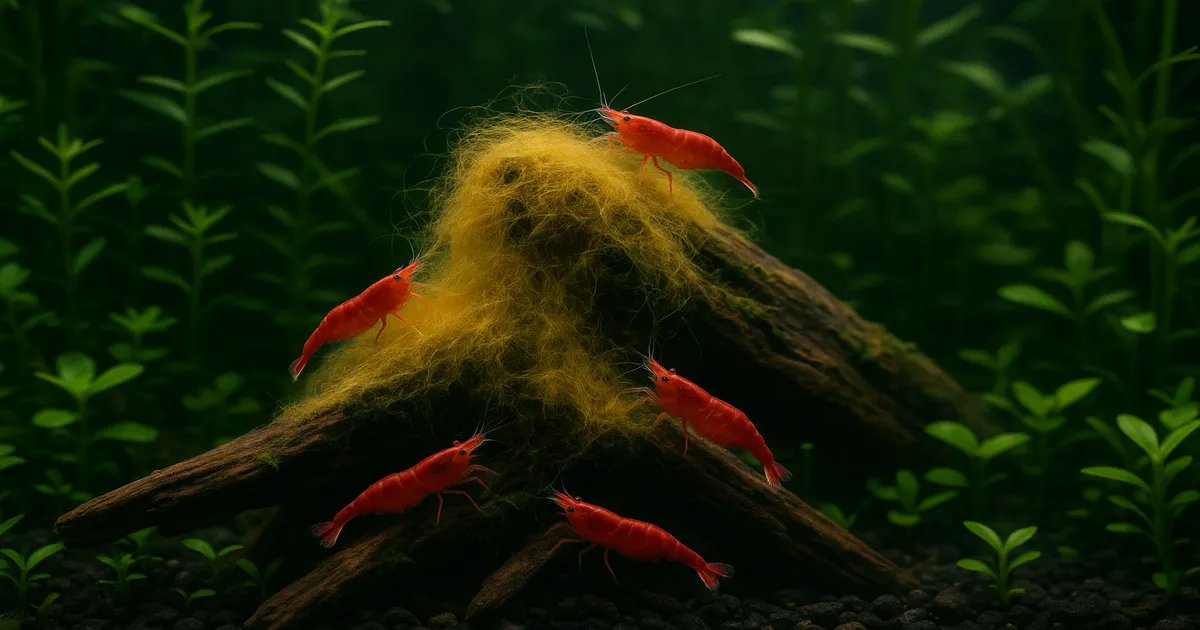
Quick Answer: The yellow, egg-shaped structures on your shrimp are zoosporangia — reproductive bodies produced by Cladogonium ogishimae (clado), a filamentous green alga that colonises shrimp exoskeletons. This sporulating stage is a natural part of the algae’s life cycle, but spores are about to be released into your tank, putting the rest of your colony at risk. Act quickly to treat affected shrimp and address the root causes before the infestation spreads.
If you’ve noticed the clado on your shrimp turning yellow and egg-shaped, you’re witnessing something specific: the algae is sporulating, meaning it’s actively reproducing. Understanding why the clado on your shrimp looks yellow and egg-shaped — and what to do about it — is the difference between a manageable nuisance and a tank-wide outbreak.
Why Is the Clado on My Shrimp Yellow and Egg-Shaped?
What Is Clado (Cladogonium ogishimae)?
Clado is hobbyist shorthand for Cladogonium ogishimae, a filamentous green alga in the division Chlorophyta. Unlike typical tank algae that grows on glass or substrate, clado is epizoic — it lives directly on the exoskeletons of freshwater dwarf shrimp. It attaches most commonly to the carapace, rostrum, antennae, and leg joints, appearing as fine green tufts that can resemble miniature moss.
It affects virtually all popular dwarf shrimp species: every colour variant of Neocaridina davidi (Cherry, Blue Dream, Yellow, Black Rose), Crystal Red and Crystal Black Shrimp, Taiwan Bee variants, and even sensitive Sulawesi Cardinals.
The Yellow, Egg-Shaped Stage: Sporulation Explained
In its normal state, clado looks like a fuzzy green coating. When it turns yellow and rounded, the filaments have swollen into zoosporangia — spore-producing structures that are about to release reproductive cells into your water column. This is a completely natural stage of the algae’s life cycle, but it’s a red flag. Once those spores are released, they can re-infect the same shrimp, colonise others, or settle on plants and hardscape to establish new colonies.
That colour shift from green to golden-yellow is your clearest visual cue that sporulation is underway. It’s the moment to act.
What Triggers Clado to Turn Yellow and Sporulate?
Sporulation is often the algae’s response to changing conditions — the colony hedging its bets by reproducing before circumstances get worse. Common triggers include:
- Temperature spikes above the upper end of your shrimp’s preferred range
- Sudden lighting changes in intensity or photoperiod
- pH or KH swings destabilising water chemistry
- Elevated nutrients — nitrates above 20 ppm or phosphates above 0.5 ppm
- Colony maturity — a well-established colony will eventually sporulate naturally
KH instability deserves special mention. Even small, repeated fluctuations — the kind that don’t kill shrimp outright — can push a stable clado colony into its reproductive phase. Overfeeding is the most common reason nutrients spike in a shrimp tank: uneaten food decays, nitrates climb, and suddenly your clado problem accelerates.
Sometimes there’s no single dramatic trigger. A mature colony will sporulate as part of its natural cycle, which is why even well-maintained tanks can see it occasionally. Good husbandry dramatically reduces frequency and severity, but it doesn’t guarantee immunity.
Is Clado Harmful to Shrimp?
It depends on severity. A light dusting of green tufts is largely cosmetic, and shrimp will often groom each other and graze on it naturally. Moderate to heavy infestations are a different story. Thick algal mats impair gill function, restrict movement, and can cover eyes and antennae. Left unchecked, a severe infestation can be fatal — particularly for sensitive Caridina species.
The yellow, egg-shaped sporulating stage isn’t directly toxic, but it signals rapid spread is imminent. That’s what makes it the critical moment to intervene.
Water Parameters: Conditions That Discourage Clado Outbreaks
Stability matters more than perfect numbers. A tank sitting at pH 7.2 consistently is far better than one swinging between 6.8 and 7.6 every few days. Stability reduces stress on your shrimp and removes the environmental cues that trigger sporulation.
Ideal Parameters for Neocaridina (Cherry Shrimp)
| Parameter | Target Range |
|---|---|
| pH | 6.8–7.8 (optimal 7.0–7.4) |
| GH | 6–8 dGH |
| KH | 2–5 dKH |
| Temperature | 68–78°F (20–26°C) |
| Nitrate | Below 20 ppm |
| TDS | 150–250 ppm |
Ideal Parameters for Caridina (Crystal and Bee Shrimp)
| Parameter | Target Range |
|---|---|
| pH | 5.8–6.8 (optimal 6.2–6.5) |
| GH | 4–6 dGH |
| KH | 0–2 dKH |
| Temperature | 68–74°F (20–23°C) |
| Nitrate | Below 10 ppm |
| TDS | 100–150 ppm |
Keeping nitrates below those thresholds and phosphates below 0.5 ppm removes the fuel clado needs to grow aggressively. Regular water changes using a quality dechlorinator like Seachem Prime are your primary tool for keeping nutrients in check. Test regularly with a reliable liquid kit like the API Freshwater Master Test Kit — guesswork is how small problems become big ones.
Tank Setup to Prevent and Control Clado
Tank Size
Smaller tanks swing in temperature and chemistry fast. A 5-gallon can shift significantly in just a few hours. Ten gallons is a practical minimum for Neocaridina; for Caridina, treat 10 gallons as the absolute floor and go larger whenever possible.
Substrate
Neocaridina can thrive on inert gravel or sand. Caridina need an active buffering substrate — options like ADA Amazonia, Fluval Stratum , or SL-Aqua More Soil maintain the low pH and near-zero KH these shrimp require. Buffering substrates also absorb excess nutrients, giving you a passive line of defence against clado growth.
Live Plants
Dense planting is the single most effective long-term strategy for clado control. Plants outcompete algae for nitrates, phosphates, and CO₂, starving clado of the nutrients it needs. The best choices for shrimp tanks:
- Java Moss (Taxiphyllum barbieri) — easy, dense, shrimp love it
- Anubias spp. — hardy, low-light, great on hardscape
- Bucephalandra spp. — slow-growing but excellent nutrient competition
- Java Fern (Microsorum pteropus) — bulletproof and versatile
Filtration and UV Sterilisation
Sponge filters are the gold standard for shrimp tanks — gentle flow, excellent biological filtration, no risk of sucking up shrimp or fry. A dual sponge filter setup lets you clean one at a time without crashing your cycle.
If you’re dealing with an active clado outbreak, add a UV steriliser. It kills free-floating spores in the water column before they can find a new host, directly interrupting the reproductive cycle. This is one of the most effective tools you have once sporulation has started.
Lighting
Stick to 8–10 hours of light per day under normal conditions, and cut back to 6–8 hours during an outbreak. Clado is photosynthesis-dependent — less light means slower growth. A simple timer makes this effortless and provides the consistency your shrimp benefit from. Keep the tank away from direct sunlight; uncontrolled natural light is one of the most reliable ways to fuel an algae problem.
Driftwood and Indian Almond Leaves
Indian Almond leaves and driftwood release tannins that mildly acidify the water and have reported antialgal properties. They won’t cure a clado outbreak, but they contribute to an environment that’s generally less hospitable to algal overgrowth — and shrimp love grazing the biofilm that builds up on decomposing leaves.
Treating Yellow, Egg-Shaped Clado on Your Shrimp
Manual Removal
For light infestations, manual removal is a solid first step. Move the affected shrimp to a small container of tank water and use a soft toothbrush or cotton swab to gently brush the algae from the exoskeleton. It’s tedious, but it works and causes minimal stress. Handle shrimp quickly and minimise time out of water.
Hydrogen Peroxide Dip
H₂O₂ dips are the most widely used treatment for moderate to heavy infestations:
- Prepare a dip container with tank water
- Add 1–2 ml of 3% hydrogen peroxide per litre of dip water
- Place the shrimp in the solution for 30–60 seconds maximum
- Rinse in clean tank water before returning to the main tank
Do not use this method on berried females or already-stressed shrimp. Monitor closely throughout — if a shrimp shows signs of severe distress, remove it immediately. H₂O₂ can also spot-treat affected plants at 1.5 ml per litre; rinse thoroughly before returning them to the tank.
Potassium Permanganate Dip
Potassium permanganate at a 10 ppm solution is a more aggressive option used by experienced keepers. It’s effective but less forgiving than H₂O₂. Research the specific method carefully before attempting it, and don’t start here if you’re new to dips.
Treating the Tank Environment
Treating shrimp while spores remain in the water column is a losing battle. After treating individual animals, address the tank itself: run a UV steriliser, perform a significant water change, spot-treat visible algae on plants with diluted H₂O₂, reduce feeding, and lower photoperiod to 6–8 hours. All of these steps together interrupt the cycle; any one of them alone won’t be enough.
Feeding to Minimise Clado Risk
Every bit of uneaten food that decays raises nitrates and phosphates — the exact nutrients that drive clado growth. Feed only what your shrimp will consume in 2–3 hours, every 1–2 days, and build in a weekly fast day to prevent slow nutrient creep.
Quality staple foods include Hikari Shrimp Cuisine and Dennerle Shrimp King Complete. Rotate in blanched vegetables (zucchini, spinach, cucumber) and leaf litter for variety and additional biofilm surfaces. GlasGarten Bacter AE is excellent for Caridina tanks, promoting the biofilm colonies shrimp naturally graze on.
Shrimp do graze on clado naturally, and this can help keep very light infestations in check. However, heavily sporulating clado in its yellow, egg-shaped stage appears to be less palatable. Don’t count on your colony to self-resolve a significant outbreak.
Compatible Tank Mates
Otocinclus catfish are the standout algae-grazing choice — peaceful, small, and safe with adult shrimp. Nerite snails are voracious algae eaters that can’t breed in freshwater, making them easy to manage. Mystery snails and Ramshorn snails round out a solid cleanup crew.
For nano fish safe with adult Neocaridina, Ember Tetras and Chili Rasboras are excellent — tiny mouths, peaceful temperaments, compatible water parameters.
Avoid bettas (unpredictable with shrimp), loaches, gouramis, and cichlids. Caridina are best kept in species-only or shrimp-only setups — their water parameters are incompatible with most fish, and the added stress of tank mates is a real concern. Nerite and Ramshorn snails are the safe exceptions.
Frequently Asked Questions About Yellow Egg-Shaped Clado on Shrimp
Why is the clado on my shrimp yellow and egg-shaped?
The yellow, egg-shaped structures are zoosporangia — the sporulating stage of Cladogonium ogishimae. The filaments swell and shift from green to golden-yellow as they prepare to release spores into the water column. It’s a natural part of the algae’s life cycle, but it signals that the infestation is about to spread rapidly. Act now rather than waiting.
How do I get rid of clado on my freshwater shrimp?
Use a hydrogen peroxide dip (1–2 ml of 3% H₂O₂ per litre, 30–60 seconds) for moderate to heavy infestations, or manual brushing for lighter cases. At the same time, run a UV steriliser, reduce nutrients through water changes, cut back feeding, and lower photoperiod to 6–8 hours. Treating shrimp without fixing the tank environment leads to re-infestation.
Can clado spread from one shrimp to another?
Yes. When clado sporulates, it releases spores into the water column that can settle on other shrimp, plants, and hardscape. This is exactly why the yellow, egg-shaped stage is the critical moment to intervene — once spores are released, every shrimp in the tank is at risk.
What causes clado to suddenly appear in a shrimp tank?
Clado is most often introduced on new plants, shrimp, or hardscape without the keeper realising it. It can remain as a barely visible light infestation until a trigger — a temperature spike, nutrient surge from overfeeding, or a water chemistry fluctuation — causes it to bloom. Always quarantine new additions before they enter your main tank.
Will Otocinclus or snails eat clado off my shrimp?
Otocinclus and snails may graze on early-stage clado growing on surfaces and hardscape, and they’re valuable members of a shrimp tank cleanup crew. However, they cannot reliably remove clado from a shrimp’s exoskeleton, and they won’t resolve an active outbreak on their own. Use them as prevention support, not as a primary treatment.