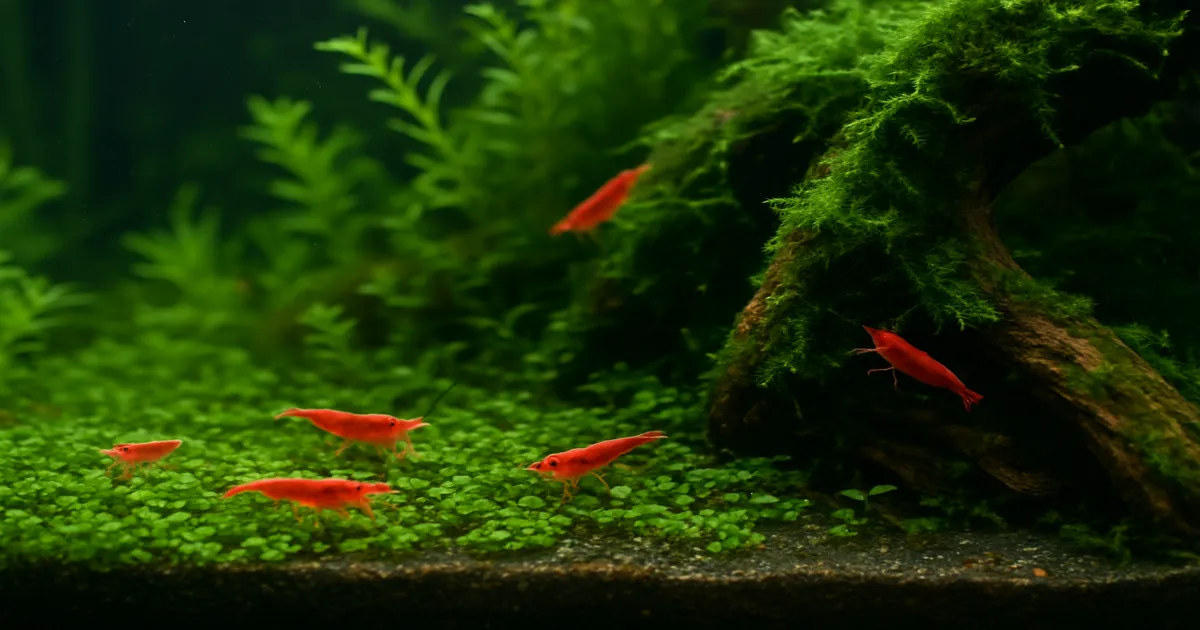
Quick Answer: Most things growing spontaneously in a freshwater planted shrimp tank are completely normal — and many are actively beneficial. Biofilm, diatoms, and white fuzzy fungus on driftwood are all healthy signs of a maturing ecosystem that your shrimp will graze on constantly. The growths worth acting on quickly are blue-green algae (cyanobacteria), black beard algae, planaria, and hydra.
If you’ve ever peered into your tank and thought “what is growing in my freshwater planted shrimp tank?” — you’re in good company. Shrimp tanks are living ecosystems, and a healthy one is almost never a sterile, crystal-clear box. Surfaces get coated, leaves develop crusts, driftwood goes fuzzy, and tiny creatures appear from nowhere. Most of it is exactly what you want.
This guide walks you through everything you’re likely to see, from beneficial microbial communities to the handful of growths that actually need your attention.
What Is Growing in Your Freshwater Planted Shrimp Tank? A Quick-Reference Guide
Identification at a Glance
| Growth | Appearance | Category |
|---|---|---|
| Biofilm | Thin iridescent or milky film on all surfaces | ✅ Beneficial |
| Diatoms (brown algae) | Dusty brown coating, wipes off easily | ✅ Beneficial / Self-resolving |
| White fuzzy fungus | Cottony threads on driftwood, leaves | ✅ Beneficial |
| Aufwuchs / periphyton | Living crust on hardscape and wood | ✅ Beneficial |
| Infusoria | Tiny specks moving through water | ✅ Beneficial |
| Green spot algae (GSA) | Hard green discs on glass and slow plants | ⚠️ Nuisance |
| Green dust algae (GDA) | Soft green smear on glass | ⚠️ Nuisance / Self-resolving |
| Hair / thread algae | Tangled green filaments | ⚠️ Nuisance |
| Staghorn algae | Grey branching strands on plant edges | ⚠️ Nuisance |
| Blue-green algae (BGA) | Slimy blue-green or purple mats, musty smell | 🚨 Treat immediately |
| Black beard algae (BBA) | Dark grey-black tufts on plants and hardscape | 🚨 Treat immediately |
| Planaria | Flat worms with triangular heads | 🚨 Dangerous |
| Hydra | Tiny tentacled organism on glass | 🚨 Remove immediately |
| Pest snails | Various; cone, flat-coil, or left-coil shells | ✅ Generally beneficial |
| Scuds / amphipods | Small curved crustaceans, rapid movement | ⚠️ Usually harmless |
Beneficial vs. Harmful: How to Tell the Difference
The single most useful rule: if your shrimp are actively grazing on it, it’s almost certainly fine. Shrimp spend most of their waking hours picking at surfaces, and a tank rich in biofilm, diatoms, and fungal growth is a shrimp paradise.
The growths that demand action share a few warning signs — slimy, sheet-like mats with a bad smell, extremely dark tufts that nothing will eat, or small animals with stinging tentacles. Everything else is either neutral or actively helping your tank.
Beneficial Growths: What Your Shrimp Actually Want to Eat
Biofilm: The Most Important Food Source in Any Shrimp Tank
Biofilm is the foundation of your shrimp tank’s food web. It’s a living matrix of bacteria (Nitrosomonas, Nitrobacter, Bacillus, Pseudomonas, and dozens more), diatoms, microorganisms, and extracellular substances that coats every submerged surface. Under good light you’ll see it as a thin, slightly iridescent or milky film on glass, rocks, wood, and plant leaves.
Dwarf shrimp — both Neocaridina and Caridina species — graze on biofilm constantly. It’s not a supplement to their diet; in a mature tank, it is their diet. The more diverse your hardscape and botanicals, the more surface area you provide, and the richer the biofilm community becomes.
Diatoms (Brown Algae): Why a New Tank Turns Brown
That dusty brown coating appearing a few weeks after setup is diatoms — unicellular algae with silica-based cell walls, belonging to the class Bacillariophyceae. They thrive when silicate levels are elevated (common with new tap water and fresh substrate) and light is moderate.
The good news: diatoms are highly nutritious, and shrimp and snails graze them enthusiastically. They’re also self-limiting. As the tank matures and silicate levels drop below 0.5 ppm, diatoms fade on their own — usually within four to eight weeks of setup. No intervention needed.
White Fuzzy Fungus on Driftwood and Leaves: Should You Remove It?
No — leave it alone. The white cottony growth on new driftwood, Indian Almond Leaves, Cholla wood, or alder cones is saprophytic fungi and water molds (commonly Saprolegnia spp. and Mucor spp.) breaking down decaying organic matter. It’s protein-rich and shrimp actively seek it out.
Many experienced keepers add Indian Almond Leaves specifically to encourage this growth — SunGrow Indian Almond Leaves are a popular choice. The only time white fuzzy growth is a concern is if it appears on a live shrimp, which can indicate a Saprolegnia infection in a stressed or injured individual.
Aufwuchs and Periphyton: The Living Crust Shrimp Graze All Day
Aufwuchs (German for “that which grows upon”) describes the complete living community attached to submerged surfaces — algae, bacteria, fungi, protozoa, and microinvertebrates together. Think of it as biofilm’s fully developed, mature form.
Shrimp don’t graze on individual organisms; they’re picking through this entire ecosystem simultaneously. Mature driftwood, smooth river stones, and dense leaf litter all develop rich aufwuchs communities over time. It’s exactly why experienced keepers age their tanks before adding shrimp.
Infusoria: Invisible Food for Baby Shrimp
Look closely at a mature shrimp tank with a flashlight and you’ll see tiny specks drifting and darting through the water — paramecia, rotifers, copepods, ostracods. These microscopic organisms form what hobbyists call infusoria, and they’re critical nutrition for newly hatched shrimp. A tank rich in infusoria is a tank that successfully raises fry.
Common Nuisance Algae: Identification and Causes
Green Spot Algae (GSA): Hard Green Discs on Glass
GSA shows up as small (1–3 mm), bright green discs that feel hard and glassy — you can’t smear them. It tends to appear on slow-growing plants like Anubias and Bucephalandra, and on the glass near high-light areas. The primary cause is low phosphate (below 0.5 ppm), often combined with high lighting. Shrimp rarely bother eating it.
Nerite snails are the most effective biological control — they’re one of the only animals that can reliably rasp GSA off surfaces.
Green Dust Algae (GDA): The Soft Green Smear on Your Glass
Unlike GSA, GDA wipes off easily — it’s a soft, dusty green coating on the glass, likely unicellular algae related to Chlorella. It’s most common in new tanks with fluctuating CO₂ and unstable nutrients. GDA often resolves on its own as the tank stabilizes. A simple algae scraper handles it in the meantime, and shrimp will graze the residue lightly.
Hair Algae and Thread Algae: Tangled Green Mats
Filamentous algae covers several genera: Spirogyra is silky and slides apart easily, Cladophora is coarser and branching, Oedogonium forms fine bright-green threads. All thrive when light duration is excessive, CO₂ fluctuates, or ammonia spikes.
Amano shrimp (Caridina multidentata) are the gold-standard biological control for soft filamentous types. A group of eight to twelve in a 20-gallon tank can clear a light outbreak within days. Neocaridina will graze it too, but less aggressively.
Staghorn Algae: Branching Grey Strands on Plant Edges
Staghorn (Compsopogon spp.) is a red alga despite its grey-green color. It grows as firm, antler-like strands on plant edges, filter intakes, and hardscape — difficult to pull off cleanly. CO₂ instability is the primary trigger. If your pH is swinging more than 0.5 units per day, staghorn is likely to follow. Fix CO₂ consistency for the long term; spot-treat existing growth with hydrogen peroxide.
Serious Problem Growths: What to Treat Immediately in Your Freshwater Planted Shrimp Tank
Blue-Green Algae (Cyanobacteria): Slimy Mats That Can Harm Your Shrimp
Despite the name, blue-green algae isn’t algae at all — it’s a photosynthetic bacterium (Oscillatoria, Phormidium, Lyngbya, and related genera). It forms slimy, sheet-like mats in blue-green, dark green, or reddish-purple, with a distinctive musty, earthy odor. It peels off in sheets rather than breaking apart. Some strains produce cyanotoxins (microcystins, anatoxins) that are harmful to shrimp at high concentrations. Don’t wait on this one.
Causes: Low flow or dead spots, nitrates below 5 ppm, high organic load.
Treatment:
- Improve circulation — reposition your filter outlet or add a small powerhead to eliminate dead spots
- Raise nitrates above 10 ppm if they’re deficient
- Remove as much BGA manually as possible
- Run a 3–5 day blackout (cover the tank completely)
- Spot-treat remaining patches with 1–2 mL of 3% hydrogen peroxide per 10 gallons, applied via syringe directly to the mat with the filter off for 10 minutes
- Erythromycin (antibiotic) is effective but significantly disrupts biological filtration — use only as a last resort and monitor ammonia closely afterward
Black Beard Algae (BBA): The Stubborn Dark Tufts That Won’t Budge
BBA (Audouinella spp.) is another red alga — dark grey to black tufts, 2–10 mm long, on plant edges, hardscape, and equipment. It’s extremely tough; shrimp won’t eat it, and it can’t be pulled off cleanly. CO₂ fluctuation is the primary trigger, compounded by low flow and organic buildup.
Treatment:
- Spot-treat directly with 3% hydrogen peroxide or a glutaraldehyde-based liquid carbon product like Seachem Flourish Excel via syringe; turn off the filter for 10 minutes
- Treated BBA turns red or pink within 24–48 hours, then dies and can be removed
- Fix CO₂ stability to prevent recurrence
Shrimp safety note: Remove shrimp to a holding tank during any chemical treatment if possible, or reduce dosing by 25–50% and monitor closely.
Uninvited Invertebrates: Pest or Beneficial?
Pest Snails: Friend or Foe?
Malaysian Trumpet Snails (Melanoides tuberculata) are genuinely useful — they burrow through the substrate constantly, aerating it and preventing anaerobic pockets. Bladder Snails (Physa spp.) are harmless detritivores that eat algae and decaying matter. Ramshorn Snails are generally beneficial algae grazers, though they may nibble healthy plants if underfed.
All three hitchhike in on plants or hardscape. Population explosions are almost always a sign of overfeeding — cut back on food and numbers self-correct.
Planaria and Detritus Worms: Which Are Dangerous?
Detritus worms — thin, wriggling red or white worms in the substrate — are harmless decomposers. Large numbers signal high organic load, so treat them as a prompt to reduce feeding or increase water changes.
Planaria are a different matter. These flatworms (look for the distinctive triangular head) can attack shrimp during molting. If you see them, treat with a dedicated dewormer such as No Planaria and improve tank hygiene to remove the organic load that sustains them.
Hydra: The One Hitchhiker You Must Remove Immediately
Hydra are tiny cnidarians — 5–15 mm tall with a tubular body and radiating tentacles — that attach to glass and hardscape. Their stinging cells can paralyze and consume shrimp fry and small juveniles, making them a serious threat to any breeding colony. Remove them manually, then treat the tank with fenbendazole or a product like No-Planaria. Don’t delay.
Scuds and Amphipods
Scuds (Hyalella azteca and relatives) are small, curved crustaceans that move in a rapid, jerky lateral motion — often mistaken for baby shrimp. They’re harmless to healthy adults but may harass shrimp during molting. In a heavily planted tank with plenty of hiding spots, this is rarely a serious problem.
Water Parameters That Drive What Grows in Your Tank
How Silicates, Phosphate, and Nitrate Trigger Specific Algae
Water chemistry is the underlying driver of what thrives:
- Silicates > 0.5 ppm → diatom blooms (especially in new tanks)
- Phosphate < 0.5 ppm → green spot algae
- Nitrate < 5 ppm with elevated phosphate → cyanobacteria
- CO₂ fluctuations / pH swings > 0.5 units per day → BBA and staghorn algae
- Ammonia spikes → filamentous and hair algae
Testing with a reliable liquid test kit gives you the accuracy needed to diagnose these issues correctly. The API Freshwater Master Test Kit covers pH, ammonia, nitrite, and nitrate and is a solid baseline for any shrimp keeper.
CO₂ Stability: The Single Biggest Factor in Algae Control
Consistent CO₂ delivery matters more than the absolute level. A tank running CO₂ at 20 ppm with rock-solid stability will have far less problem algae than one swinging between 10 and 30 ppm throughout the day. Use a drop checker to monitor levels visually — the Aquario Neo CO₂ Drop Checker is a popular and accurate option — and pair it with a quality regulator on a timer solenoid.
Neocaridina vs. Caridina: Parameter Requirements
| Parameter | Neocaridina (Cherry Shrimp) | Caridina (Bee / Crystal Shrimp) |
|---|---|---|
| pH | 6.8–7.5 | 5.8–6.8 |
| Temperature | 65–78 °F (18–26 °C) | 62–74 °F (17–23 °C) |
| GH | 6–12 dGH | 3–6 dGH |
| KH | 2–8 dKH | 0–2 dKH |
| TDS | 150–250 ppm | 100–150 ppm |
| Ammonia / Nitrite | 0 ppm | 0 ppm |
| Nitrate | < 20 ppm | < 10 ppm |
Caridina bee shrimp are significantly more sensitive to parameter swings than Neocaridina. They typically require active substrate (such as ADA Aqua Soil or Brightwell Aquatics FlorinVolcanit) to buffer pH and KH into the correct range, and remineralized RO water to hit target GH and TDS values precisely.
Volunteer and Intentional Aquatic Plants
Mosses: Java Moss, Christmas Moss, and Mini Pellia
Java Moss (Taxiphyllum barbieri), Christmas Moss (Vesicularia montagnei), and Mini Pellia (Riccardia chamedryfolia) are the three most popular mosses in shrimp tanks. Their intricate branching structure accumulates biofilm faster than almost any other surface, giving shrimp a constant grazing buffet. Dense moss coverage also provides shelter for juvenile shrimp and egg attachment sites for breeding pairs — tanks with good moss coverage consistently show better fry survival rates.
Fast-Growing Stem Plants and Floaters
Ceratophyllum demersum (Hornwort) grows fast, roots nowhere, and exports nutrients aggressively — all useful traits in a shrimp tank. Floaters like Salvinia natans and Pistia stratiotes shade the surface, reduce algae pressure, and provide cover that makes shrimp feel secure enough to breed.
FAQ: What Is Growing in My Freshwater Planted Shrimp Tank?
Q: Is the white film on my tank water surface harmful? A: Usually not. A thin white or oily film on the surface is typically a protein film caused by surface agitation being too low. Increase surface movement with your filter outlet or an air stone and it will clear within a day or two. It’s not harmful to shrimp.
Q: My shrimp are covered in white fuzz — is that the same as the fungus on driftwood? A: No. White fuzz on a live shrimp is a Saprolegnia infection, not the same harmless saprophytic fungus that grows on wood. It usually affects stressed, injured, or newly imported shrimp. Improve water quality, reduce stress, and quarantine affected individuals if possible.
Q: How do I tell planaria from detritus worms? A: Detritus worms are thin, thread-like, and wriggle in an S-shape — they look like tiny earthworms. Planaria are flat, move smoothly by gliding, and have a distinctive triangular or arrow-shaped head. If you’re unsure, drop a small piece of food near the worm at night and observe with a flashlight.
Q: Can I have too much biofilm? A: Not really. Biofilm doesn’t accumulate to harmful levels in a well-maintained tank — shrimp, snails, and other grazers keep it in check. A visibly thick, slimy buildup that smells bad is more likely cyanobacteria than true biofilm.
Q: My new tank has brown dust everywhere — should I clean it off? A: Leave it. That brown dust is diatoms, and it’s one of the best early foods you can offer shrimp. Let your shrimp and snails graze it naturally. It will disappear on its own within four to eight weeks as the tank matures and silicate levels drop.