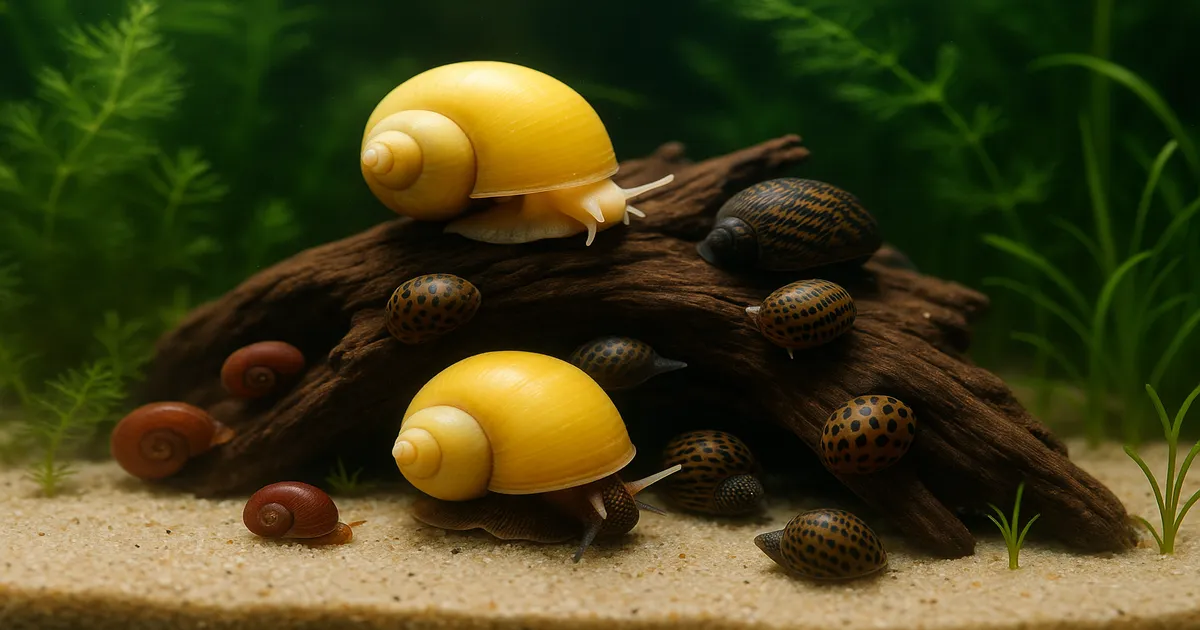
Quick Answer: The fastest way to identify an aquarium snail is to look at shell shape (rounded, conical, flat-coiled, or turreted), coiling direction (left-handed coil means bladder snail), and whether it has an operculum (trap door). Mystery snails are large with a round shell and lay pink egg clutches above the waterline; nerites are small with bold patterns and leave white sesame-seed eggs on glass; MTS are conical and burrow; bladder snails coil left.
So you’ve spotted something unfamiliar cruising across your aquarium glass and you’re asking, “Can you help identify this snail?” You’re not alone — snail ID is one of the most common questions in the hobby, and getting it right matters. A misidentified “mystery snail” could turn out to be an invasive apple snail, and that harmless-looking hitchhiker on your new plant could be the start of a population explosion.
Can You Help Identify This Snail? Start Here
The Fastest Way to Narrow Down Your Snail Species
Start with shell shape. Is it round and globular? Flat and coiled like a ram’s horn? Long and pointy like a cone or turret? That single observation eliminates most species immediately.
Next, check coiling direction. Hold the shell with the apex (pointy tip) facing up. If the opening is on the left, you have a bladder snail (Physella acuta) — the only common aquarium snail with a left-handed (sinistral) coil.
Then look for an operculum, the hard “trap door” that seals the shell when the snail retracts. Mystery snails, nerites, MTS, assassin snails, and rabbit snails all have one. Ramshorns, pond snails, and bladder snails do not.
Finally, check size. A 2–3 inch rounded shell is almost certainly a mystery or apple snail. Anything under half an inch that you didn’t intentionally add is almost certainly a hitchhiker.
Key Visual Clues at a Glance
| Species | Shell Shape | Key ID Feature |
|---|---|---|
| Mystery Snail | Large, round, globular | Pink egg clutches above waterline |
| Nerite Snail | Dome-shaped, flat underside | White sesame-seed eggs on hard surfaces |
| Ramshorn Snail | Flat, disc-like coil | Reddish body; red hemoglobin blood |
| Malaysian Trumpet Snail | Elongated, turreted cone | Burrows in substrate during the day |
| Assassin Snail | Conical with yellow/black bands | Bumblebee coloring; hunts other snails |
| Pond Snail | Tall, pointed, right-handed coil | Thin shell; common plant hitchhiker |
| Bladder Snail | Small, sinistral (left-handed) coil | Only common snail that coils left |
| Rabbit Snail | Long, turreted; 2–4 inches | Wrinkled, elephant-like skin on foot |
The 8 Most Common Aquarium Snails Identified
Mystery Snails & Apple Snails (Pomacea spp.)
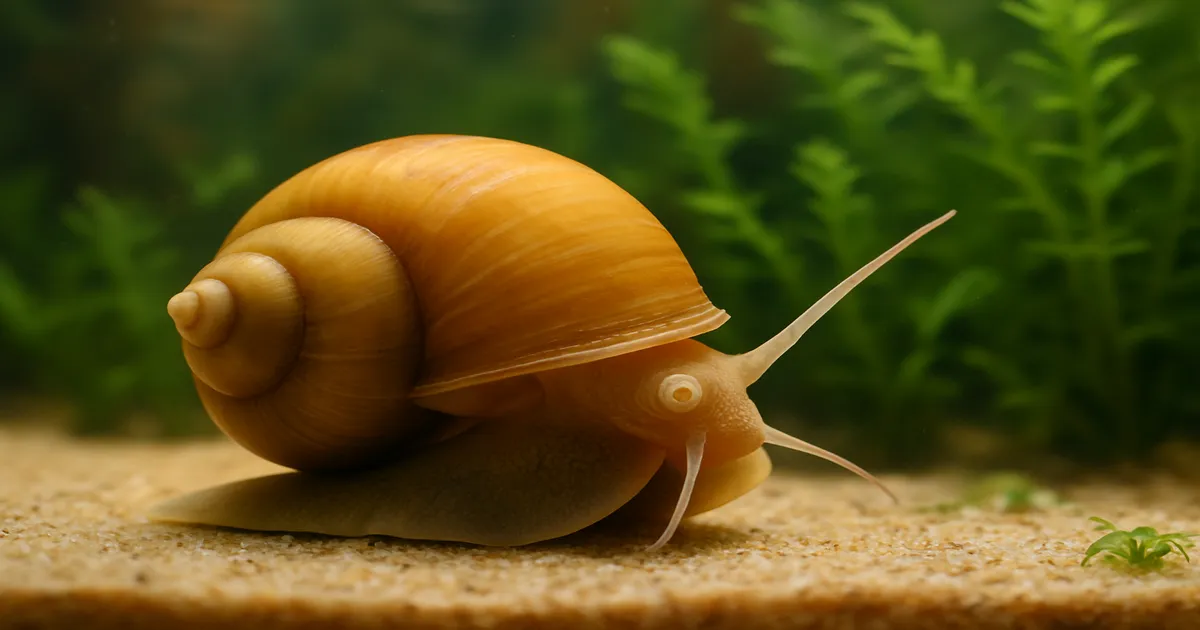
Mystery snails are the golden retrievers of the snail world — big, friendly, and hard to miss. Their round, globular shells reach 2–3 inches (5–7.5 cm) and come in gold, blue, purple, ivory, and brown morphs. They have a clear operculum and a distinctive siphon tube they extend to breathe air at the surface.
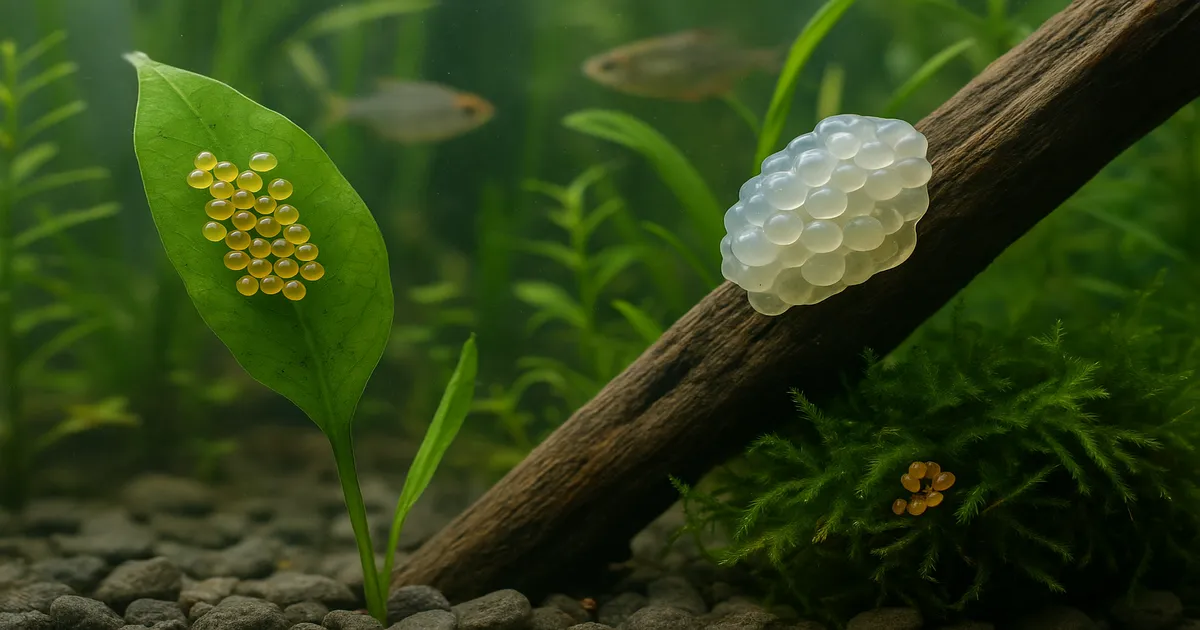
The species most commonly sold as “mystery snail” is Pomacea diffusa (spike-topped apple snail), which is relatively plant-safe. P. canaliculata, the channeled apple snail, looks nearly identical but destroys planted tanks and is an invasive agricultural pest — illegal to own in several U.S. states. The single most reliable ID feature: mystery snails lay large, pink-to-white calcified egg clutches above the waterline.
Nerite Snails (Neritina & Vittina spp.)
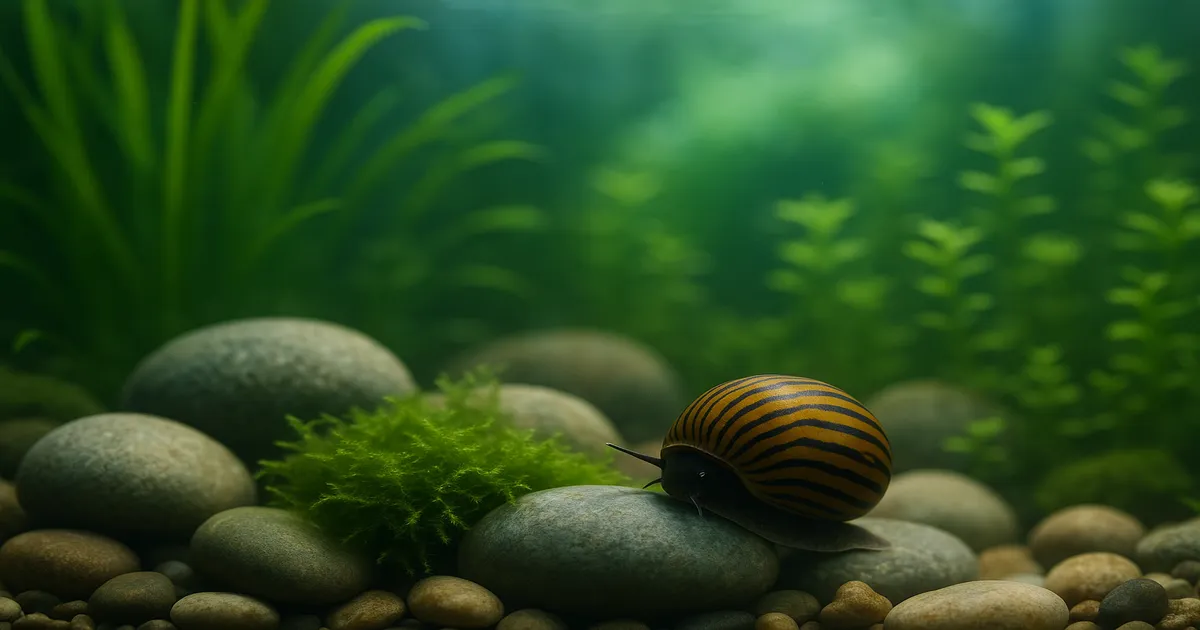
Nerites are small — just 0.5–1 inch (1.2–2.5 cm) — but they’re exceptional algae grazers. The shell is dome-shaped with a distinctly flat underside and a hard, calcified operculum. Patterns vary widely by species: zebra stripes, tiger spots, olive green, or the spiky horned nerite (Clithon corona).
Their most reliable distinguishing feature is their eggs: tiny, white, sesame-seed-like capsules glued firmly to glass, rocks, and decorations. These eggs will never hatch in freshwater — larvae require brackish conditions to develop, which makes nerites completely non-invasive in a home aquarium.
Ramshorn Snails (Planorbarius & Planorbella spp.)
The flat, disc-like shell coiled in a single plane is unmistakable — it genuinely looks like a ram’s horn viewed from the side. Size ranges from 0.25 inch (0.6 cm) for pest varieties up to 1.5 inches (3.8 cm) for the larger ornamental red ramshorn (Planorbella duryi). Uniquely among freshwater mollusks, ramshorns contain hemoglobin in their blood, which gives their body a reddish hue.
Small brown ramshorns are considered pests by most hobbyists. The larger red, pink, or blue color morphs are intentionally kept and are genuinely useful algae cleaners.
Malaysian Trumpet Snails (Melanoides tuberculata)
MTS are immediately recognizable by their elongated, conical shell — think a miniature turret — reaching 0.5–1.5 inches (1.2–3.8 cm) in brown with dark mottling. The giveaway behavior: they disappear into the substrate during the day and emerge at night. If you see conical snails appearing only after lights-out, it’s MTS.
They’re parthenogenetic, meaning females reproduce without males, which explains their legendary population growth. Despite their pest reputation, they’re genuinely valuable — their constant burrowing aerates substrate and prevents dangerous anaerobic gas pockets.
Assassin Snails (Clea helena)
The bumblebee pattern — alternating yellow and dark brown bands on a conical shell — makes assassin snails one of the easiest snails to identify at a glance. They reach 0.75–1.25 inches (2–3 cm) and move with surprising purpose, actively tracking prey using a distinct siphon. They’re carnivores, and they’re very good at their job.
Pond Snails (Lymnaea stagnalis and related species)
Pond snails have a tall, pointed shell with a classic right-handed coil, ranging from 0.5–2 inches (1.2–5 cm). The shell is typically brown or olive with noticeably thin walls. They’re fast reproducers and almost always arrive uninvited on live plants. Most aquarists consider them a pest, though they do consume decaying matter and uneaten food.
Bladder Snails (Physella acuta)
Bladder snails are tiny — 0.25–0.5 inch (0.6–1.2 cm) — with a translucent brownish shell and a spotted mantle visible right through the shell wall. The definitive ID marker is the left-handed (sinistral) coil. Hold the shell apex-up: if the opening faces left, it’s a bladder snail, full stop. No other common aquarium snail does this.
Rabbit Snails (Tylomelania spp.)
Rabbit snails are striking and unmistakable once you’ve seen one. The shell is long and turreted, reaching 2–4 inches (5–10 cm), but the real giveaway is the head and foot: deeply wrinkled skin that looks remarkably like an elephant’s hide. Color morphs include yellow, orange, white, and black. They’re endemic to Sulawesi, Indonesia, reproduce by live birth, and are among the most water-parameter-sensitive snails in the hobby.
Pest Snail vs. Pet Snail: How to Tell the Difference
Which Snails Are Hitchhikers on Live Plants?
Bladder snails, pond snails, and small brown ramshorns are the three most common uninvited guests. They enter tanks as eggs or juveniles clinging to live plants, in the water from fish bags, or on wet equipment. The eggs are nearly invisible — tiny gel-like masses pressed against leaves or glass.
The best prevention is a simple plant quarantine. Soak new plants in a diluted potassium permanganate or alum solution for 10–20 minutes before adding them to your display tank. A plain water quarantine of 2–4 weeks in a separate container also works — any hitchhikers hatch and can be removed manually.
When a ‘Pest’ Snail Is Actually Beneficial
MTS deserve a genuine defense. Their nocturnal burrowing constantly turns and aerates the substrate, preventing the anaerobic pockets that can release hydrogen sulfide into the water column — a real danger in tanks with deep, fine substrate. Many experienced aquarists deliberately keep MTS for exactly this reason. Even bladder snails and ramshorns serve as a free cleanup crew, consuming decaying plant matter and uneaten food before it can spike ammonia.
The single most overlooked factor in pest snail control is overfeeding. Excess fish food decays into organic waste, which feeds bacteria and creates the biofilm and detritus that bladder snails and ramshorns thrive on. Cutting back to what your fish consume in two minutes per feeding is often enough to stabilize or reduce a pest population without any other intervention.
Water Parameters for Every Aquarium Snail Species
pH, GH, and KH: Why Hardness Matters for Shell Health
Snail shells are made of calcium carbonate, and that calcium has to come from the water. General hardness (GH) reflects the calcium and magnesium available to your snail. Carbonate hardness (KH) buffers pH and contributes to shell calcification. When either drops too low, shells start to pit, erode, and crack. Keep pH at 7.0 or above for most species, and supplement calcium in soft-water tanks with cuttlebone or crushed coral added to your filter media.
A reliable liquid test kit is essential for monitoring these values accurately.
The Copper Warning
Copper is lethal to every snail species, even at trace levels. Check your liquid fertilizers for copper content, avoid copper-based medications, and if you have older copper plumbing, run the tap briefly before using water for changes. A quality water conditioner that detoxifies heavy metals adds an extra layer of protection. (Seachem Prime)
Species-by-Species Parameter Quick-Reference Table
| Species | pH | GH (dGH) | KH (dKH) | Temperature |
|---|---|---|---|---|
| Mystery Snail | 7.0–8.0 | 8–18 | 3–12 | 68–82°F (20–28°C) |
| Nerite Snail | 7.0–8.5 | 8–20 | 5–15 | 72–82°F (22–28°C) |
| Ramshorn Snail | 7.0–8.0 | 5–15 | 3–10 | 65–80°F (18–27°C) |
| Malaysian Trumpet Snail | 7.0–8.0 | 8–18 | 5–15 | 70–82°F (21–28°C) |
| Assassin Snail | 7.0–8.0 | 8–15 | 3–10 | 75–82°F (24–28°C) |
| Pond Snail | 6.5–8.0 | 5–15 | 3–10 | 65–80°F (18–27°C) |
| Bladder Snail | 6.5–8.0 | 5–15 | 3–10 | 65–80°F (18–27°C) |
| Rabbit Snail | 7.5–8.5 | 6–10 | 2–6 | 76–86°F (24–30°C) |
Note on ramshorn pH: The original article listed 6.5 as the low end for ramshorns. While they can survive briefly at 6.5, shell erosion becomes visible below 7.0 in soft water. A minimum of 7.0 is the practical recommendation for long-term shell health.
Note on assassin snail parameters: The original article listed a pH range of 6.5–7.5 and KH of 2–15. Published care data consistently places assassin snails at 7.0–8.0 pH and 3–10 dKH; the wider ranges have been corrected here.
Tank Setup and Compatibility
Substrate, Lids, and Filtration
MTS and rabbit snails both burrow and need fine sand — ideally 1–3 inches deep — to do it safely. Coarse gravel can damage rabbit snail foot tissue and prevents MTS from aerating the substrate effectively. Nerites don’t care about substrate; they spend their time grazing on glass and decorations. Mystery snails do best on smooth gravel or fine sand.
Mystery snails, nerites, and rabbit snails are all accomplished escape artists. A snail found dried out on the floor is a dead snail. Mystery snails also need 2–3 inches of air space between the waterline and the lid — they breathe through a siphon tube and lay egg clutches in that dry headspace.
Slow-moving snails and powerful filter intakes are a bad combination. A sponge pre-filter over your intake prevents snails from being trapped or injured.
Minimum Tank Size by Species
- Mystery Snail: 5 gallons minimum; 10 gallons for a group
- Nerite Snail: 5 gallons
- Ramshorn Snail: Any size
- Malaysian Trumpet Snail: Any size
- Assassin Snail: 10 gallons
- Rabbit Snail: 20 gallons
Safe and Unsafe Tank Mates
Most peaceful community fish make excellent snail companions — small tetras, rasboras, corydoras, otocinclus, and livebearers all coexist without issues. Avoid any fish known to eat snails: clown loaches, yoyo loaches, pufferfish of any species, large cichlids, and goldfish will all target snails. Dwarf puffers in particular will methodically hunt down every snail in the tank. Assassin snails can be kept with other snails in a large enough tank, but they will eventually reduce pest snail populations — which may or may not be the goal.
Feeding Your Aquarium Snails
Nerites are among the best algae grazers in the freshwater hobby, consuming green spot algae, green dust algae, and biofilm efficiently. Mystery snails are less picky, eating algae, biofilm, and decaying plant matter. Both benefit from supplemental foods like blanched zucchini, spinach, or algae wafers when tank algae runs low. Ramshorns and MTS fill a similar niche, consuming biofilm, decaying leaves, and any uneaten fish food they find.
Assassin snails eat other snails — that’s their primary food source. In a tank with an active pest snail population, they’ll feed themselves. When prey becomes scarce, supplement with frozen bloodworms, small pieces of shrimp, or sinking carnivore pellets.
Rabbit snails graze slowly on biofilm and soft algae. They won’t touch most vegetables and don’t need heavy supplementation in an established tank with good biofilm growth.
Frequently Asked Questions
Can you help identify this snail if I only have a blurry photo? Focus on three things even in a poor photo: overall shell shape (round, flat-coiled, or conical), approximate size relative to something in the tank, and whether the shell opening appears to be on the left or right side. Those three clues alone will narrow it down to one or two species in most cases.
Is my snail dead or just sleeping? Snails retract fully and go dormant for hours or even days, especially after a water change or temperature shift. Gently pick up the snail — a living snail will feel heavy and may react to touch. A dead snail smells strongly of decay almost immediately and the body will hang loosely out of the shell.
Why is my snail’s shell turning white or pitting? This is almost always a calcium or pH problem. Shell erosion means the water is either too soft (low GH), too acidic (pH below 7.0), or both. Test your water, raise pH toward 7.5, and add a cuttlebone or crushed coral to boost calcium.
Can I keep assassin snails with my mystery snails or nerites? Generally yes, with caution. Assassin snails strongly prefer smaller prey and rarely bother large mystery snails or nerites. However, in a tank with no small snails available, hungry assassins have been known to attack larger species. Keep them well-fed with supplemental meaty foods if pest snails run out.
How do I stop snails from multiplying out of control? Reduce feeding first — this is the most effective single step. Then manually remove snails you see during water changes. For severe infestations, assassin snails provide long-term biological control. Chemical treatments exist but will crash your tank’s cleanup crew and may harm shrimp and other invertebrates.